
Mapa mental
ATOMIC MASS UNIT
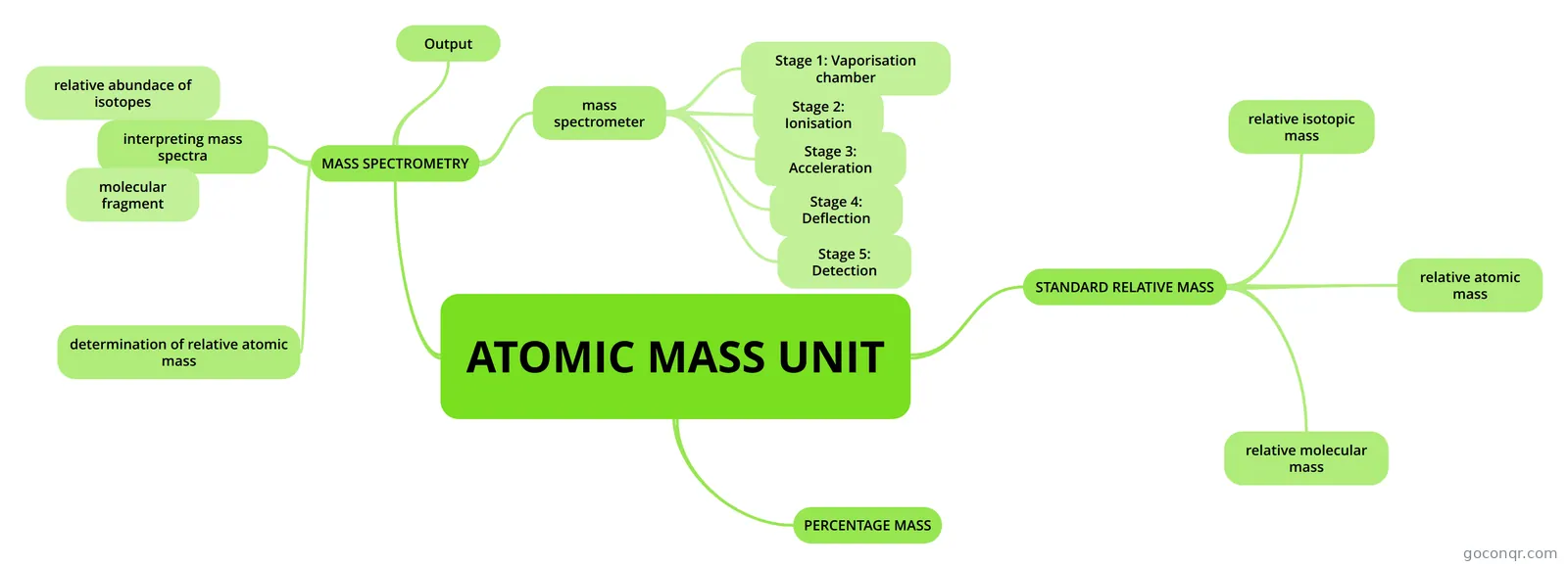
Mind map: atomic mass unit
Conteúdo do mapa
ATOMIC MASS UNIT
STANDARD RELATIVE MASS
- masses of other atoms or molecules measured relative to the mass of an atom of carbon-12.
- relative isotopic mass
- Most elements exist as two or more isotopes. The relative isotopic mass of an isotope is defined as the ratio of the mass of one atom of the isotope to 1/12 of the mass of one atom of carbon-12 isotope Relative isotopic mass on the carbon scale = Mass of one atom of the isotope / Mass of one atom of carbon-12 X (12)
- For elements that have isotopes, the relative atomic mass is calculated by using the formula: = m1x + m2y + m3z /100 Where m1, m2 and m3 = nucleon numbers of isotopes 1,2,3 respectively x, y and z = relative abundance of isotopes 1, 2, 3 respectively
- relative molecular mass
- Is the ratio of the average mass of one molecule of a substance to 1/12 of the mass of an atom of carbon-12
- Relative molecular mass (Mr) of a substance on the carbon-12 scale = Average mass of one molecule of substance / Mass of one atom of carbon-12 X (12) The relative molecular mass of a substance is calculated by adding up the relative atomic masses of all the atoms present in one molecule of the substance
- relative atomic mass
- The relative atomic mass (Ar) of an element is defined as the ratio of the mass of one atom of the element to 1/12 of the mass of a carbon-12 atom.
- Relative atomic mass (Ar) of an element on the carbon-12 scale = Mass of one atom of the element x 12 Mass of one atom of carbon-12
- *Atomic mass = atomic weight = average atomic mass = average atomic weight
PERCENTAGE MASS
- Percentage mass (%) = mass of element -------------------- X 100 % relative formula mass
MASS SPECTROMETRY
- Modern technique that uses mass spectrometer to measure very accurately The relative isotopic mass The relative abundance of an isotope in a sample of the element The relative atomic mass The relative molecular mass The structure of organic compounds
- mass spectrometer
- Stage 1: Vaporisation chamber
- •Sample is being vaporised before injected into ionisation chamber
- Stage 2: Ionisation
- •The atom is ionised by knocking one or more electrons off to give a positive ion. •This include element that expected to form negative ions (i.e.chlorine) or never form ions at all (i.e.argon). •Mass spectrometers always work with positive ions.
- Stage 3: Acceleration
- The ions are accelerated so that they all have the same kinetic energy.
- Stage 4: Deflection
- •The ions are then deflected by a magnetic field according to their masses. •The lighter they are, the more they are deflected. •The amount of deflection also depends on the number of positive charges on the ion - in other words, on how many electrons were knocked off in the first stage. •The more the ion is charged, the more it gets deflected.
- Stage 5: Detection
- •The beam of ions passing through the machine is detected electrically
- Stage 1: Vaporisation chamber
- Output
- Commonly the diagram are converted into a "stick diagram". This shows the relative current produced by ions of varying mass/charge ratio. the vertical axis is labeled as either "relative abundance" or "relative intensity“ the greater the current, the more abundant the ion.
- interpreting mass spectra
- molecular fragment
- For a compound, the mass spectrum will show the peaks of molecular ion and also the ion of molecular fragment. The highest m/e value is usually the molecular ion (parent ion) and the mass of this ion is the relative molecular mass of the compound
- relative abundace of isotopes
- These are where element that have isotopes will shows multiple peak corresponding to each isotopes. It also show the intensities of the peak that correlate to the abundance
- molecular fragment
- determination of relative atomic mass
- If an element A has three isotopes X, Y and Z with m/e ratios of a,b and c and the heights of intensities of h1, h2 and h3 then Relative atomic mass(Ar) = ah1 + bh2 + ch3 h1+h2+h3
- I.E. The isotopic composition of a certain element X is 80% 24{X}, 10% 25{X} and 10% 26{X}. The relative-atomic mass of X is ? Answer: Ar = (80x24)+(10x25)+(10x26) 80+10+10 = 24.3
Informações
- Descrição
- CHEMISTRY 2 (ATOM & STOICHIOMETRY) Mapa Mental sobre ATOMIC MASS UNIT, criado por emptyastea em 08-07-2013.
- Criado por
- emptyastea
- Visualizações
- 192
- Tags
- Avaliação