
Mapa mental
Chapter 28:Lean production
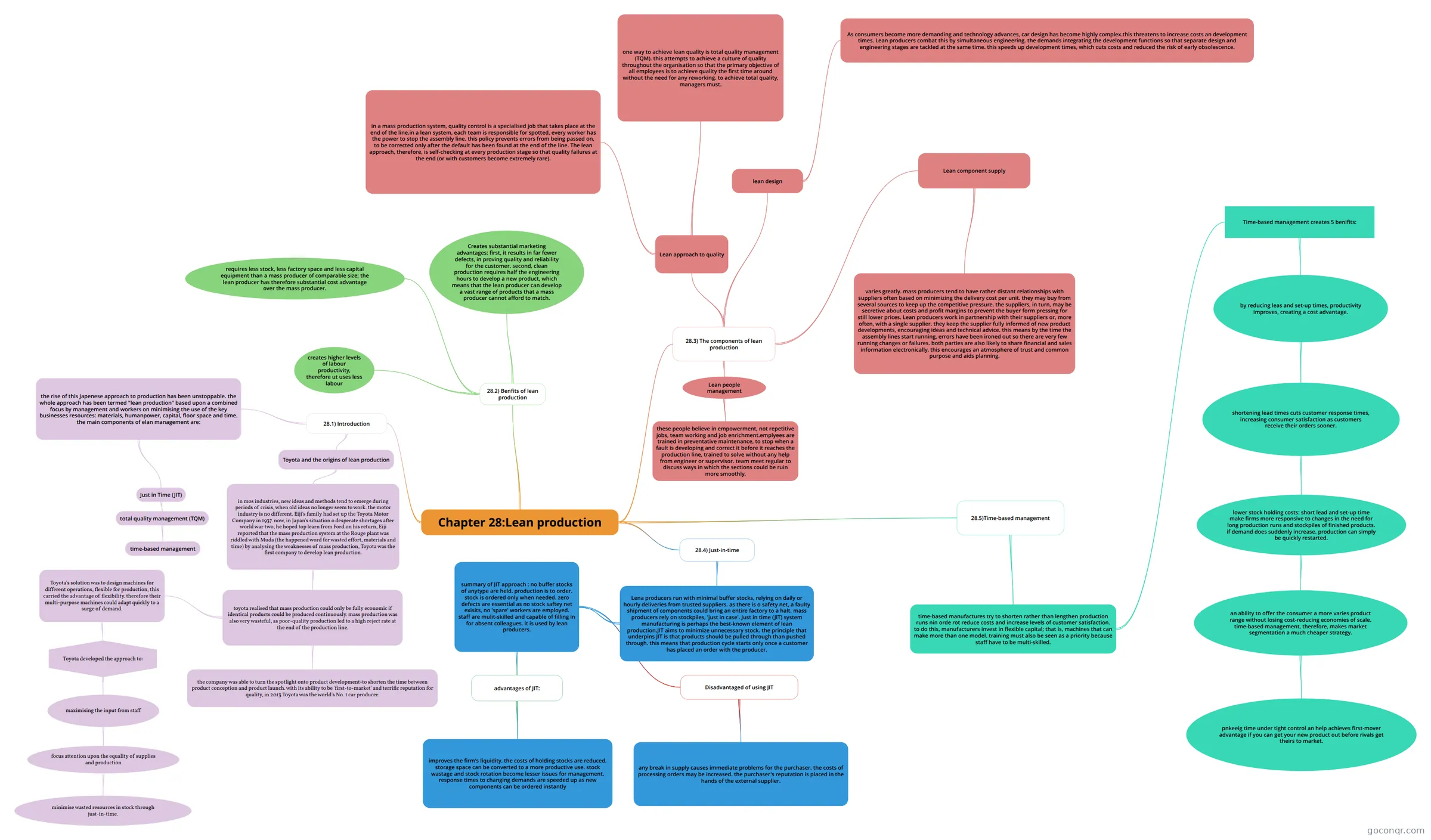
Mind map: Lean production
Conteúdo do mapa
Chapter 28:Lean production
28.1) Introduction
- the rise of this Japenese approach to production has been unstoppable. the whole approach has been termed "lean production" based upon a combined focus by management and workers on minimising the use of the key businesses resources: materials, humanpower, capital, floor space and time. the main components of elan management are:
- Just in Time (JIT)
- total quality management (TQM)
- time-based management
- total quality management (TQM)
- Just in Time (JIT)
- Toyota and the origins of lean production
- in mos industries, new ideas and methods tend to emerge during periods of crisis, when old ideas no longer seem to work. the motor industry is no different. Eiji's family had set up the Toyota Motor Company in 1937. now, in Japan's situation o desperate shortages after world war two, he hoped top learn from Ford.on his return, Eiji reported that the mass production system at the Rouge plant was riddled with Muda (the happened word for wasted effort, materials and time) by analysing the weaknesses of mass production, Toyota was the first company to develop lean production.
- toyota realised that mass production could only be fully economic if identical products could be produced continuously. mass production was also very wasteful, as poor-quality production led to a high reject rate at the end of the production line.
- Toyota's solution was to design machines for different operations, flexible for production, this carried the advantage of flexibility. therefore their multi-purpose machines could adapt quickly to a surge of demand.
- Toyota developed the approach to:
- maximising the input from staff
- focus attention upon the equality of supplies and production
- minimise wasted resources in stock through just-in-time.
- focus attention upon the equality of supplies and production
- maximising the input from staff
- Toyota developed the approach to:
- the company was able to turn the spotlight onto product development-to shorten the time between product conception and product launch. with its ability to be 'first-to-market' and terrific reputation for quality, in 2013 Toyota was the world's No. 1 car producer.
- Toyota's solution was to design machines for different operations, flexible for production, this carried the advantage of flexibility. therefore their multi-purpose machines could adapt quickly to a surge of demand.
- toyota realised that mass production could only be fully economic if identical products could be produced continuously. mass production was also very wasteful, as poor-quality production led to a high reject rate at the end of the production line.
- in mos industries, new ideas and methods tend to emerge during periods of crisis, when old ideas no longer seem to work. the motor industry is no different. Eiji's family had set up the Toyota Motor Company in 1937. now, in Japan's situation o desperate shortages after world war two, he hoped top learn from Ford.on his return, Eiji reported that the mass production system at the Rouge plant was riddled with Muda (the happened word for wasted effort, materials and time) by analysing the weaknesses of mass production, Toyota was the first company to develop lean production.
- the rise of this Japenese approach to production has been unstoppable. the whole approach has been termed "lean production" based upon a combined focus by management and workers on minimising the use of the key businesses resources: materials, humanpower, capital, floor space and time. the main components of elan management are:
28.2) Benfits of lean production
- creates higher levels of labour productivity, therefore ut uses less labour
- requires less stock, less factory space and less capital equipment than a mass producer of comparable size; the lean producer has therefore substantial cost advantage over the mass producer.
- Creates substantial marketing advantages: first, it results in far fewer defects, in proving quality and reliability for the customer. second, clean production requires half the engineering hours to develop a new product, which means that the lean producer can develop a vast range of products that a mass producer cannot afford to match.
28.3) The components of lean production
- Lean people management
- these people believe in empowerment, not repetitive jobs, team working and job enrichment.emplyees are trained in preventative maintenance, to stop when a fault is developing and correct it before it reaches the production line, trained to solve without any help from engineer or supervisor. team meet regular to discuss ways in which the sections could be ruin more smoothly.
- Lean approach to quality
- in a mass production system, quality control is a specialised job that takes place at the end of the line.in a lean system, each team is responsible for spotted, every worker has the power to stop the assembly line. this policy prevents errors from being passed on, to be corrected only after the default has been found at the end of the line. The lean approach, therefore, is self-checking at every production stage so that quality failures at the end (or with customers become extremely rare).
- one way to achieve lean quality is total quality management (TQM). this attempts to achieve a culture of quality throughout the organisation so that the primary objective of all employees is to achieve quality the first time around without the need for any reworking. to achieve total quality, managers must.
- lean design
- As consumers become more demanding and technology advances, car design has become highly complex.this threatens to increase costs an development times. Lean producers combat this by simultaneous engineering. the demands integrating the development functions so that separate design and engineering stages are tackled at the same time. this speeds up development times, which cuts costs and reduced the risk of early obsolescence.
- Lean component supply
- varies greatly. mass producers tend to have rather distant relationships with suppliers often based on minimizing the delivery cost per unit. they may buy from several sources to keep up the competitive pressure. the suppliers, in turn, may be secretive about costs and profit margins to prevent the buyer form pressing for still lower prices. Lean producers work in partnership with their suppliers or, more often, with a single supplier. they keep the supplier fully informed of new product developments, encouraging ideas and technical advice. this means by the time the assembly lines start running, errors have been ironed out so there are very few running changes or failures. both parties are also likely to share financial and sales information electronically. this encourages an atmosphere of trust and common purpose and aids planning.
- Lean people management
28.4) Just-in-time
- Lena producers run with minimal buffer stocks, relying on daily or hourly deliveries from trusted suppliers. as there is o safety net, a faulty shipment of components could bring an entire factory to a halt. mass producers rely on stockpiles, 'just in case'. Just in time (JIT) system manufacturing is perhaps the best-known element of lean production.JIT aims to minimize unnecessary stock. the principle that underpins JIT is that products should be pulled through than pushed through. this means that production cycle starts only once a customer has placed an order with the producer.
- summary of JIT approach : no buffer stocks of anytype are held. production is to order. stock is ordered only when needed. zero defects are essential as no stock saftey net exisits, no 'spare' workers are employed. staff are mulit-skilled and capable of filling in for absent colleagues. it is used by lean producers.
- advantages of JIT:
- improves the firm's liquidity. the costs of holding stocks are reduced. storage space can be converted to a more productive use. stock wastage and stock rotation become lesser issues for management. response times to changing demands are speeded up as new components can be ordered instantly
- Disadvantaged of using JIT
- any break in supply causes immediate problems for the purchaser. the costs of processing orders may be increased. the purchaser's reputation is placed in the hands of the external supplier.
- advantages of JIT:
- summary of JIT approach : no buffer stocks of anytype are held. production is to order. stock is ordered only when needed. zero defects are essential as no stock saftey net exisits, no 'spare' workers are employed. staff are mulit-skilled and capable of filling in for absent colleagues. it is used by lean producers.
- Lena producers run with minimal buffer stocks, relying on daily or hourly deliveries from trusted suppliers. as there is o safety net, a faulty shipment of components could bring an entire factory to a halt. mass producers rely on stockpiles, 'just in case'. Just in time (JIT) system manufacturing is perhaps the best-known element of lean production.JIT aims to minimize unnecessary stock. the principle that underpins JIT is that products should be pulled through than pushed through. this means that production cycle starts only once a customer has placed an order with the producer.
28.5)Time-based management
- time-based manufactures try to shorten rather than lengthen production runs nin orde rot reduce costs and increase levels of customer satisfaction. to do this, manufacturers invest in flexible capital; that is, machines that can make more than one model. training must also be seen as a priority because staff have to be multi-skilled.
- Time-based management creates 5 benifits:
- by reducing leas and set-up times, productivity improves, creating a cost advantage.
- shortening lead times cuts customer response times, increasing consumer satisfaction as customers receive their orders sooner.
- lower stock holding costs: short lead and set-up time make firms more responsive to changes in the need for long production runs and stockpiles of finished products. if demand does suddenly increase. production can simply be quickly restarted.
- an ability to offer the consumer a more varies product range without losing cost-reducing economies of scale. time-based management, therefore, makes market segmentation a much cheaper strategy.
- pnkeeig time under tight control an help achieves first-mover advantage if you can get your new product out before rivals get theirs to market.
- an ability to offer the consumer a more varies product range without losing cost-reducing economies of scale. time-based management, therefore, makes market segmentation a much cheaper strategy.
- lower stock holding costs: short lead and set-up time make firms more responsive to changes in the need for long production runs and stockpiles of finished products. if demand does suddenly increase. production can simply be quickly restarted.
- shortening lead times cuts customer response times, increasing consumer satisfaction as customers receive their orders sooner.
- by reducing leas and set-up times, productivity improves, creating a cost advantage.
- Time-based management creates 5 benifits:
- time-based manufactures try to shorten rather than lengthen production runs nin orde rot reduce costs and increase levels of customer satisfaction. to do this, manufacturers invest in flexible capital; that is, machines that can make more than one model. training must also be seen as a priority because staff have to be multi-skilled.
Informações
- Descrição
- A level Business Studies Mapa Mental sobre Chapter 28:Lean production, criado por Firdaws Shahed em 23-10-2018.
- Criado por
- Firdaws Shahed
- Visualizações
- 0
- Avaliação