
Mapa mental
Mechanisms of Hormone Action
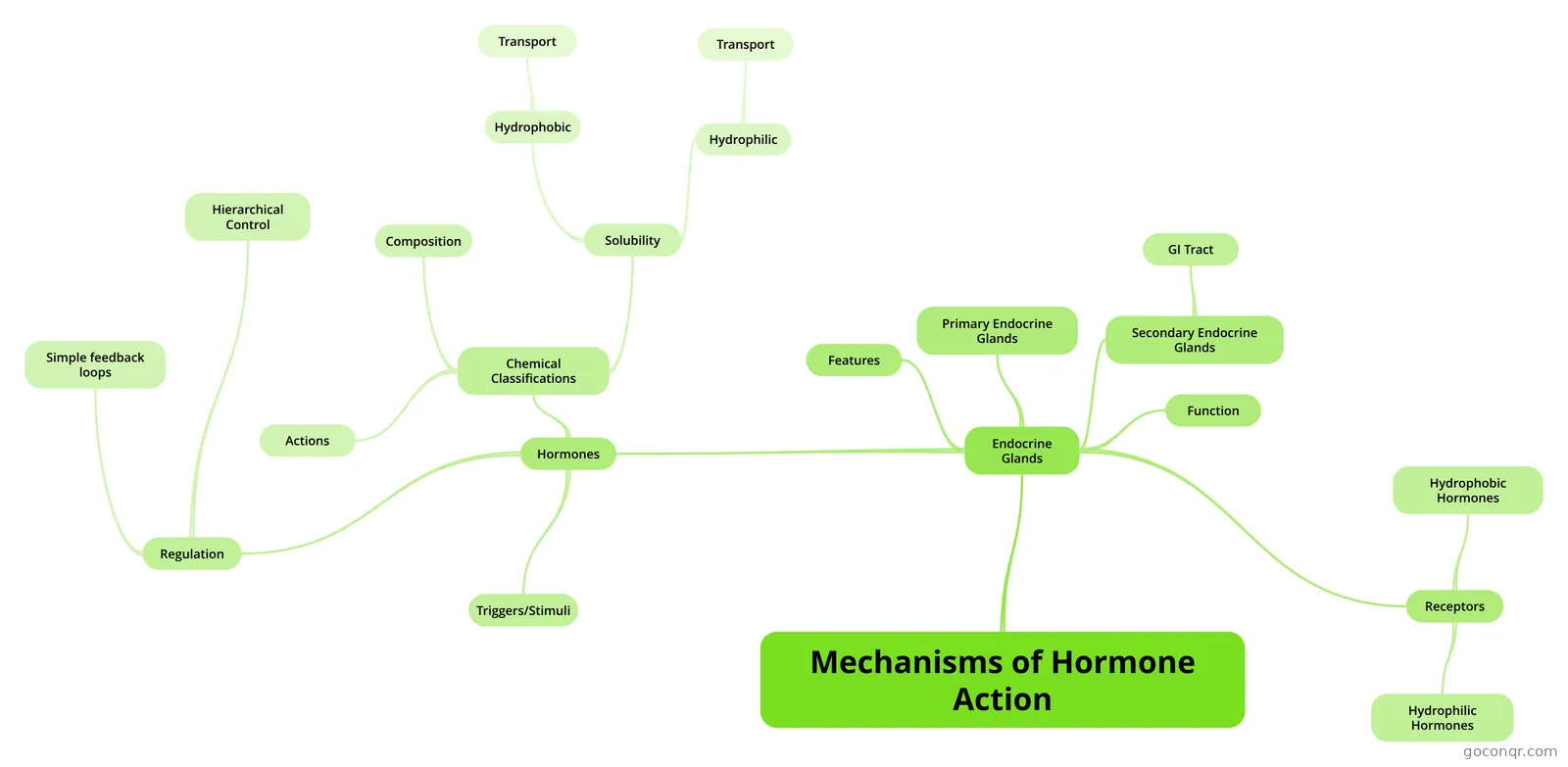
Mind map: Mechanisms of hormone action
Conteúdo do mapa
Mechanisms of Hormone Action
Endocrine Glands
- Primary Endocrine Glands
- Primary function is to secrete hormones into the blood stream. The glands are: Pineal, (regulate circardian rhythm) Hypothalamus: Feel good (balance) Thyroid/Parathyroid: Regulate growth (can be able to feel or palpate) Thymus glands: T-cells activation Adrenal Glands: Adrenaline (one on each kidney) Pancreas: Secrete glucagon and insulin Ovaries + Testis: Oestrogen and Testosterone
- Secondary Endocrine Glands
- Secondary endocrine glands are mostly organs that have primary functions but the secondary function are to secrete hormones. Examples are: Heart Stomach Liver Kidneys Intestines (Control diet) Skin: Vitamin D
- GI Tract
- Stomach produces gastrin Small intestines produces CCK and GIP (cholecytokinin and glucose-depedent insulintropic peptide).
- Function
- Integration and control Control and coordinate function of cells and organs over the body for example metabolism. Control and maintain homeostasis and to maintain and regulate baseline activity. Endocrine system however tends to be quite slower and act over a longer time. An exception is adrenaline.
- Features
- Arranged in cords or groupling of cells. Organ has good vasculature (loads of capillaries) with fenestrated features. Hormones circulate throughout the whole body.
- Hormones
- Chemical messenger Can be synthesized and released by specialized organs or cells. Secreted in blood streams in small amounts and acts at target tissues via specific receptors.
- Chemical Classifications
- Composition
- Amines: Derived from amino acid (tyrosine), examples are adrenaline, noradrenaline and hormones secrete from thyroid. Peptides/Proteins: Synthesized by mRNA. Steroids: Synthesized from cholesterol.
- Solubility
- Hydrophilic: Most of the hormones, catecholamines, amines and peptides or proteins. Hydrophobic: Steroid hormones and thyroid.
- Hydrophobic
- Unable to be stored inside cells Synthesized on demand Released by diffusion Slow response Metabolised slowly, long acting
- Transport
- Secreted by simple diffusion across cell membrane. Bound to carrier protein (le chatelier's) matter of equilibrium. Free hormones are only able to be bound
- Hydrophilic
- Easily stored inside side cells. Synthesised and stored beforehand RElease by exocytosis Fast response Metabolize fast, short acting
- Transport
- Secreted by exocytosis Dissolved in plasma in blood Transported in dissolved form
- Actions
- Autocrine: Chemical signals send to itself. More of self regulation to act on the population in the cell itself. Paracrine: Chemical acts on neighbouring cells Endocrine: Released into blood. Act to target cells at specific receptors. Neurohormones: Similar action to neurotransmitter
- Composition
- Regulation
- Hierarchical Control
- Simple feedback loops
- Triggers/Stimuli
- Hormonal Stimuli: Release due to another hormone Humoral: Changes within the environment of the body Neuronal: Response to emotion or physical stress or cognitive
- Receptors
- Specific. Receptors can be in the cell or on the surface
- Hydrophilic Hormones
- Uses G-protein coupled receptors. Surface membrane receptors
- Hydrophobic Hormones
- Lipid based. Binds to HRE to control gene expression Binds to the intracellular receptors to control gene expression.
- Primary Endocrine Glands
Informações
- Descrição
- Physiology 1B (Glands) Mapa Mental sobre Mechanisms of Hormone Action, criado por Daniel Elandix G em 03-08-2013.
- Criado por
- Daniel Elandix G
- Visualizações
- 139
- Tags
- Avaliação