
Mapa mental
Musculoskeletal System
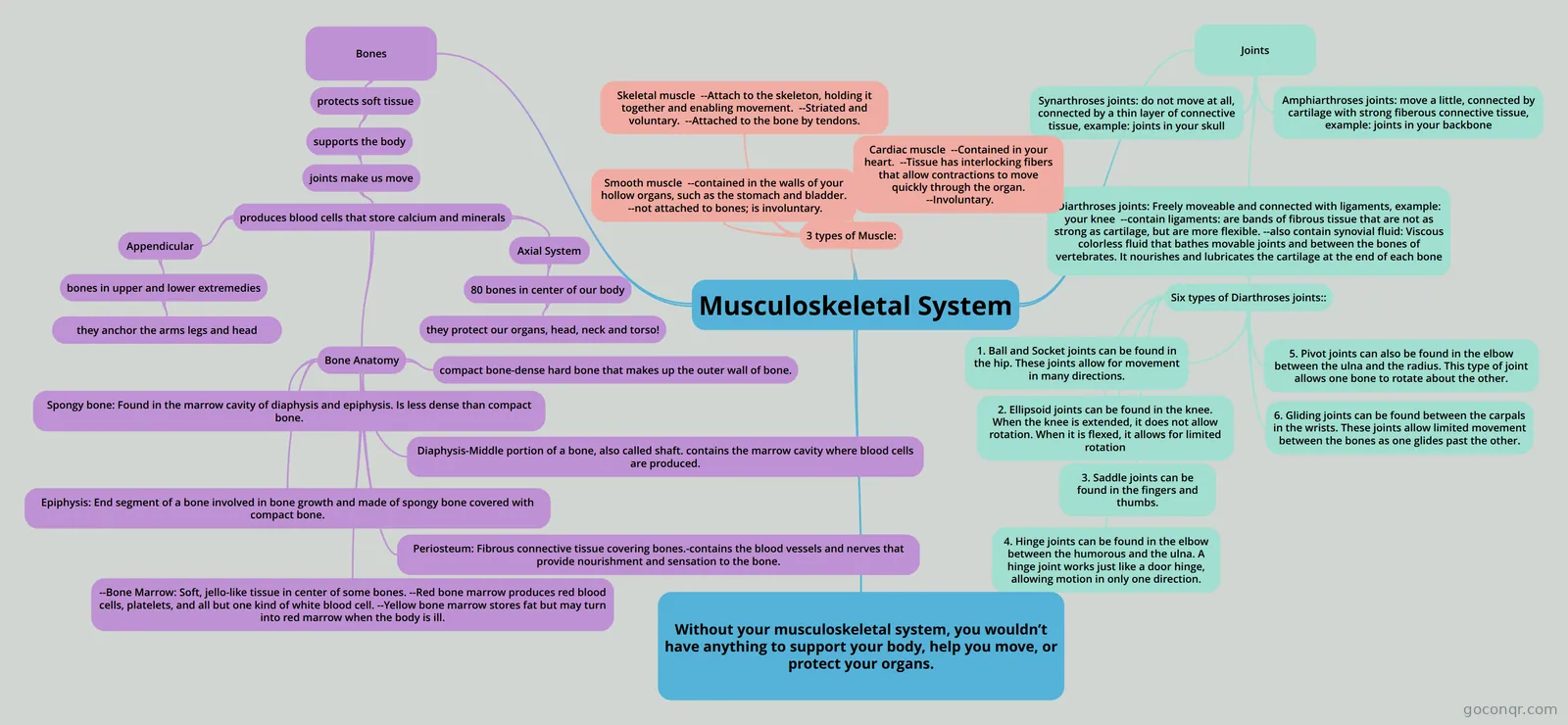
Mind map: Musculoskeletal system
Conteúdo do mapa
Musculoskeletal System
Bones
- protects soft tissue
- supports the body
- joints make us move
- produces blood cells that store calcium and minerals
- Axial System
- 80 bones in center of our body
- they protect our organs, head, neck and torso!
- 80 bones in center of our body
- Appendicular
- bones in upper and lower extremedies
- they anchor the arms legs and head
- bones in upper and lower extremedies
- Bone Anatomy
- compact bone-dense hard bone that makes up the outer wall of bone.
- Diaphysis-Middle portion of a bone, also called shaft. contains the marrow cavity where blood cells are produced.
- Epiphysis: End segment of a bone involved in bone growth and made of spongy bone covered with compact bone.
- Spongy bone: Found in the marrow cavity of diaphysis and epiphysis. Is less dense than compact bone.
- Periosteum: Fibrous connective tissue covering bones.-contains the blood vessels and nerves that provide nourishment and sensation to the bone.
- --Bone Marrow: Soft, jello-like tissue in center of some bones. --Red bone marrow produces red blood cells, platelets, and all but one kind of white blood cell. --Yellow bone marrow stores fat but may turn into red marrow when the body is ill.
- Axial System
- produces blood cells that store calcium and minerals
- joints make us move
- supports the body
- protects soft tissue
Joints
- Synarthroses joints: do not move at all, connected by a thin layer of connective tissue, example: joints in your skull
- Amphiarthroses joints: move a little, connected by cartilage with strong fiberous connective tissue, example: joints in your backbone
- Diarthroses joints: Freely moveable and connected with ligaments, example: your knee --contain ligaments: are bands of fibrous tissue that are not as strong as cartilage, but are more flexible. --also contain synovial fluid: Viscous colorless fluid that bathes movable joints and between the bones of vertebrates. It nourishes and lubricates the cartilage at the end of each bone
- Six types of Diarthroses joints::
- 3. Saddle joints can be found in the fingers and thumbs.
- 2. Ellipsoid joints can be found in the knee. When the knee is extended, it does not allow rotation. When it is flexed, it allows for limited rotation
- 1. Ball and Socket joints can be found in the hip. These joints allow for movement in many directions.
- 4. Hinge joints can be found in the elbow between the humorous and the ulna. A hinge joint works just like a door hinge, allowing motion in only one direction.
- 5. Pivot joints can also be found in the elbow between the ulna and the radius. This type of joint allows one bone to rotate about the other.
- 6. Gliding joints can be found between the carpals in the wrists. These joints allow limited movement between the bones as one glides past the other.
- Six types of Diarthroses joints::
3 types of Muscle:
- Smooth muscle --contained in the walls of your hollow organs, such as the stomach and bladder. --not attached to bones; is involuntary.
- Skeletal muscle --Attach to the skeleton, holding it together and enabling movement. --Striated and voluntary. --Attached to the bone by tendons.
- Cardiac muscle --Contained in your heart. --Tissue has interlocking fibers that allow contractions to move quickly through the organ. --Involuntary.
Without your musculoskeletal system, you wouldn’t have anything to support your body, help you move, or protect your organs.
Informações
- Descrição
- 730 final exam study guide
- Criado por
- Laura Fauth
- Visualizações
- 15
- Avaliação
Mais sobre Skeletal and Muscular Systems