
Introduction to Anatomy
1,037 resources created by 913 users
This Introduction to Anatomy page on GoConqr gathers community-made quizzes, mind maps, flashcards, notes and slides, from branches of anatomy and directional terms to body planes, cavities and tissues. It's built for university students practising terminology and structure, and for teachers after ready-made material. There are over 900 resources here, including more than 280 quizzes, over 100 mind maps and more than 500 flashcards. Pick a quiz to find your gaps, then see what sticks.
Top Introduction to Anatomy resources
-
18 questionsAnatomy- Clinical cases for Quiz 1- PMU A patient complains of pain on the lower left side of her back. A radiograph confirms a hernia passing post...
-
131 cardsNAS 2 TCC Study Guide Flashcards Page 1 NAS 2 Study Guide Flashcards
-
77 questionsAnatomy - final Within the lateral cord of the brachial plexus origin:
-
33 questionsAnatomy Week One Quiz Where in layman's terms is the popliteal region
-
33 questionsAP Test 2 Lab No head and neck atlas as per Usman May 20th class
-
65 questionsMerrill's Chapter 3 What plane is shown?
-
16 questionsBranches of Anatomy
-
24 questionsBreast Anatomy & Histology Breast Anatomy & Histology lecture given by Paul felts on 07/01/2019. First day back.
Quizzes
See all 299 quizzes-
18 questionsAnatomy- Clinical cases for Quiz 1- PMU A patient complains of pain on the lower left side of her back. A radiograph confirms a hernia passing post...
-
77 questionsAnatomy - final Within the lateral cord of the brachial plexus origin:
-
33 questionsAnatomy Week One Quiz Where in layman's terms is the popliteal region
-
33 questionsAP Test 2 Lab No head and neck atlas as per Usman May 20th class
-
65 questionsMerrill's Chapter 3 What plane is shown?
-
16 questionsBranches of Anatomy
-
24 questionsBreast Anatomy & Histology Breast Anatomy & Histology lecture given by Paul felts on 07/01/2019. First day back.
-
16 questionsAnatomy and Physiology: Chapter 1 Part 1 Select all that are considered Anatomy (Not Physiology.)
Mind maps
See all 120 mind maps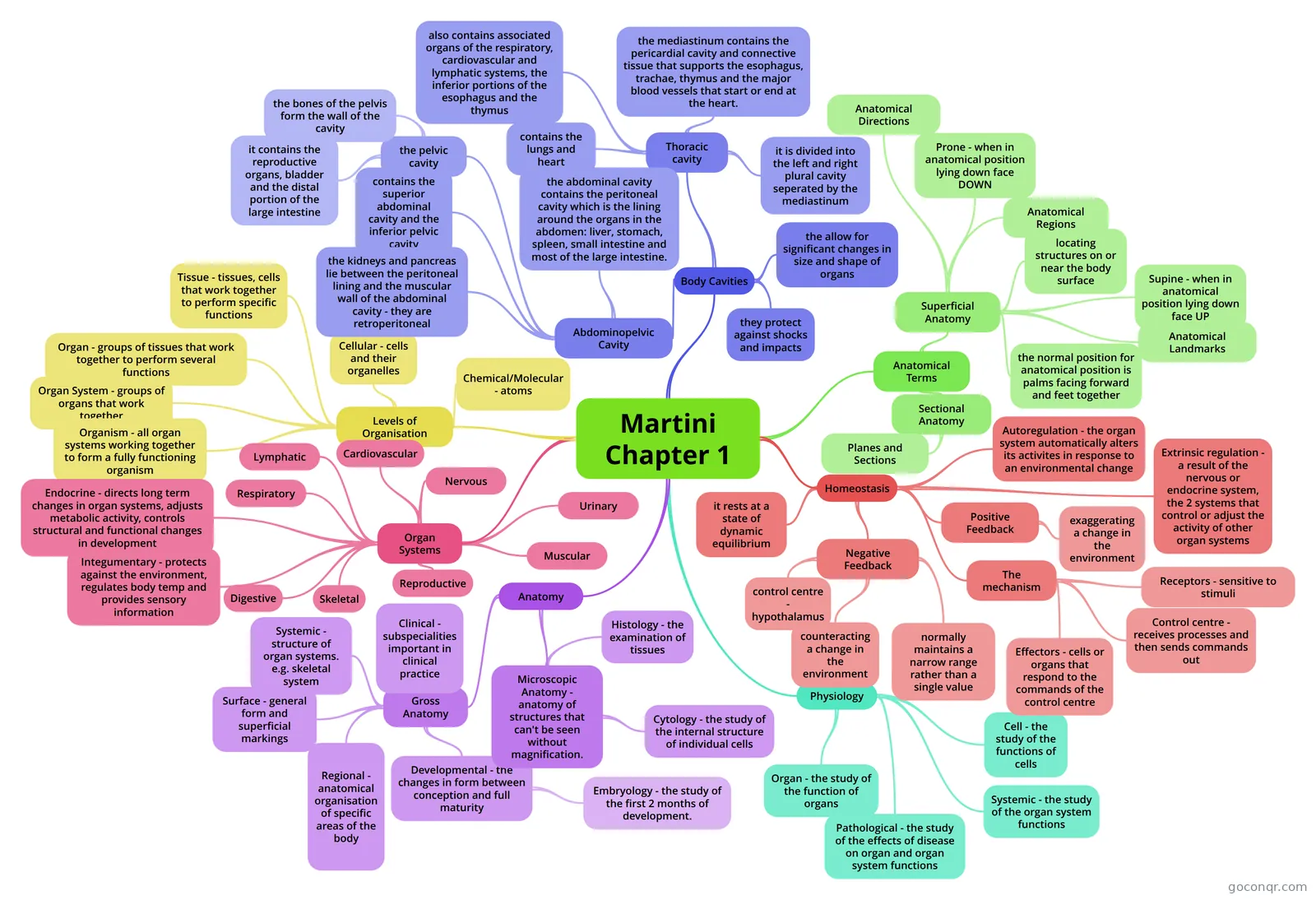
Flashcards
See all 582 flashcards-
131 cardsNAS 2 TCC Study Guide Flashcards Page 1 NAS 2 Study Guide Flashcards
-
25 cardsFundamentals of the Muscular System and Muscle Tissue What are the 3 types of muscle tissue?
-
4 cardsChapter 1 / Human Anatomy / Table 1-1 / Anatomical, Directional and Regional Terms ACE Essentials of Exercise Science for Fitness Professionals Chapter 1 / Human Anatomy Table 1-1 / Anatomic...
-
100 cardsGross Anatomy IV (100 Flash cards) During intraoral injection to the mandibular foramen, the needle passes through the mucous membrane and the...
-
90 cardsLower Limb SWAY What 3 ligaments maintain the hip joint?
-
199 cardsA&P I: Lecture & Lab - Senses & Muscular
-
168 cardsHuman Anatomy Describe blood supply of the brain
-
114 cardsAnatomy & Physiology Final Exam Study Cards
Flowcharts
Notes
See all 25 notes-
Anatomy and Physiology Two important Concepts in Anatomy and Physiology Structure underlies function Homeostasis Structure Underlies Function
-
Lecture 1 Basic Definitions Anatomy- the study of the structure of the body Physiology- the study of the functional processes of the body Microscopic Anatomy-the study of the structure of cells, tissues, and organs ...
-
BIOL 2457 Orientation to the Human Body *NOT ON TEST but vocabs will be used* Gross Anatomy: Large body structures visible W/O microscope Regional Anatomy: All structures in a particular body region (ex. abdomen) Sy...
-
skeletal Distal means closer to the destination of the flow.Groups of similar cells are organized into tissues. Organs are composed of groups of tissue that have common function & work together. Organ systems made up of organs...
-
Ch. 4. Tissue level of organization Define resolution and its quality Resolution – Ability to distinguish between two separate points Function and features of epithelial tissue Functions Provide physical protection- Protect surfaces from abr...
-
Anatomy Terms Terms to Familiarize Chapter 2Ion: Isotope:Covalent Bond: two or more atoms sharing electrons as opposed to gaining or losing themHydrogen Bond: Forms when the Hydrogen Atom w. a partial + charge attracts the partial ...
-
Breast anatomy
-
Contrasting Muscle Motion - created from Mind Map Abduction & Adduction Flexion and Extension Elevation & Depression
Slides
Topics in Introduction to Anatomy
More Anatomy topics
About Introduction to Anatomy
GoConqr OriginalWhat this unit covers
The unit gathers the opening ideas of an anatomy course. Many resources begin with the basic split between anatomy (structure) and physiology (function). The quiz Branches of Anatomy asks you to match gross, or macroscopic, anatomy to structures visible to the naked eye, such as the heart, lungs and kidneys. A&P Chapter 1 lecture quiz uses fill-in-the-blank questions on the same split.
Where to start
Begin with vocabulary. The flashcard deck Anatomical Terminology and the deck on anterior, posterior, medial and lateral terms from Table 1-1 cover direction and region. Then try Merrill's Chapter 3, which asks which plane is shown, including the plane that divides the body into superior and inferior segments. Anatomy Week One Quiz adds regions and the coronal plane.
- Read a mind map such as Body Planes and Cavities or Levels of Organisation.
- Learn terms with a flashcard deck.
- Test yourself with a quiz.
- Return to the map for anything you missed.
Using quizzes and maps together
Maps give you the overall shape of a topic; quizzes show what you can recall. The mind map Martini Chapter 1 lays out surface, regional and systemic anatomy, so it pairs well with a quiz on the same chapter. If a question catches you out, find the matching branch on the map and read it again.
Going further
Once the basics feel steady, the page also lists more applied material. The quiz Breast Anatomy & Histology looks at lobules and supporting connective tissue. The first quiz in the list, Anatomy- Clinical cases for Quiz 1- PMU, sets a patient scenario about a hernia above the iliac crest. Others cover joints, the muscular system and tissues.
Where it sits
This unit belongs to the strand Foundations of Anatomy in the subject Anatomy, within the Health area. Everything here was made by GoConqr users. Choose one quiz and one map today, and see how far a short session takes you.
Frequently asked questions
Which resource should I open first?
Start with the Branches of Anatomy quiz or the A&P Chapter 1 lecture quiz. They cover the basic split between structure and function. Then move to the directional terms flashcards and the Merrill's Chapter 3 quiz on body planes.
What do the mind maps cover?
The mind maps include Body Planes and Cavities, Levels of Organisation, Anatomical Terminology and Martini Chapter 1, which sets out surface, regional and systemic anatomy. Others reach into joints, the musculoskeletal system, tissues and the neck and head.
Are the resources free to use?
Yes. Every resource listed here is free to open, study and take, with no account needed. A free account also saves your quiz scores and lets you make your own quizzes, mind maps, flashcards and notes.
Who made these resources?
They were made by GoConqr users, not by GoConqr itself. Over 800 contributors have added material to this unit, so styles and depth vary. Check a few resources and choose the ones that match your course.
Which levels is this page suited to?
It is mostly university-level material, with a small share aimed at professional study and a few school-level items. It suits university students practising terminology and structure, and teachers looking for ready-made quizzes, maps and flashcards.
What if my topic is not listed?
Look through the related quizzes, flashcards and notes first, since many cover several topics at once. If nothing fits, you can build your own mind map, quiz or flashcard deck on the topic and use it for your own revision.