
Mapa mental
Chapter 14: Reformation
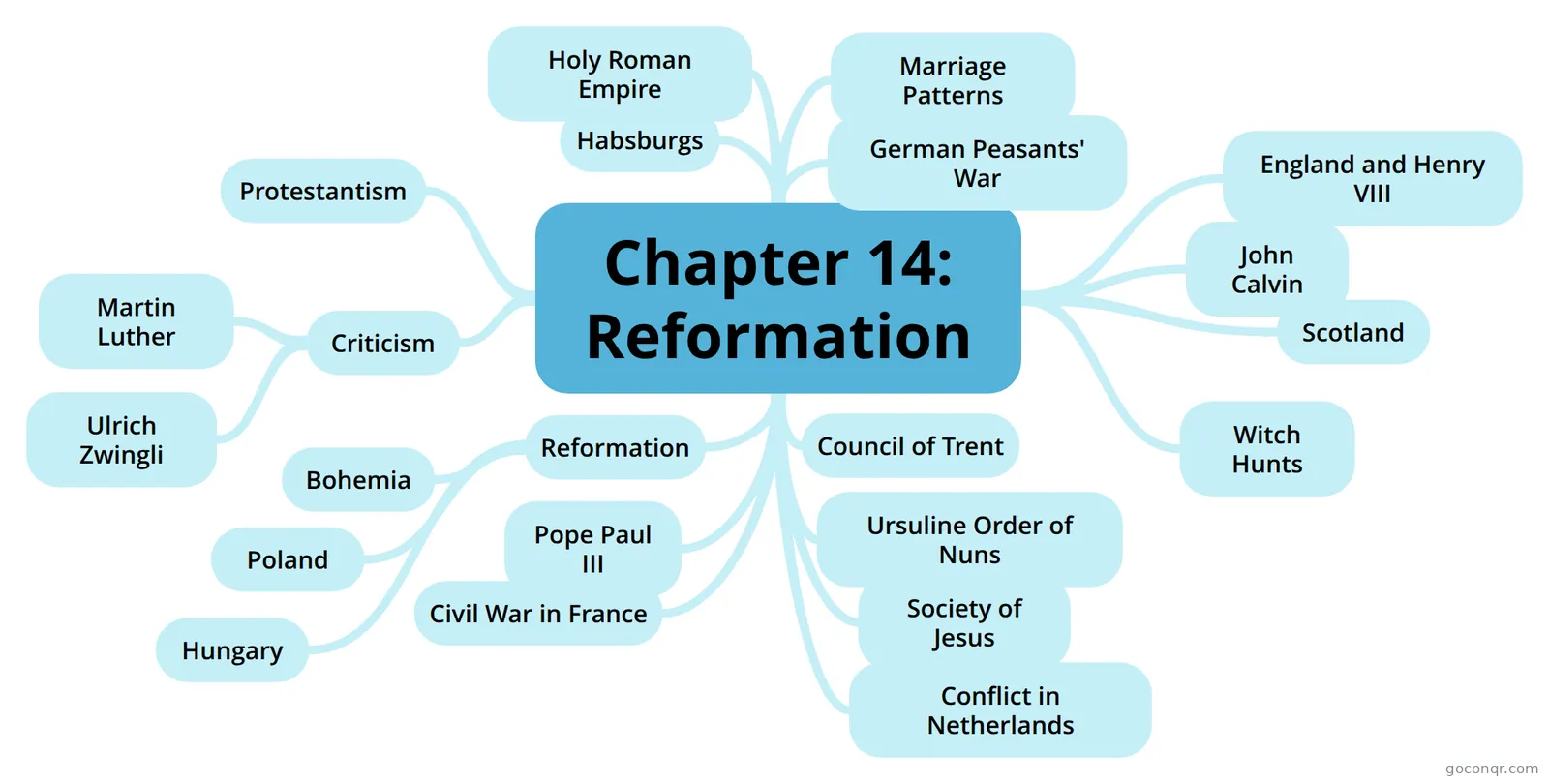
Mind map: Reformation mind map
Conteúdo do mapa
Chapter 14: Reformation
Criticism
- People were very pious, and devoted a lot of their income to religious activities and foundations. The Church had lost much of its prestige during the Babylonian Captivity and the Great Schism, which made the Catholics question the church and its teachings. Anticlericalism, or the opposition of the clergy, became popular.
- Martin Luther
- Martin Luther was a German university professor, as well as a priest. He believed in “faith alone, grace alone, Scripture alone.” He thought that salvation and justification came from faith, and that faith is a free gift from God. When the church began to sell indulgences, Luther was worried that people would no longer feel the need to repent their sins once they had bought indulgences. He decided to share his ideas by writing a letter to the archbishop. He called it his Ninety-five Theses on the Power of Indulgences. When the authorities told him to recant, he responded saying that it is not safe or right to go against his conscience.
- Ulrich Zwingli
- Ulrich Zwingli was a Swiss humanist and priest who also believed in some of Luther’s protestant ideas. The main protestant ideas were that salvation comes from faith alone, authority rests only in the Bible, and that the Church is a spiritual priesthood of all believers, an invisible fellowship. Zwingli believed that Christ was present in spirit among the faithful, but not in the Eucharist. However, Luther believed that Christ was present in the bread and wine because of God’s mystery, not a priest’s actions.
Protestantism
- Educated thinkers and humanists were attracted to Luther’s ideas because they focused on a simpler personal religion based on faith, and the centrality of the Scriptures. The Reformation ideas started in Germany and spread to other parts of Europe with the help of the printing press.
- Radical Protestants’ ideas varied from person to person, but they did agree on some points. Some saw outward sacraments misguided. Many lived very simply and rejected anything they thought was unbiblical. Some reacted harshly to those who deviated, but others wanted religious toleration. Few refused to swear oaths or hold office, which marked them as societal outcasts.
German Peasants' War
- The crop failure of 1523 and 1524 was the first of many issues that started the German Peasants’ War. Next, nobles began seizing village common lands, imposing rents and requiring additional services. They also took the household’s best horses or cows whenever the head of a household died. Martin Luther did not want a rebellion to occur. More than seventy-five thousand peasants were killed, but the peasants’ economic situation moderately improved.
Marriage Patterns
- Marriage became a way to bring spiritual advantages and was the proper remedy for lust. Protestants allowed priests to marry. Because Protestants did not believe that marriage was a sacrament, divorce was allowed, although it was considered a final resort. Also, prostitution was severely punished and banned from the cities because marriage was now the proper way to treat lust.
Habsburgs
- Charles V had inherited the Spanish New Empire, as well as parts of Spain and France. The Hapsburgs married rich princesses in order to gain more land and more wealth. Charles V wanted religious unity as well as a total unified state. He defended both church and empire.
Holy Roman Empire
- The Holy Roman Empire was surrounded by Protestant ideas, and many people began to adopt the Lutheran ideas. The Catholics had to rid their lands of Protestant ideas that could possibly overpower their own. The Peace of Augsburg stated that each political authority could choose its own religion, but it had to recognize and tolerate other religions. However, many territories disobeyed this order and made other religions convert or leave. This variation of religion created disunity in the area, but it did end religious wars in Germany for many decades
England and Henry VIII
- – Henry VIII wanted a son to be his heir - 1st wife = Catherine of Aragon >> daughter Mary - Marriage to brother’s widow is against the canon law - 2nd wife = Anne Boleyn - Catholics did not allow is marriage choices - Henry separated England from the papal jurisdiction and put himself at the head of his own church - Beheaded enemies, including Thomas More - Anne Boleyn couldn’t have son = beheaded - 3rd wife = Jane Seymour >> son Edward - Jane died in childbirth - Henry collected monastery land = wealth - Pilgrimage of Grace = massive rebellion against Henry’s new religious decisions >> truce accepted - Most Irish were still Catholic in secret, pretending to be Protestant in public, some converted
John Calvin
- French reformist who studied law and was protestant -believed that God selected him to reform the church -The Institutes of the Christian Religion - the absolute sovereignty and omnipotence of God - weakness of humanity - God knew who would be saved and damned - Predestination - people were executed or punished for heresy, adultery, blasphemy or witchcraft - model for Presbyterian church in Scotland
Scotland
- – King James V and Mary = opposed reform - Nobles wanted reform - John Knox = dominated reform movement - based Scottish church after Geneva - persuaded Scottish parliament to end papal authority - the Presbyterian Church of Scotland - Calvinist doctrine, simple service of worship, emphasis on preaching
Reformation
- Bohemia
- -Lutheranism appealed to Germans in Bohemia -Czechs adopted the ideas of Jan Hus -Catholic Hapsburgs
- Poland
- -diverse population thinly spread throughout areas -Anti-German feelings >> Calvinism attractive -Stanislaus Hosius >> Catholic Poland
- Hungary
- -Lutheranism spread by students -Reform ideas stop when Ottomans invade -King Louis II is killed -divided to 3 parts = Turks, Hapsburgs, Janos Zapolya -Nobles accepted Lutheranism -Christians had to pay extra taxes
- Bohemia
Pope Paul III
- -supported improvements in education for the clergy, the end of simony, and stricter control of clerical life -The Supreme Sacred Congregation of the Roman and Universal Inquisition (aka Holy Office) -6 cardinals with the ability to arrest, to imprison and execute suspected heretics -Index of Prohibited Books, a list of forbidden reading - Papal States >> effective, outside >> slight influence
Council of Trent
- – goals = to reform the catholic church and reconcile with the Protestants -a solid basis for the spiritual renewal of the Catholic Church, equal validity to Scriptures and to traditions, reaffirmed the seven sacraments and the traditional teachings on transubstantiation. -required bishops to live in their own dioceses, suppressed pluralism, forbade the selling of indulgences, established a seminary to educate clergy -for a marriage to be valid there had to be a priest and witnesses present
Ursuline Order of Nuns
- -Angela Merici -education of women -training future wives and mothers -rapidly spread to France and the New World
Society of Jesus
- -Jesuits -Ignatius Loyola -strengthening Catholicism in Europe and spreading faith to new places -Spiritual Exercises, a program of meditation
Civil War in France
- –Concordat of Bologna = king appoints bishops -Clergy found Calvinism attractive -weak monarchy bc of Hapsburg-Valois Wars >> nobles cloaking independence with Protestantism -armed clashes = Catholic Royalists vs. Calvanist anti-monarchial lords -preachers incited violence, religious ceremonies triggered it -mobs destroyed works of art -Saint Bartholomew’s Day Massacre(pg 434) -politiques = Catholic and Protestant moderates -Edict of Nantes = liberty of public worship to Huguenots
Conflict in Netherlands
- –Protestant ideas spread with the reign of Phillip II -Spanish authorities attempted to suppress Calvinist worship and raised taxes -30 Catholic churches were sacked and religious images were destroyed -Alva was sent to pacify the Low Countries, but instead of “pacifying” them, he was cruel to them - Council of Blood = 1500 men were executed -Union of Utrecht = independence of Spain -War continued -English gives money and support to Holland
Witch Hunts
- –religious superstition -extreme notions of the Devil’s powers -women were viewed as weaker -witches used magic they had received when making a pact with the devil -witches became the ultimate heretics -legal changes made it easier to accuse people bc the accusers didn’t have to face the accused’s family -many people doubted that witchcraft was even real -tensions between families led to accusations -confessions followed with execution by fire -“witch panics” = large hunts for witches -mass hysteria was a huge part of the witch-hunts, as witchcraft is not possible.
Informações
- Descrição
- AP European History (Chapter 14: Reformation) Mapa Mental sobre Chapter 14: Reformation, criado por queendonnaa em 15-12-2014.
- Criado por
- queendonnaa
- Visualizações
- 89
- Avaliação