
Mapa mental
Topic three- Chemistry
Conteúdo do mapa
Topic three- Chemistry
Flame tests.
- potassium ---> purple
- lithium ----> pinky red
- Calcium ----> orangey-red
- sodium ----> yellowy - orange
- Barium -----> green
- Flame tests are used to find out cation metals.
- pawwwsitive ( positive ions)
Precipitation reactions
- precipitation reactions are used to find out anions.
- negative ions
- precipitation reactions can also be used to test for cations
- Aluminium (3+) and Calcium (2+) create a white precipitate.
- copper (2+) precipitates out blue
- iron (2+) creates a green precipitate
- Iron ( 3+) creates a brown precipitate
- To test these transition metals we added sodium hydroxide
- precipitation reactions are used to find out anions.
TITRATIONS
- A strong acid added to a strong alkali = a base and a salt. But ONLY if it's in the right quantities.
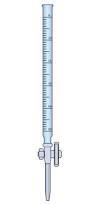
- 1) fill the BURETTE with HCL solution to exactly zero. Use the tap to pour some out if it's not exact.
- 2) Fill the beaker underneath the burette with 25cm cubed of NaOH.
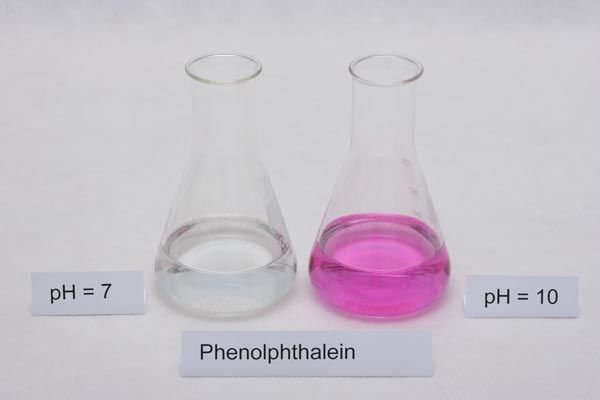
- Put two drops of phenolphthalein indicator into the beaker.
- Let the HCL into the beaker until the colour makes a slight change and then turn the tap one turn at a time.
- Make sure you're swirling the beaker all the time and when the product turns colourless stop letting the HCL out.
- wash the conical flask with dilute water and the acid that you're using and refill it with alkali and the indicator.
- redo the experiment and record the results on the table.
- wash the conical flask with dilute water and the acid that you're using and refill it with alkali and the indicator.
- Make sure you're swirling the beaker all the time and when the product turns colourless stop letting the HCL out.
- Let the HCL into the beaker until the colour makes a slight change and then turn the tap one turn at a time.
- place a while tile under the beaker
- Put two drops of phenolphthalein indicator into the beaker.
- 2) Fill the beaker underneath the burette with 25cm cubed of NaOH.
Calculating moles
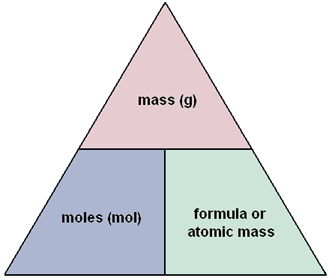
- mass = moles * formula or atomic mass
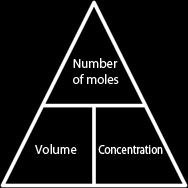
- moles = volume * concentration
- Step 1) write the known information
- what's the concentration, the volume etc.?
- Step 2) write out the balanced equations
- Step 3) Calculate the moles
- concentration = moles * volume
- divide cm by 1000 to create dm
- dont actually understand this :S
- Step 1) write the known information
Hard water
- permanent
- contains calcium hydrogen carbonate ions and magnesium hydrogen carbonate ions
- ion exchange resin columns
- The resin is coated in sodium ions, which have a positive charge. The magnesium and calcium have a stronger positive charge and so displace the sodium ions. The sodium ions dissolve into the water- this hard water is softened using this method.
- washing powder
- creates a scum and removes the calcium and magnesium ions.
- temporary
- can be boiled to soften. Creates CaCo3 (s) which is limescale.
- permanent
Imagens e arquivos do mapa
Informações
- Descrição
- I don't understand all of this, so i'm trying to understand it.... meh..
- Criado por
- greenchloe1998
- Visualizações
- 108
- Tags
- Avaliação