
Mapa mental
APUSH: Topic 5.10 Reconstruction
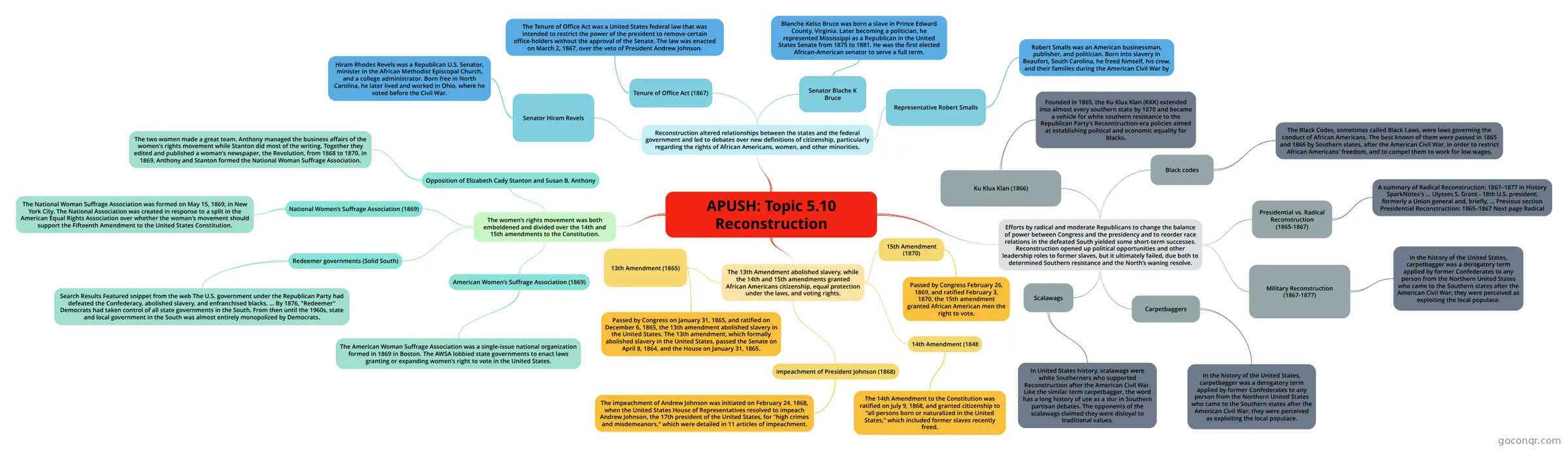
Mind map: APUSH Reconstruction
Conteúdo do mapa
APUSH: Topic 5.10 Reconstruction
Reconstruction altered relationships between the states and the federal government and led to debates over new definitions of citizenship, particularly regarding the rights of African Americans, women, and other minorities.
- Senator Hiram Revels
- Hiram Rhodes Revels was a Republican U.S. Senator, minister in the African Methodist Episcopal Church, and a college administrator. Born free in North Carolina, he later lived and worked in Ohio, where he voted before the Civil War.
- Senator Blache K Bruce
- Blanche Kelso Bruce was born a slave in Prince Edward County, Virginia. Later becoming a politician, he represented Mississippi as a Republican in the United States Senate from 1875 to 1881. He was the first elected African-American senator to serve a full term.
- Representative Robert Smalls
- Robert Smalls was an American businessman, publisher, and politician. Born into slavery in Beaufort, South Carolina, he freed himself, his crew, and their families during the American Civil War by
- Tenure of Office Act (1867)
- The Tenure of Office Act was a United States federal law that was intended to restrict the power of the president to remove certain office-holders without the approval of the Senate. The law was enacted on March 2, 1867, over the veto of President Andrew Johnson.
- Senator Hiram Revels
The 13th Amendment abolished slavery, while the 14th and 15th amendments granted African Americans citizenship, equal protection under the laws, and voting rights.
- 13th Amendment (1865)
- Passed by Congress on January 31, 1865, and ratified on December 6, 1865, the 13th amendment abolished slavery in the United States. The 13th amendment, which formally abolished slavery in the United States, passed the Senate on April 8, 1864, and the House on January 31, 1865.
- 14th Amendment (1848
- The 14th Amendment to the Constitution was ratified on July 9, 1868, and granted citizenship to “all persons born or naturalized in the United States,” which included former slaves recently freed.
- 15th Amendment (1870)
- Passed by Congress February 26, 1869, and ratified February 3, 1870, the 15th amendment granted African American men the right to vote.
- impeachment of President Johnson (1868)
- The impeachment of Andrew Johnson was initiated on February 24, 1868, when the United States House of Representatives resolved to impeach Andrew Johnson, the 17th president of the United States, for "high crimes and misdemeanors," which were detailed in 11 articles of impeachment.
- 13th Amendment (1865)
The women’s rights movement was both emboldened and divided over the 14th and 15th amendments to the Constitution.
- Opposition of Elizabeth Cady Stanton and Susan B. Anthony
- The two women made a great team. Anthony managed the business affairs of the women's rights movement while Stanton did most of the writing. Together they edited and published a woman's newspaper, the Revolution, from 1868 to 1870. In 1869, Anthony and Stanton formed the National Woman Suffrage Association.
- National Women’s Suffrage Association (1869)
- The National Woman Suffrage Association was formed on May 15, 1869, in New York City. The National Association was created in response to a split in the American Equal Rights Association over whether the woman's movement should support the Fifteenth Amendment to the United States Constitution.
- American Women’s Suffrage Association (1869)
- The American Woman Suffrage Association was a single-issue national organization formed in 1869 in Boston. The AWSA lobbied state governments to enact laws granting or expanding women's right to vote in the United States.
- Redeemer governments (Solid South)
- Search Results Featured snippet from the web The U.S. government under the Republican Party had defeated the Confederacy, abolished slavery, and enfranchised blacks. ... By 1876, "Redeemer" Democrats had taken control of all state governments in the South. From then until the 1960s, state and local government in the South was almost entirely monopolized by Democrats.
- Opposition of Elizabeth Cady Stanton and Susan B. Anthony
Efforts by radical and moderate Republicans to change the balance of power between Congress and the presidency and to reorder race relations in the defeated South yielded some short-term successes. Reconstruction opened up political opportunities and other leadership roles to former slaves, but it ultimately failed, due both to determined Southern resistance and the North’s waning resolve.
- Black codes
- The Black Codes, sometimes called Black Laws, were laws governing the conduct of African Americans. The best known of them were passed in 1865 and 1866 by Southern states, after the American Civil War, in order to restrict African Americans' freedom, and to compel them to work for low wages.
- Ku Klux Klan (1866)
- Founded in 1865, the Ku Klux Klan (KKK) extended into almost every southern state by 1870 and became a vehicle for white southern resistance to the Republican Party’s Reconstruction-era policies aimed at establishing political and economic equality for blacks.
- Presidential vs. Radical Reconstruction (1865-1867)
- A summary of Radical Reconstruction: 1867–1877 in History SparkNotes's ... Ulysses S. Grant - 18th U.S. president; formerly a Union general and, briefly, ... Previous section Presidential Reconstruction: 1865–1867 Next page Radical
- Military Reconstruction (1867-1877)
- In the history of the United States, carpetbagger was a derogatory term applied by former Confederates to any person from the Northern United States who came to the Southern states after the American Civil War; they were perceived as exploiting the local populace.
- Carpetbaggers
- In the history of the United States, carpetbagger was a derogatory term applied by former Confederates to any person from the Northern United States who came to the Southern states after the American Civil War; they were perceived as exploiting the local populace.
- Scalawags
- In United States history, scalawags were white Southerners who supported Reconstruction after the American Civil War. Like the similar term carpetbagger, the word has a long history of use as a slur in Southern partisan debates. The opponents of the scalawags claimed they were disloyal to traditional values.
- Black codes
Informações
- Descrição
- 11th grade US History Mapa Mental sobre APUSH: Topic 5.10 Reconstruction, criado por Christian Stephens em 20-01-2020.
- Criado por
- Christian Stephens
- Visualizações
- 13
- Avaliação