
Mapa mental
IB paper 1 Text types
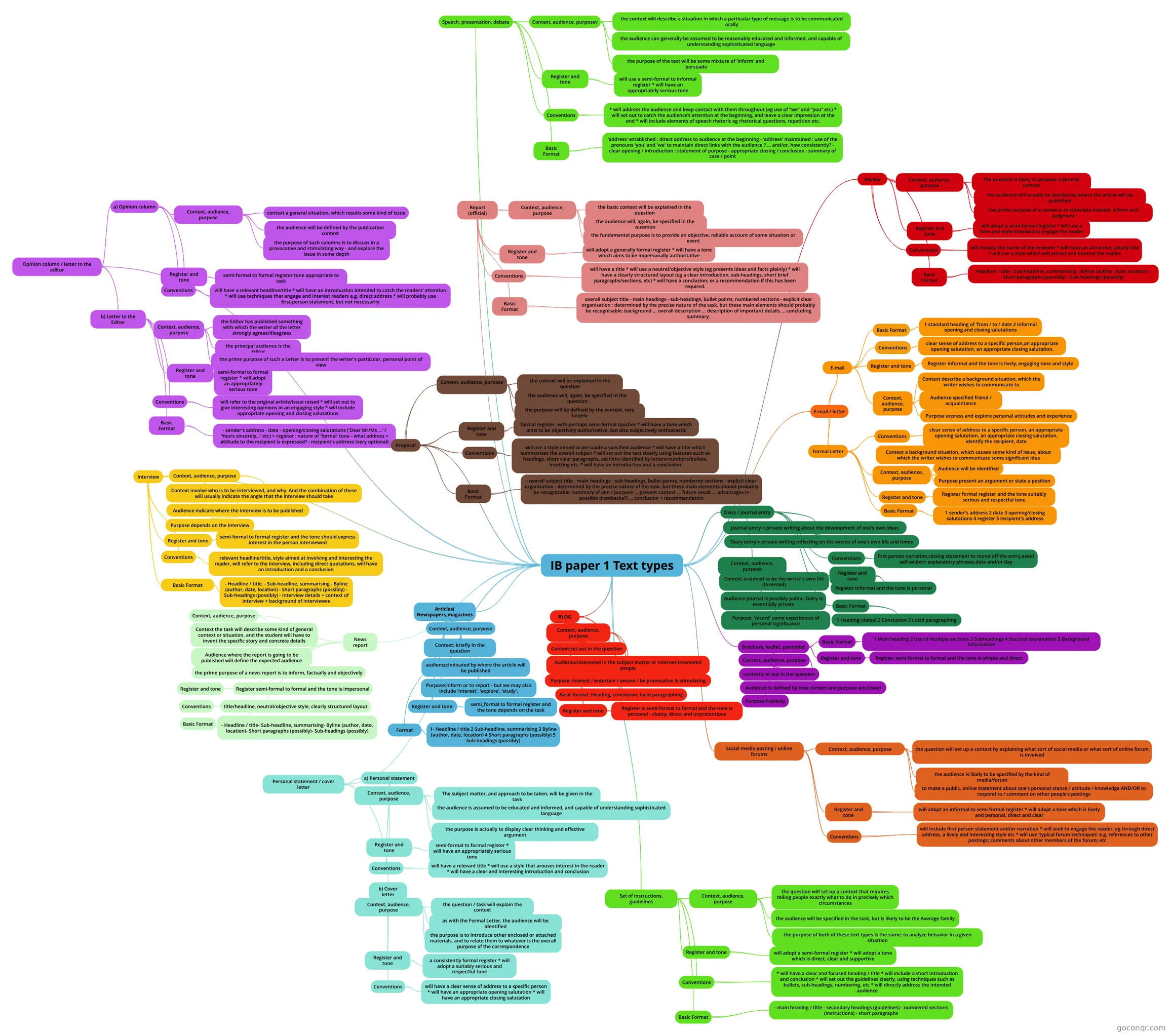
Mind map: IB paper 1 text types
Conteúdo do mapa
IB paper 1 Text types
Articles( Newspapers,magazines
- Context, audience, purpose
- Context: briefly in the question
- audience:Indicated by where the article will be published
- Purpose:inform or to report - but we may also include 'interest', 'explore', 'study'.
- Register and tone:
- semi_formal to formal register and the tone depends on the task
- Format
- 1- Headline / title 2 Sub-headline, summarising 3 Byline (author, date, location) 4 Short paragraphs (possibly) 5 Sub-headings (possibly)
- Context, audience, purpose
BLOG
- Context, audience, purpose
- Context:set out in the question
- Audience:interested in the subject matter or internet-interested people
- Purpose: interest / entertain / amuse / be provocative & stimulating
- Register and tone
- Register is semi-formal to formal and the tone is personal - chatty, direct and unpretentious
- Basic format: Heading, conclusion, lucid paragraphing
- Context, audience, purpose
Brochure, leaflet, pamphlet
- Context, audience, purpose
- contexts: et out in the question
- Audience Is defined by how context and purpose are linked
- Purpose:Publicity
- Register and tone
- Register semi-formal to formal and the tone is simple and direct
- Basic Format
- 1 Main heading 2 Use of multiple sections 3 Subheadings 4 Succinct explanation 5 Background information
- Context, audience, purpose
Diary / journal entry
- Journal entry = private writing about the development of one's own ideas
- Diary entry = private writing reflecting on the events of one's own life and times
- Context, audience, purpose
- Context assumed to be the writer's own life (Invented)
- Audience Journal is possibly public. Dairy is essentially private
- Purpose: 'record' some experiences of personal significance
- Register and tone
- Register Informal and the tone is personal
- Basic Format
- 1 Heading (dates) 2 Conclusion 3 Lucid paragraphing
- Conventions
- first person narration,closing statement to round off the entry,avoid self-evident explanatory phrases,date and/or day
- Journal entry = private writing about the development of one's own ideas
E-mail / letter
- E-mail
- Context, audience, purpose
- Context describe a background situation, which the writer wishes to communicate to
- Audience specified friend / acquaintance
- Purpose express and explore personal attitudes and experience
- Register and tone
- Register informal and the tone is lively, engaging tone and style
- Conventions
- clear sense of address to a specific person,an appropriate opening salutation, an appropriate closing salutation.
- Basic Format
- 1 standard heading of 'from / to / date 2 informal opening and closing salutations
- Context, audience, purpose
- Formal Letter
- Context, audience, purpose
- Context a background situation, which causes some kind of issue, about which the writer wishes to communicate some significant idea
- Audience will be identified
- Purpose present an argument or state a position
- Register and tone
- Register formal register and the tone suitably serious and respectful tone
- Conventions
- clear sense of address to a specific person, an appropriate opening salutation, an appropriate closing salutation, identify the recipient, date
- Basic Format
- 1 sender's address 2 date 3 opening/closing salutations 4 register 5 recipient's address
- Context, audience, purpose
- E-mail
Interview
- Context, audience, purpose
- Context involve who is to be interviewed, and why. And the combination of these will usually indicate the angle that the interview should take
- Audience indicate where the interview is to be published
- Purpose depends on the interview
- Register and tone
- semi-formal to formal register and the tone should express interest in the person interviewed
- Conventions
- relevant headline/title, style aimed at involving and interesting the reader, will refer to the interview, including direct quotations, will have an introduction and a conclusion
- Basic Format
- - Headline / title. - Sub-headline, summarising - Byline (author, date, location) - Short paragraphs (possibly) - Sub-headings (possibly) - Interview details + context of interview + background of interviewee
- Context, audience, purpose
News report
- Context, audience, purpose
- Context the task will describe some kind of general context or situation, and the student will have to invent the specific story and concrete details
- Audience where the report is going to be published will define the expected audience
- the prime purpose of a news report is to inform, factually and objectively
- Register and tone
- Register semi-formal to formal and the tone is impersonal
- Conventions
- title/headline, neutral/objective style, clearly structured layout
- Basic Format
- - Headline / title- Sub-headline, summarising- Byline (author, date, location)- Short paragraphs (possibly)- Sub-headings (possibly)
- Context, audience, purpose
Opinion column / letter to the editor
- a) Opinion column
- Context, audience, purpose
- context a general situation, which results some kind of issue
- the audience will be defined by the publication context
- the purpose of such columns is to discuss in a provocative and stimulating way - and explore the issue in some depth
- Register and tone
- semi-formal to formal register tone appropriate to task
- Conventions
- will have a relevant headline/title * will have an introduction intended to catch the readers’ attention * will use techniques that engage and interest readers e.g. direct address * will probably use first-person statement, but not necessarily
- Context, audience, purpose
- b) Letter to the Editor
- Context, audience, purpose
- the Editor has published something with which the writer of the letter strongly agrees/disagrees
- the principal audience is the Editor
- the prime purpose of such a Letter is to present the writer's particular, personal point of view
- Register and tone
- semi-formal to formal register * will adopt an appropriately serious tone
- Conventions
- will refer to the original article/issue raised * will set out to give interesting opinions in an engaging style * will include appropriate opening and closing salutations
- Basic Format
- - sender's address - date - opening/closing salutations ('Dear Mr/Ms ...' / 'Yours sincerely...' etc) > register : nature of 'formal' tone - what address + attitude to the recipient is expressed? - recipient's address (very optional)
- Context, audience, purpose
- a) Opinion column
Personal statement / cover letter
- a) Personal statement
- Context, audience, purpose
- The subject matter, and approach to be taken, will be given in the task
- the audience is assumed to be educated and informed, and capable of understanding sophisticated language
- the purpose is actually to display clear thinking and effective argument
- Register and tone
- semi-formal to formal register * will have an appropriately serious tone
- Conventions
- will have a relevant title * will use a style that arouses interest in the reader * will have a clear and interesting introduction and conclusion
- Context, audience, purpose
- b) Cover letter
- Context, audience, purpose
- the question / task will explain the context
- as with the Formal Letter, the audience will be identified
- the purpose is to introduce other enclosed or attached materials, and to relate them to whatever is the overall purpose of the correspondence
- Register and tone
- a consistently formal register * will adopt a suitably serious and respectful tone
- Conventions
- will have a clear sense of address to a specific person * will have an appropriate opening salutation * will have an appropriate closing salutation
- Context, audience, purpose
- a) Personal statement
Proposal
- Context, audience, purpose -
- the context will be explained in the question
- the audience will, again, be specified in the question
- the purpose will be defined by the context, very largely
- Register and tone
- formal register, with perhaps semi-formal touches * will have a tone which aims to be objectively authoritative, but also subjectively enthusiastic
- Conventions
- will use a style aimed to persuade a specified audience * will have a title which summarises the overall subject * will set out the text clearly using features such as headings, short clear paragraphs, sections identified by letters/numbers/bullets, insetting etc. * will have an introduction and a conclusion
- Basic Format
- - overall subject title - main headings - sub-headings, bullet points, numbered sections - explicit clear organization : determined by the precise nature of the task, but these main elements should probably be recognizable: summary of aim / purpose ... present context ... future result ... advantages (+ possible drawbacks?) ... conclusion + recommendation
- Context, audience, purpose -
Report (official)
- Context, audience, purpose
- the basic context will be explained in the question
- the audience will, again, be specified in the question
- the fundamental purpose is to provide an objective, reliable account of some situation or event
- Register and tone
- will adopt a generally formal register * will have a tone which aims to be impersonally authoritative
- Conventions
- will have a title * will use a neutral/objective style (eg presents ideas and facts plainly) * will have a clearly structured layout (eg a clear introduction, sub-headings, short brief paragraphs/sections, etc) * will have a conclusion; or a recommendation if this has been required.
- Basic Format
- overall subject title - main headings - sub-headings, bullet points, numbered sections - explicit clear organisation : determined by the precise nature of the task, but these main elements should probably be recognisable: background … overall description … description of important details … concluding summary.
- Context, audience, purpose
Review
- Context, audience, purpose
- the question is likely to propose a general context
- the audience will usually be decided by where the article will be published
- the prime purpose of a review is to stimulate interest, inform and judgment
- Register and tone
- will adopt a semi-formal register * will use a tone and style intended to engage the reader
- Conventions
- will include the name of the reviewer * will have an attractive, catchy title * will use a style which will attract and interest the reader
- Basic Format
- Headline / title - Sub-headline, summarising - Byline (author, date, location) - Short paragraphs (possibly) - Sub-headings (possibly)
- Context, audience, purpose
Set of instructions, guidelines
- Context, audience, purpose
- the question will set up a context that requires telling people exactly what to do in precisely which circumstances
- the audience will be specified in the task, but is likely to be the Average family
- the purpose of both of these text types is the same: to analyze behavior in a given situation
- Register and tone
- will adopt a semi-formal register * will adopt a tone which is direct, clear and supportive
- Conventions
- * will have a clear and focused heading / title * will include a short introduction and conclusion * will set out the guidelines clearly, using techniques such as bullets, sub-headings, numbering, etc * will directly address the intended audience
- Basic Format
- - main heading / title - secondary headings (guidelines) - numbered sections (instructions) - short paragraphs
- Context, audience, purpose
Social media posting / online forums
- Context, audience, purpose
- the question will set up a context by explaining what sort of social media or what sort of online forum is involved
- the audience is likely to be specified by the kind of media/forum
- to make a public, online statement about one's personal stance / attitude / knowledge AND/OR to respond to / comment on other people's postings
- Register and tone
- will adopt an informal to semi-formal register * will adopt a tone which is lively and personal, direct and clear
- Conventions
- will include first person statement and/or narration * will seek to engage the reader, eg through direct address, a lively and interesting style etc * will use 'typical forum techniques' e.g. references to other postings; comments about other members of the forum; etc
- Context, audience, purpose
Speech, presentation, debate
- Context, audience, purposev
- the context will describe a situation in which a particular type of message is to be communicated orally
- the audience can generally be assumed to be reasonably educated and informed, and capable of understanding sophisticated language
- the purpose of the text will be some mixture of 'inform' and 'persuade
- Register and tone
- will use a semi-formal to informal register * will have an appropriately serious tone
- Conventions
- * will address the audience and keep contact with them throughout (eg use of “we” and “you” etc) * will set out to catch the audience’s attention at the beginning, and leave a clear impression at the end * will include elements of speech rhetoric eg rhetorical questions, repetition etc.
- Basic Format
- 'address' established : direct address to audience at the beginning - 'address' maintained : use of the pronouns 'you' and 'we' to maintain direct links with the audience ? … and/or, how consistently? - clear opening / introduction : statement of purpose - appropriate closing / conclusion : summary of case / point
- Context, audience, purposev
Informações
- Descrição
- Mapa Mental sobre IB paper 1 Text types, criado por Tomas Turres em 18-03-2020.
- Criado por
- Tomas Turres
- Visualizações
- 7
- Avaliação