
Mapa mental
Physics Unit 1
Conteúdo do mapa
Physics Unit 1
Section 1: Particles and Radiation
- Atomic Structure
- Protons have a mass of 1.67 x 10⁻²⁷
- Protons have a charge of +1.6 x 10⁻¹⁹
- Neutrons have a charge of 0
- Neutrons have a mass of 1.67 x 10⁻²⁷
- Electron has a mass of 9.11 x 10⁻³¹
- Electron has a charge of -1.6 x 10⁻¹⁹
- Specific Charge = charge/mass
- Isotopes are atoms with the same number of protons and different number of neurtons
- Stable and Unstable Nuclei
- Strong nuclear force
- Holds the nucleus together
- <0.5fm: High Repulsive
- 0.5fm - 3fm: High Attraction, High Repulsive Electromagnetic force
- >3fm: Low Repulsive Electromagnetic force, Low Attractive
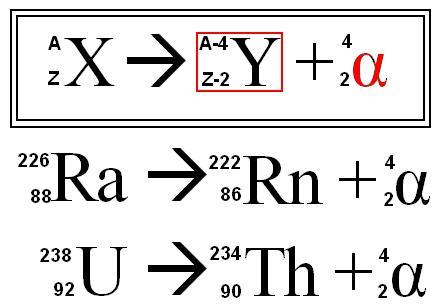
- Alpha Decay
- 4 2 helium nuclei
- Nuclion number -4
- Proton Number -2
- Beta Decay
- Stray electron
- Anti-neutrino
- Nucion Number stays the same
- Proton number +1
- Strong nuclear force
- AntiParticles and Photons
- Photons
- EM (Electromagnetic) waves can only exist in wave-packets "Photons"
- E = hf
- E = hc/wavelength
- h = Plank's constant (6.63 x 10⁻³⁴)
- Antiparticles
- Example: electron and positron
- Same mass
- Opposite charge
- Photons
- Pair Production
- When energy is converted into mass
- Only can happen when there is enough enegy to produce the mass needed
- Makes the same amounts of particles and antiparticles
- Annihilation
- When a particle meets its antiparticle
- All of the mass become Gamma Photon energy
- Classification of particles
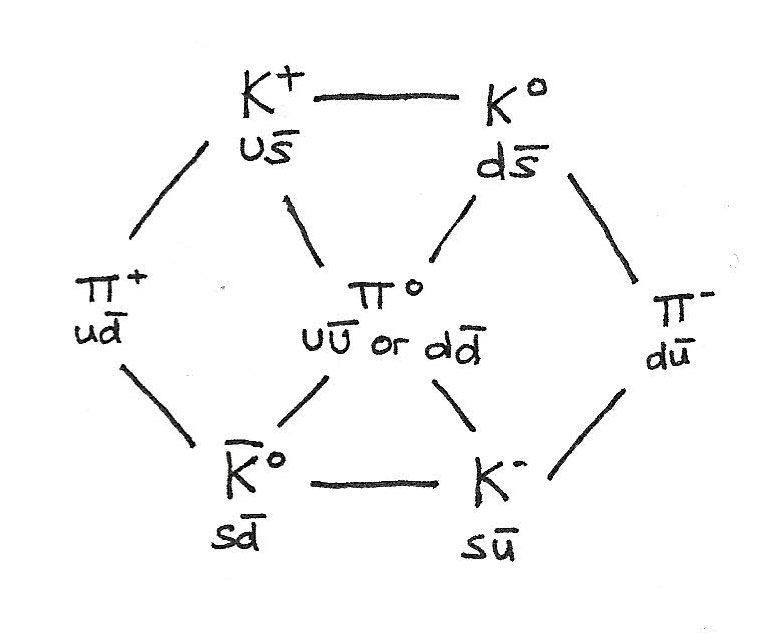
- Hadrons
- Baryons
- Nucleons p,n, sigma, others
- Mesons
- Pions, Kaons, others
- Baryons
- Leptons
- Electrons
- Hadrons
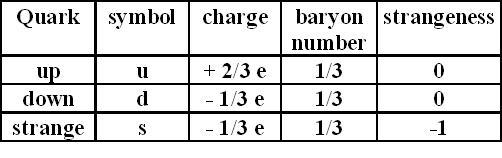
- Quarks and antiquarks
- Protons: uud
- Nutrons: udd
- Quark Confinement
- A Proton
- Energy is supplied to remove u quark
- When enough energy is suppied the u quark pari produces and the u quark stays in the proton
- Energy is supplied to remove u quark
- A Proton
- Conservation of properties
- Charge
- Any particle reaction
- Baryon and lepton numbers
- Any particle reaction
- Strangness
- Only strong interactions
- Charge
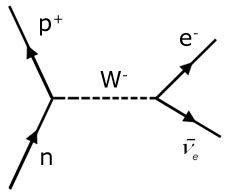
- Feynaman Diagrams
- Beta - Minus
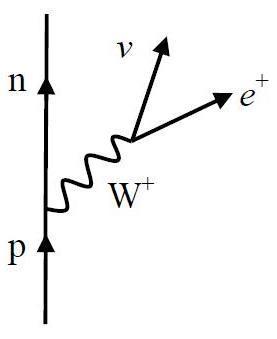
- Beta - Plus
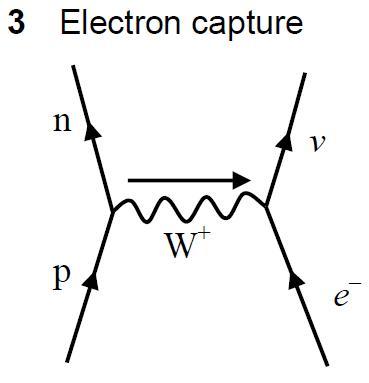
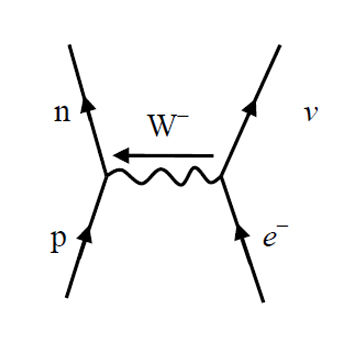
- Electron Capture
- Electron - proton collisions
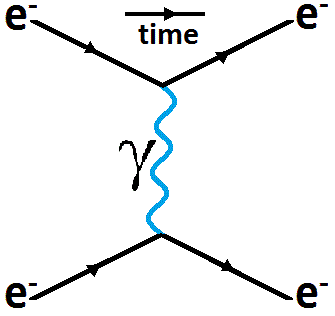
- Electromagnetic Repulsion
- Atomic Structure
Section 2: Electromagnetic Radiation and Quantum Phenomena
- The Photoelectric effect
- If enough energy is absorbed by a metal the free electrons will be emitted
- 4 Conclusions
- No electrons emitted underthreshold frequency
- The maximum kinetic energy increases with the frequency of the radiation
- The maximum kinetic energy is unaffected by the intensity of the radiation
- The number of electrons emitted per second is proportional to the intensity of the radiation
- E = hf = hc/wavelength
- E= energy in 1 wave-packet
- h= planks constant = 6.63x10⁻³⁴
- c = speed of light 3x10⁸
- Work Function: the energy needed to break the bonds holding the electron
- Threshold frequency = workfunction/h
- Maximum Kinetic energy
- hf = workfunction + Ek
- hf = work function + 1/2mv^2
- Energy levels in atoms
- 1 eV = 1.6x10⁻¹⁹ J
- electrons can ony exist in defined levels
- n = 1 is ground state
- Electrons can only move states by emitting a photon
- The energy of these photons can only take a certain value
- electrons can move up levels if they absorb a photon
- movment of an electron to a higher level is called excitation
- ^E = E1 - E2 = hf = hc/wavelength
- the transmission of an electron from n1 to n2
- ^E = E1 - E2 = hf = hc/wavelength
- movment of an electron to a higher level is called excitation
- ionisation energy is the energy needed to remove an electron fromground state
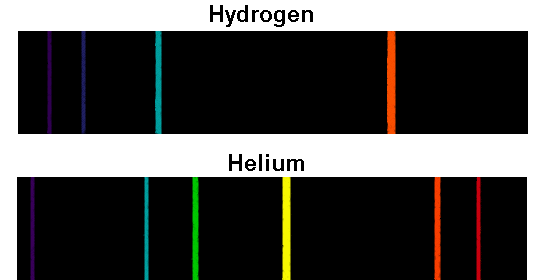
- Line emission spectra
- split the light from a fluoresent tube
- get different colours on a black background
- shows that electrons exsist in discrete energy levels
- get different colours on a black background
- split the light from a fluoresent tube
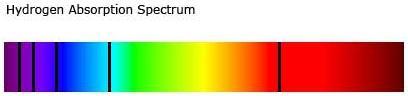
- Line absorbtion spectra
- split white light you see all the colours
- all of the electrons are on ground level
- split white light you see all the colours
- Wave-particle duality
- Light a wave or a particle
- Diffraction
- if it was a particle it wouldnt diffract
- photoelectric effect
- photons are light with particle properties
- its both known as the wave-particle duality
- Diffraction
- de broglie wavelength = h/mv
- Electron diffraction
- shows electrons have wave properties
- when the velocity of the electrons is greater the wavelength is smaller
- Electron microscopes
- the greater the diffraction the more blury the image is
- smaller wavelength less blur
- electrons need to be as fast as possible
- Light a wave or a particle
- The Photoelectric effect
Section 3: Current Electricity
- Current and potential difference
- Current
- Rate of flow of charge
- P.D
- the work done to move a unit of charge
- Q = IT
- V = W/Q
- 1 V = 1 JC^-1
- V = W/Q
- Current
- Resistance
- how hard it is for current to flow through a component
- R = V/I
- Ohmic conductors
- Current is directly proportional to potential difference if the temperature is constant
- how hard it is for current to flow through a component
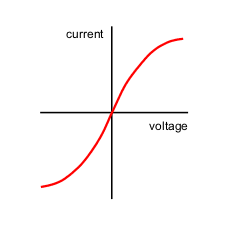
- I-V characteristics
- Filament lamps
- when you swith it on and its cold = less resistnce = more current so could blow
- goes from cold to hot very quickly so could blow
- when you swith it on and its cold = less resistnce = more current so could blow
- finding I-V characteristics
- Use a variable resistor to to increase or decrease the resistance in equal stepd
- for each resistance take a reading from the ammeter and voltmeter
- revserse the flow by switching the wires on the power pack to get negative readings
- for each resistance take a reading from the ammeter and voltmeter
- Use a variable resistor to to increase or decrease the resistance in equal stepd
- Semiconductors
- Thermistors
- as temperature goes up then resistnace goes up
- Diodes
- only allows current to flow in one direction
- LDR
- as light increases so does resistence
- Thermistors
- Filament lamps
- Resistivity and superconductors
- Resistivity
- resistance of in 1m of wire with 1m^2 cross sectional area
- p = RA/L
- resistance of in 1m of wire with 1m^2 cross sectional area
- Superconductors
- if you cool some metals under the "transition temperature" then resistance disappears compeletly
- Uses
- power calbes
- strong electromagnets
- really fast circiuts
- Uses
- if you cool some metals under the "transition temperature" then resistance disappears compeletly
- Resistivity
- Power and electrical energy
- Power
- P = E/t
- P = VI
- P = V^2/I
- P = I^2R
- P = V^2/I
- P = VI
- P = E/t
- Energy
- E = VIt
- E = V^2/R t
- E = I^2Rt
- E = V^2/R t
- E = VIt
- Power
- E.M.F and Internal resistance
- Internal resistnce causes loss of energy inside the battery
- EMF: the amount of electrical energy the battery produces and transfers to each coulmb of charge
- emf = E/Q
- emf = I(R+r)
- To get internal resistance from a graph make the equation V = -rI +emf draw a graph and -r is the graditet and emf is the y-intercept
- emf = E/Q
- EMF: the amount of electrical energy the battery produces and transfers to each coulmb of charge
- Internal resistnce causes loss of energy inside the battery
- Conservation of charge in circuits
- Parallel
- emf = V1+ V1 + V1
- I = I1+ I2 + I3
- 1/R = 1/R1+ 1/R2
- I = I1+ I2 + I3
- emf = V1+ V1 + V1
- Series
- emf = V1+V2+ v3
- I1= I2 = I3
- R = R1 + R2 + R3
- I1= I2 = I3
- emf = V1+V2+ v3
- Parallel
- The potential divider
- Vout = (R2/R1+R2)Vs
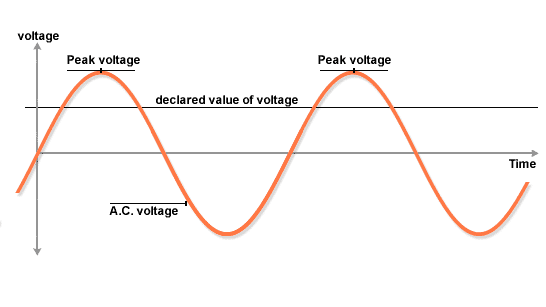
- Alternating Current
- f = 1/t
- RMS (Root Mean Square)
- Vrms = V0/square root of 2
- Irms = I0/square root of 2
- Power = Irms x Vrms
- Resistance = Vrms/Irms = V0/I0
- I0 = peak current
- Current and potential difference
Imagens e arquivos do mapa

Informações
- Descrição
- AS Physics Mapa Mental sobre Physics Unit 1, criado por Connor Sammonds em 24-03-2015.
- Criado por
- Connor Sammonds
- Visualizações
- 6
- Avaliação