
Mapa mental
Chemistry C3
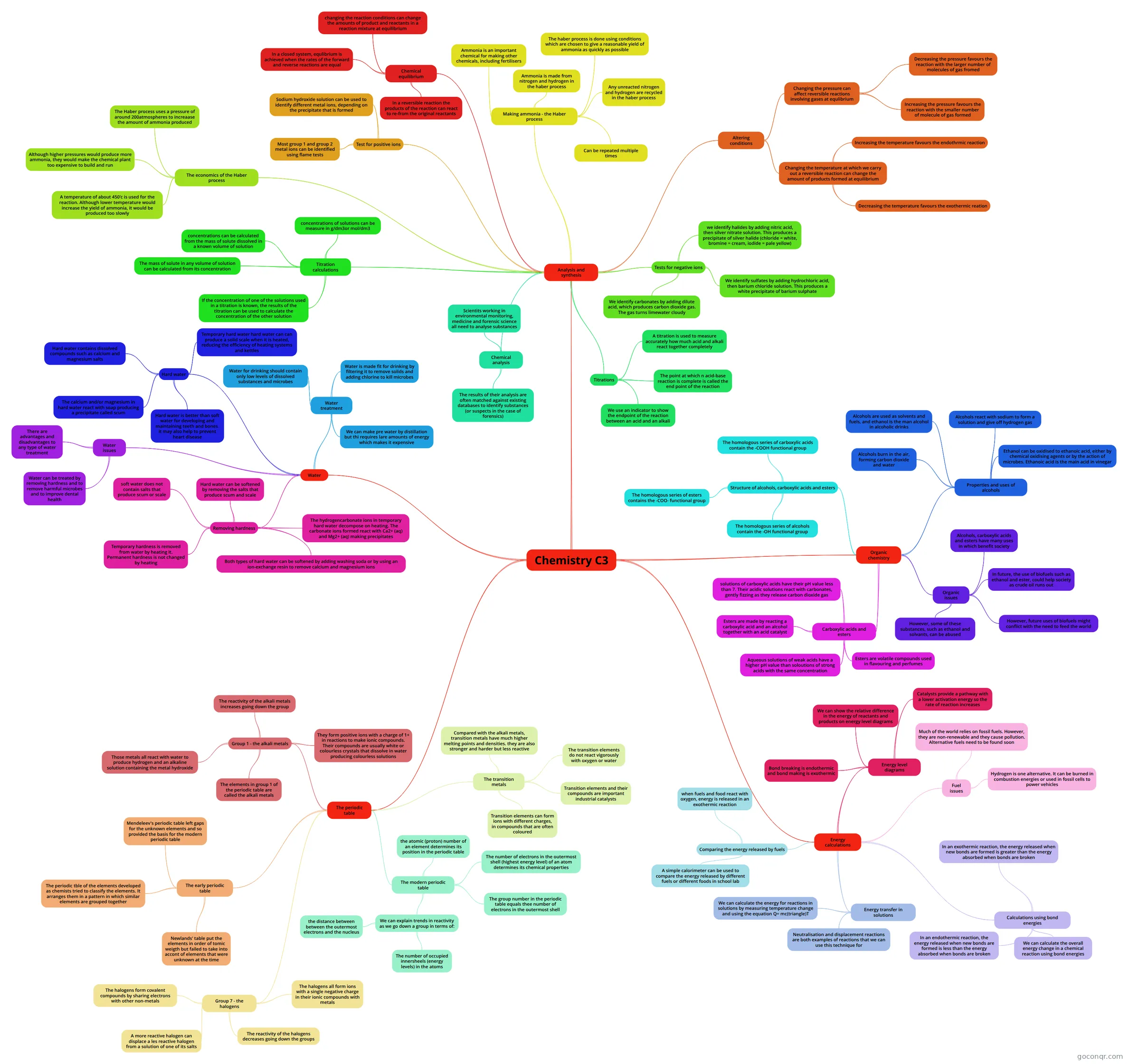
Mind map: Chemistry
Conteúdo do mapa
Chemistry C3
Analysis and synthesis
- Test for positive ions
- Most group 1 and group 2 metal ions can be identified using flame tests
- Sodium hydroxide solution can be used to identify different metal ions, depending on the precipitate that is formed
- Tests for negative ions
- We identify carbonates by adding dilute acid, which produces carbon dioxide gas. The gas turns limewater cloudy
- we identify halides by adding nitric acid, then silver nitrate solution. This produces a precipitate of silver halide (chloride = white, bromine = cream, iodide = pale yellow)
- We identify sulfates by adding hydrochloric acid, then barium chloride solution. This produces a white precipitate of barium sulphate
- Titrations
- A titration is used to measure accurately how much acid and alkali react together completely
- The point at which n acid-base reaction is complete is called the end point of the reaction
- We use an indicator to show the endpoint of the reaction between an acid and an alkali
- Titration calculations
- concentrations of solutions can be measure in g/dm3or mol/dm3
- concentrations can be calculated from the mass of solute dissolved in a known volume of solution
- The mass of solute in any volume of solution can be calculated from its concentration
- If the concentration of one of the solutions used in a titration is known, the results of the titration can be used to calculate the concentration of the other solution
- Chemical analysis
- Scientits working in environmental monitoring, medicine and forensic science all need to analyse substances
- The results of their analysis are often matched against existing databases to identify substances (or suspects in the case of forensics)
- Chemical equilibrium
- In a reversible reaction the products of the reaction can react to re-from the original reactants
- In a closed system, equlibrium is achieved when the rates of the forward and reverse reactions are equal
- changing the reaction conditions can change the amounts of product and reactants in a reaction mixture at equilibrium
- Altering conditions
- Changing the pressure can affect reversible reactions involving gases at equlibrium
- Increasing the pressure favours the reaction with the smaller number of molecule of gas formed
- Decreasing the pressure favours the reaction with the larger number of molecules of gas fromed
- Changing the temperature at which we carry out a reversible reaction can change the amount of products formed at equilibrium
- Increasing the temperature favours the endothrmic reaction
- Decreasing the temperature favours the exothermic reation
- Changing the pressure can affect reversible reactions involving gases at equlibrium
- Making ammonia - the Haber process
- Ammonia is an important chemical for making other chemicals, including fertilisers
- Ammonia is made from nitrogen and hydrogen in the haber process
- The haber process is done using conditions which are chosen to give a reasonable yield of ammonia as quickly as possible
- Any unreacted nitrogen and hydrogen are recycled in the haber process
- Can be repeated multiple times
- The economics of the Haber process
- The Haber process uses a pressure of around 200atmospheres to increaase the amount of ammonia produced
- Although higher pressures would produce more ammonia, they would make the chemical plant too expensive to build and run
- A temperature of about 450'c is used for the reaction. Although lower temperature would increase the yield of ammonia, it would be produced too slowly
- Test for positive ions
Water
- Hard water
- Hard water contains dissolved compounds such as calcium and magnesium salts
- The calcium and/or magnesium in hard water react with soap producing a precipitate called scum
- Temporary hard water hard water can can produce a solid scale when it is heated, reducing the efficiency of heating systems and kettles
- Hard water is better than soft water for developing and maintaining teeth and bones. it may also help to prevent heart disease
- Removing hardness
- soft water does not contain salts that produce scum or scale
- Hard water can be softened by removing the salts that produce scum and scale
- Temporary hardness is removed from water by heating it. Permanent hardness is not changed by heating
- The hydrogencarbonate ions in temporary hard water decompose on heating. The carbonate ions formed react with Ca2+ (aq) and Mg2+ (aq) making precipitates
- Both types of hard water can be softened by adding washing soda or by using an ion-exchange resin to remove calcium and magnesium ions
- Water treatment
- Water for drinking should contain only low levels of dissolved substances and microbes
- Water is made fit for drinking by filtering it to remove solids and adding chlorine to kill microbes
- We can make pre water by distillation but thi requires lare amounts of energy which makes it expensive
- Water issues
- There are advantages and disadvantages to any type of water treatment
- Water can be treated by removing hardness and to remove harmful microbes and to improve dental health
- Hard water
Organic chemistry
- Structure of alcohols, carboxylic acids and esters
- The homologous series of alcohols contain the -OH functional group
- The homologous series of carboxylic acids contain the -COOH functional group
- The homologous series of esters contains the -COO- functional group
- Properties and uses of alcohols
- Alcohols are used as solvents and fuels, and ethanol is the man alcohol in alcoholic drinks
- Alcohols burn in the air, forming carbon dioxide and water
- Alcohols react with sodium to form a solution and give off hydrogen gas
- Ethanol can be oxidised to ethanoic acid, either by chemical oxidising agents or by the action of microbes. Ethanoic acid is the main acid in vinegar
- Carboxylic acids and esters
- solutions of carboxylic acids have their pH value less than 7. Their acidic solutions react with carbonates, gently fizzing as they release carbon dioxide gas
- Aqueous solutions of weak acids have a higher pH value than soloutions of strong acids with the same concentration
- Esters are made by reacting a carboxylic acid and an alcohol together with an acid catalyst
- Esters are volatile compounds used in flavouring and perfumes
- Organic issues
- Alcohols, carboxylic acids and esters have many uses in which benefit society
- However, some of these substances, such as ethanol and solvants, can be abused
- In future, the use of biofuels such as ethanol and ester, could help society as crude oil runs out
- However, future uses of biofuels might conflict with the need to feed the world
- Structure of alcohols, carboxylic acids and esters
The periodic table
- The early periodic table
- The periodic tble of the elements developed as chemists tried to classify the elements. It arranges them in a pattern in which similar elements are grouped together
- Newlands' table put the elements in order of tomic weigth but failed to take into accont of elements that were unknown at the time
- Mendeleev's periodic table left gaps for the unknown elements and so provided the basis for the modern periodic table
- The modern periodic table
- the atomic (proton) number of an element determines its position in the periodic table
- The number of electrons in the outermost shell (highest energy level) of an atom determines its chemical properties
- The group number in the periodic table equals thee number of electrons in the outermost shell
- We can explain trends in reactivity as we go down a group in terms of:
- the distance between between the outermost electrons and the nucleus
- The number of occupied innersheels (energy levels) in the atoms
- Group 1 - the alkali metals
- The elements in group 1 of the periodic table are called the alkali metals
- Those metals all react with water to produce hydrogen and an alkaline solution containing the metal hydroxide
- They form positive ions with a charge of 1+ in reactions to make ionic compounds. Their compounds are usually white or colourless crystals that dissolve in water producing colourless solutions
- The reactivity of the alkali metals increases going down the group
- The transition metals
- Compared with the alkali metals, transition metals have much higher melting points and densities. they are also stronger and harder but less reactive
- The transition elements do not react vigorously with oxygen or water
- Transition elements can form ions with different charges, in compounds that are often coloured
- Transition elements and their compounds are important industrial catalysts
- Group 7 - the halogens
- The halogens all form ions with a single negative charge in their ionic compounds with metals
- The halogens form covalent compounds by sharing electrons with other non-metals
- A more reactive halogen can displace a les reactive halogen from a solution of one of its salts
- The reactivity of the halogens decreases going down the groups
- The early periodic table
Energy calculations
- Comparing the energy released by fuels
- when fuels and food react with oxygen, energy is released in an exothermic reaction
- A simple calorimeter can be used to compare the energy released by different fuels or different foods in school lab
- Energy transfer in solutions
- We can calculate the energy for reactions in solutions by measuring temperature change and using the equation Q= mc(triangle)T
- Neutralisation and displacement reactions are both examples of reactions that we can use this technique for
- Energy level diagrams
- We can show the relative difference in the energy of reactants and products on energy level diagrams
- Catalysts provide a pathway with a lower activation energy so the rate of reaction increases
- Bond breaking is endothermic and bond making is exothermic
- Calculations using bond energies
- In an exothermic reaction, the energy released when new bonds are formed is greater than the energy absorbed when bonds are broken
- In an endothermic reaction, the energy released when new bonds are formed is less than the energy absorbed when bonds are broken
- We can calculate the overall energy change in a chemical reaction using bond energies
- Fuel issues
- Much of the world relies on fossil fuels. However, they are non-renewable and they cause pollution. Alternative fuels need to be found soon
- Hydrogen is one alternative. It can be burned in combustion energies or used in fossil cells to power vehicles
- Comparing the energy released by fuels
Informações
- Descrição
- Chemistry (Chemistry in Society) Mapa Mental sobre Chemistry C3, criado por Ben_Low em 09-04-2015.
- Criado por
- Ben_Low
- Visualizações
- 1
- Histórico
-
- Criado por annabel.jennings · 9 abr 2015
- Copiado por Ben_Low · 9 abr 2015
- Avaliação