
Chemical Analysis and Tests
142 resources created by 119 users
This Chemical Analysis and Tests page on GoConqr gathers community-made mind maps, quizzes, flashcards and notes, from flame tests and anion tests to chromatography, mass spectrometry and HPLC. It's built for school students revising a topic, and for teachers after ready-made material. There are over 1,000 resources here, including more than 40 quizzes, over 500 mind maps and more than 300 flashcards, mostly at secondary level with some university-level material. Pick a topic, try a quiz to find your gaps, then make your own revision sets.
Top Chemical Analysis and Tests resources
-
Mind map HPLC
-
23 cardsTopic 8 - Chemical analysis What is a pure substance?
-
Mind map Chemical tests A mindmap consisting of inorganic chemical tests including the flame test, Halogen and halide tests and S-b...
-
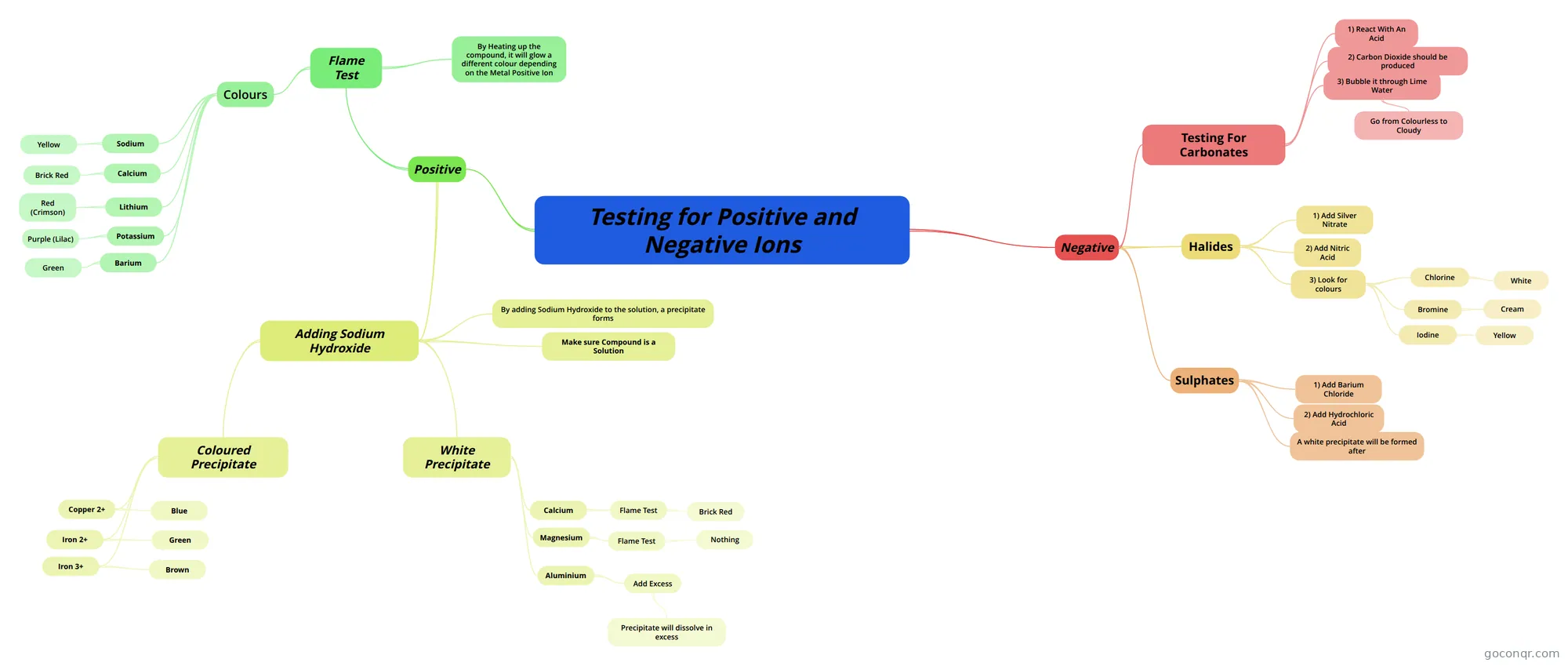 Mind map Testing for Positive and Negative Ions How you can test to see what different Negative and Positive Ions are in a substence
-
55 cardsAnalytical Techniques What are the main uses for analytical techniques?
-
19 questionsIdentification of Ions & Gases Quiz The results of two tests on solid X are shown. What is X?
-
22 cardsQualitative Analysis: Tests for cations and anions aq.NaOH: Dirty green ppt, insoluble in excess, turned reddish brown on standing in air.
-
Mind map C8 - Chemical Analysis An overview of the C8 topic, Chemical Analysis, from the AQA Chemistry GCSE course.
Quizzes
See all 17 quizzes-
19 questionsIdentification of Ions & Gases Quiz The results of two tests on solid X are shown. What is X?
-
9 questionsCation, Anion & Flame Tests You acidify an anion in solution with Nitric Acid and then add aqueous Silver Nitrate. The result is a crea...
-
5 questionsAnions test Dilute Hydrochloric acid is added then aqueous Barium Nitrate, a white precipitate forms. Which anion is pr...
-
7 questionsChromatography In liquid chromatography, molecules that interact strongly with the solvent will move quickly through the s...
-
89 questionsChemistry Colour of salts
-
8 questionsObservations and tests What reagent is used to test for sulphate ions in a solution, and what is the positive result?
-
8 questionsChromatography Which of the following statements are true about chromatography? Select all that apply.
-
23 questionsChemical Reactions What is the method of testing that there is starch present? And what is it's positive result?
Mind maps
See all 57 mind maps-
HPLC
-
Chemical tests A mindmap consisting of inorganic chemical tests including the flame test, Halogen and halide tests and S-b...
-
Testing for Positive and Negative Ions How you can test to see what different Negative and Positive Ions are in a substence
-
C8 - Chemical Analysis An overview of the C8 topic, Chemical Analysis, from the AQA Chemistry GCSE course.
-
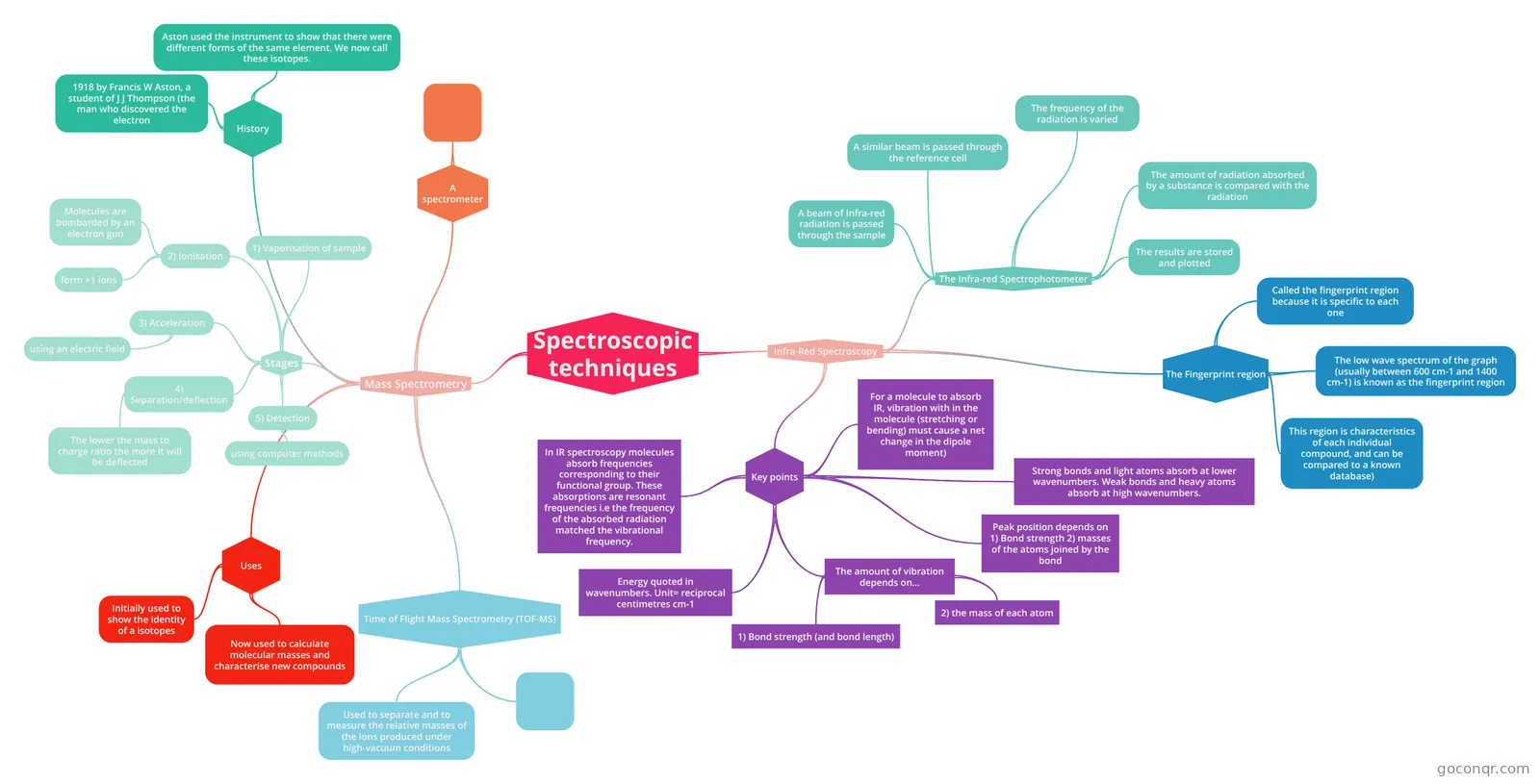 Spectroscopic techniques Pre-U Chemistry UA4- Spectroscopic Techniques
-
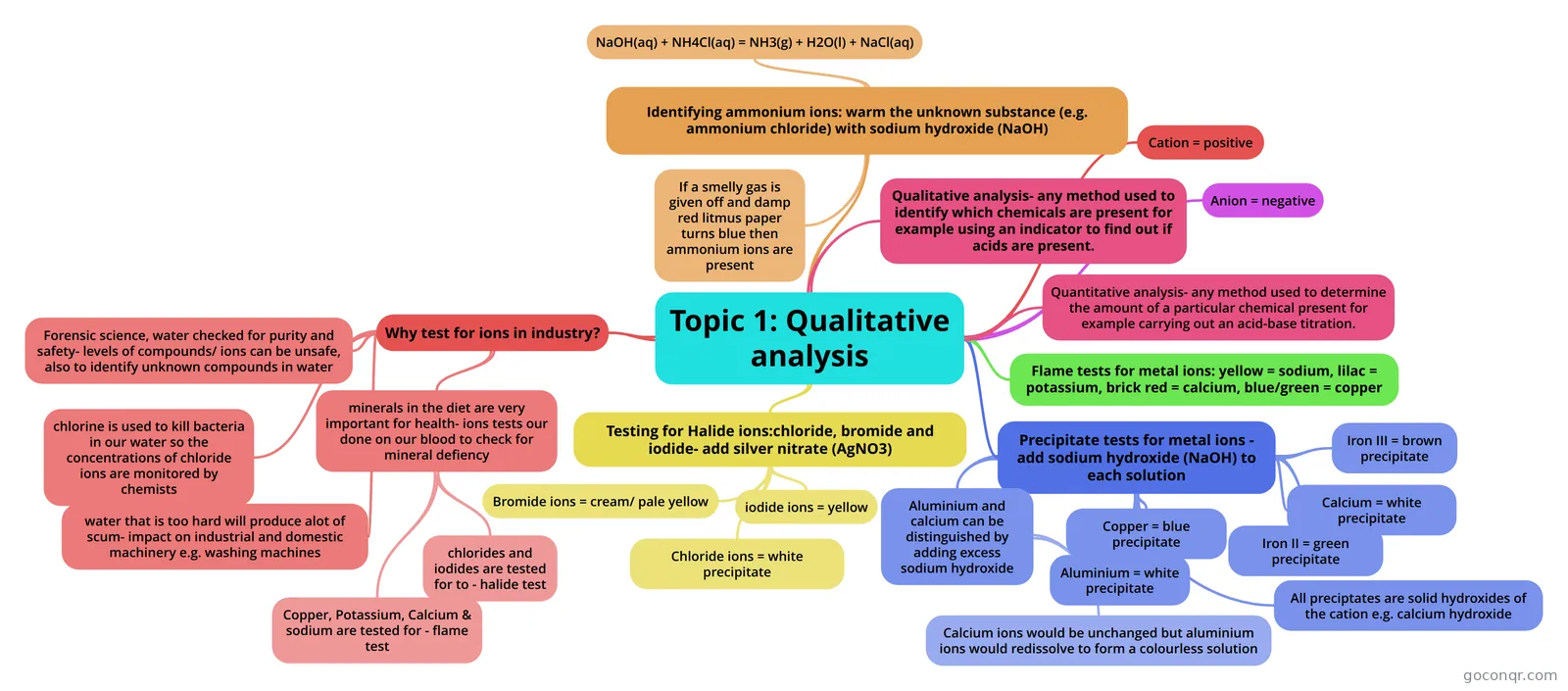 Topic 1: Qualitative analysis
-
Chemical Analysis 1 Chemistry 2
-
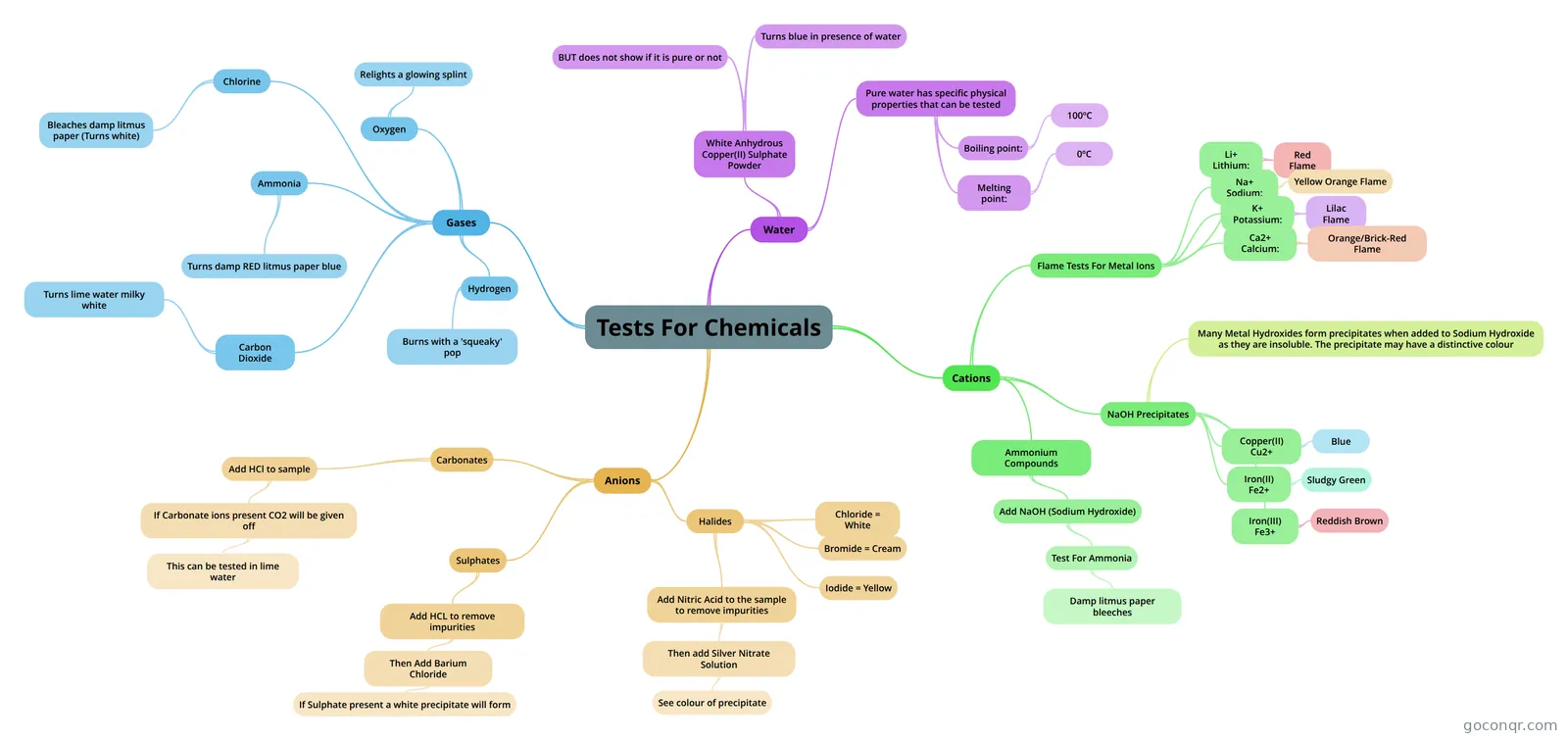 Tests For Chemicals The chemical tests for substances - IGCSE Chemisty.
Flashcards
See all 56 flashcards-
23 cardsTopic 8 - Chemical analysis What is a pure substance?
-
55 cardsAnalytical Techniques What are the main uses for analytical techniques?
-
22 cardsQualitative Analysis: Tests for cations and anions aq.NaOH: Dirty green ppt, insoluble in excess, turned reddish brown on standing in air.
-
18 cardsChemistry- Testing for gases Testing for gases
-
6 cardsFlame Tests Flame Tests What colour does calcium go in a flame test?
-
6 cardsFlame tests Flashcards for flame tests (what metal gives what colour flame)
-
38 cardsTopic 25&26 Qualitive Anaylisis - Triple Paper 2 (edexcel GCSE) Are bases corrosive?
-
26 cardsInstrumental Analysis
Flowcharts
Notes
See all 10 notes-
Unit 1 PPA - Colorimetric Determination of Manganese in Steel Aim - To use colorimetry to find the percentage of manganese, by mass, in a steel paper clip. Method - Colorimetry finds conc.s of coloured substances in solution.Colorimeter consists of light source, coloured f...
-
F324: Module 3 Specification 4.3.1 Chromatography Types of chromatography Paper chromatography can be used to illustrate the separation process. Candidates should be able to: (a) describe chromatography as an analytical technique that separates c...
-
Anylising Substances ubstances can be analysed using a variety of methods including paper chromatography, gas chromatography and mass spectrometry. Methods of AnalysisChemists can use many different methods to analyse substances.Some meth...
-
Tests For Stuff One fine day a scientistDecided to exploreHow to tell each thing apartAnd so flame tests were bornCalcium (that's Ca 2 plus)Turns brick red in a fire.Sodium was tested next;A yellow flame rose higher.Lithium was pink ...
-
Test For Ions You Can Use Chemical Tests to Identify Positive IonsPositive ions (or cations) include things like the ions of the Group 2 metals and ammonium ions. USE THE FLAME TEST TO IDENTIFY GROUP 2 IONSCompounds of some Group 2...
-
Chapter 2 - analysis by mass CHAPTER 2 - ANALYSIS BY MASS analysis based on the determination of mass is called gravimetric analysis substances or mixtures containing a volatile component, such as water, are heated to drive of the volatile materi...
-
Chapter 3 - Volumetric analysis CHAPTER 3 - VOLUMETRIC ANALYSIS volumetric analysis is the amount in mol of the substance being analsyed is determined by: measuring the volume of test solution that reacts completely with a volume of solution with kn...
-
Notes on Evaluative task
Slides
More Chemistry topics
About Chemical Analysis and Tests
GoConqr OriginalWhat the unit covers
This unit sits in the Chemical Analysis strand of Chemistry. Most of it is about identifying substances: ions, gases, water and organic compounds. The resources mention GCSE Chemistry, AQA GCSE Chemistry, IGCSE Chemistry and A-level Chemistry, and a smaller share goes further into instrumental methods.
Start with the ion tests
Begin with the mind map Chemical tests. It sets out flame test colours: yellow for Na+, crimson red for Li+, brick red for Ca2+, lilac for K+ and green or blue for Cu2+. Then open Testing for Positive and Negative Ions, which explains that heating a compound makes it glow a colour that depends on the metal ion.
Next, move to Anion Tests. It covers nitrate, iodide, chloride, carbonate and sulphate, including the sodium hydroxide and aluminium powder test that gives ammonia gas, which turns moist red litmus paper blue. The mind map Testing for ions adds the ammonium ion test.
Use quizzes and maps together
Read a map first, then test yourself. The quiz Anions test asks which anion is present when a white precipitate forms after dilute hydrochloric acid and barium nitrate. Cation, Anion & Flame Tests asks about a cream precipitate with silver nitrate. Check any wrong answers against the map, then retry the quiz.
- Map, then quiz, then flashcards.
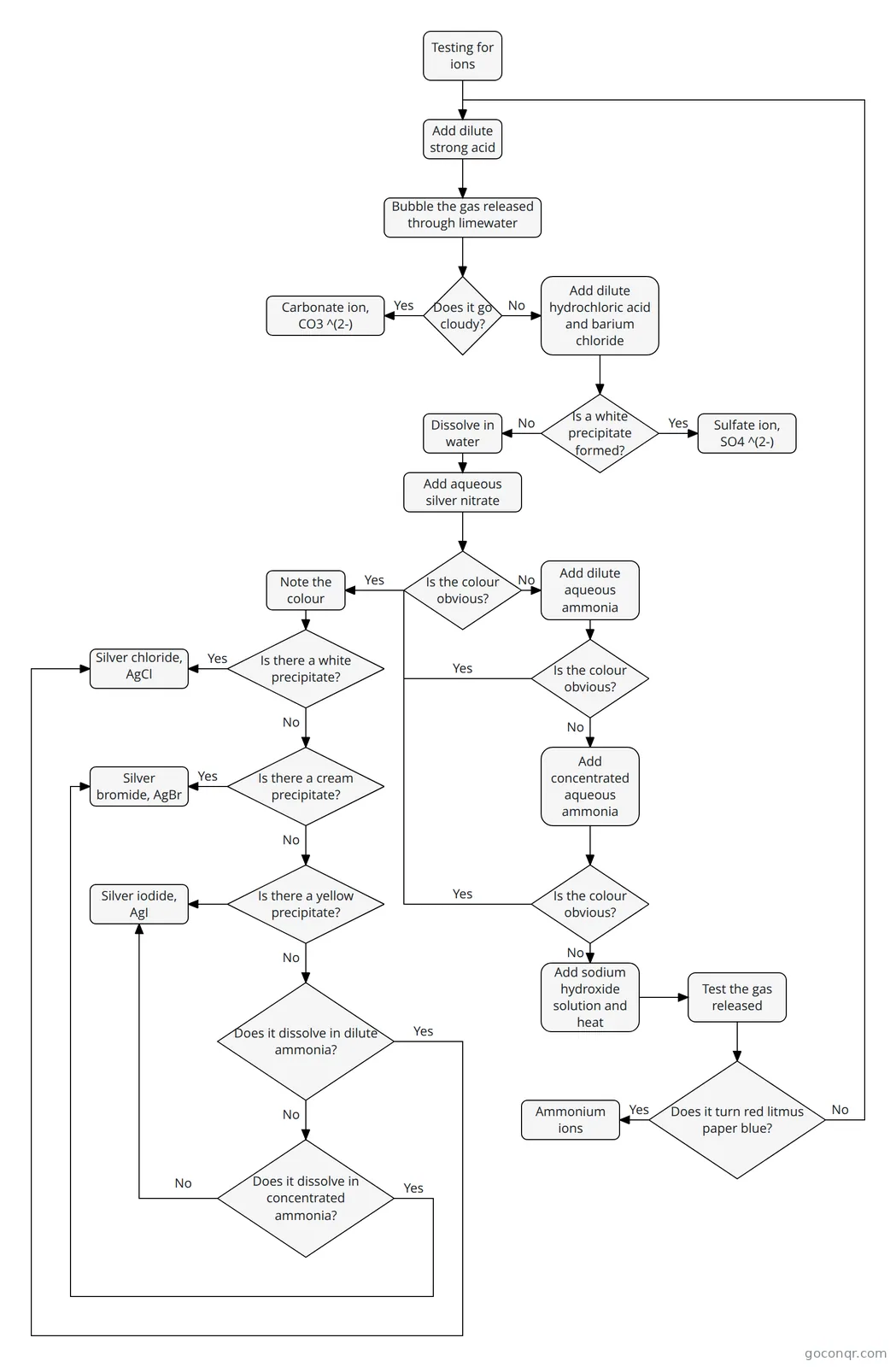
- Use the OCR A-Level flowchart on testing for ions to practise the order of steps.
- Try Identification of Ions & Gases Quiz once ions feel secure.
Going further
Once the basic tests are familiar, look at the maps on Paper Chromatography, Spectroscopic techniques, GC-MS and HPLC. The HPLC map lists advantages such as sensitivity and automation. Flashcards such as Topic 8 - Chemical analysis cover pure substances, melting and boiling points, and formulations. A few resources suit university students too.
Make it yours
Teachers can set a map or quiz as a starter task. Students can pick one set above and write a few flashcards of their own for the tests they find hardest.
Frequently asked questions
Which resource should I open first?
Start with the mind map Chemical tests. It lists flame test colours for common metal ions and gives a quick overview. After that, try Anion Tests for the negative ion reactions, then take the Anions test quiz to see what has stuck.
What do the mind maps on this page cover?
They cover flame tests, positive and negative ion tests, tests for gases and water, and chromatography. Others go into spectroscopic techniques, GC-MS, mass spectrometry, colorimetry and HPLC. Some are short topic summaries, while others work through a step-by-step test.
Which exams and levels do the resources suit?
Most of the material is secondary level. The listed resources mention GCSE Chemistry, AQA GCSE Chemistry, IGCSE Chemistry and A-level Chemistry. A smaller share is university level, mainly on instrumental methods such as mass spectrometry and chromatography.
Are the resources free to use?
Yes. Every resource listed here is free to open, study and take, with no account needed. They were made by GoConqr users rather than by GoConqr itself, so it is worth checking them against your own course notes.
Can I save my quiz scores or make my own sets?
A free account saves your quiz scores and lets you create your own quizzes, mind maps, flashcards and notes. That is handy if you want to turn a test you keep forgetting into a small flashcard deck.
What if the topic I need is missing?
Look through the related titles, as tests for gases, water and ions appear in several resources under different names. If you still cannot find it, make your own map or flashcards on that topic.