
Mapa mental
Sources Of Finance
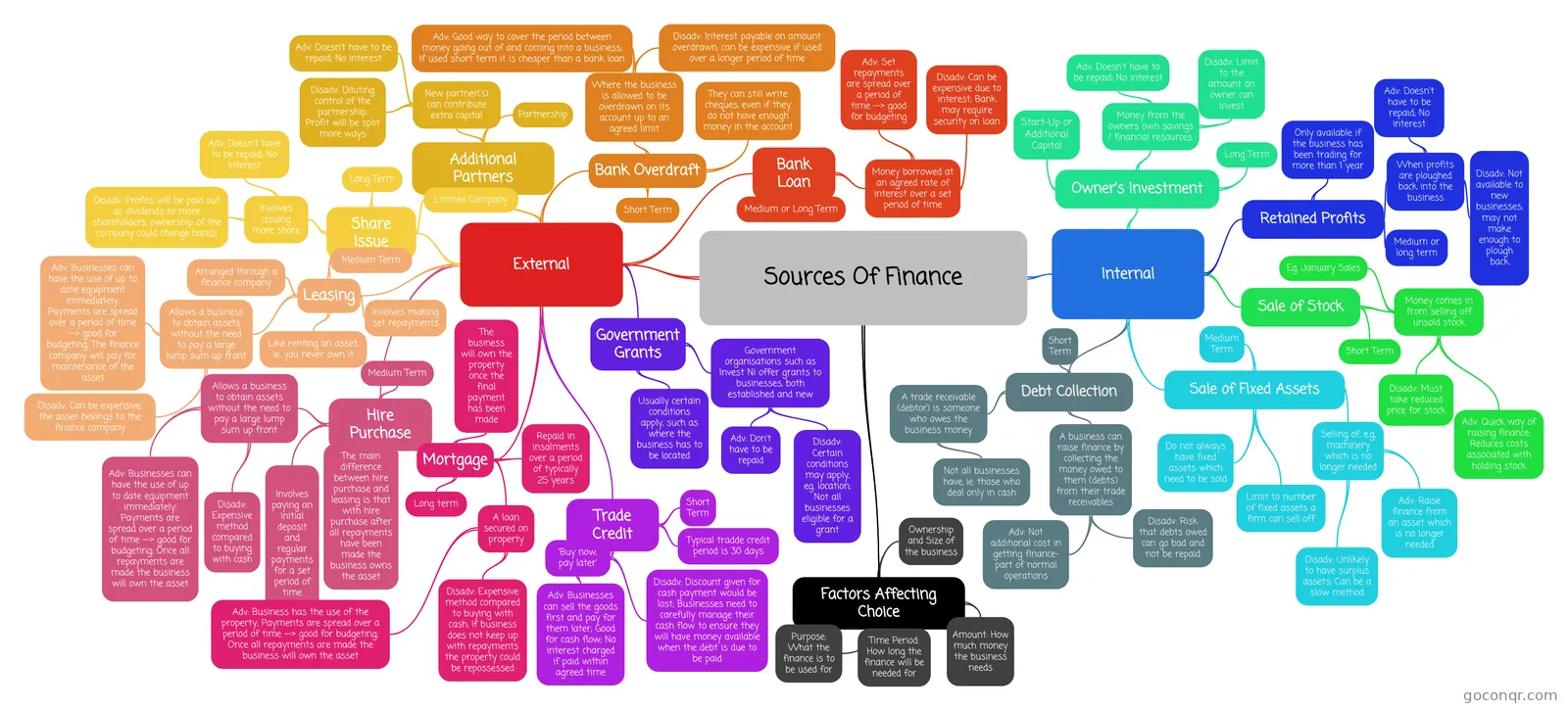
Mind map: sources of finance
Conteúdo do mapa
Sources Of Finance
Internal
- Owner's Investment
- Money from the owners own savings / financial resources.
- Adv: Doesn't have to be repaid; No interest
- Disadv: Limit to the amount an owner can invest
- Start-Up or Additional Capital
- Long Term
- Money from the owners own savings / financial resources.
- Retained Profits
- When profits are ploughed back into the business
- Adv: Doesn't have to be repaid; No interest
- Disadv: Not available to new businesses; may not make enough to plough back
- Only available if the business has been trading for more than 1 year
- Medium or long term
- When profits are ploughed back into the business
- Sale of Stock
- Money comes in from selling off unsold stock
- Eg. January Sales
- Adv: Quick way of raising finance; Reduces costs associated with holding stock
- Disadv: Must take reduced price for stock
- Short Term
- Money comes in from selling off unsold stock
- Sale of Fixed Assets
- Medium Term
- Do not always have fixed assets which need to be sold
- Limit to number of fixed assets a firm can sell off
- Selling of, e.g, machinery which is no longer needed
- Adv: Raise finance from an asset which is no longer needed
- Disadv: Unlikely to have surplus assets; Can be a slow method
- Debt Collection
- A trade receivable (debtor) is someone who owes the business money
- Not all businesses have, ie. those who deal only in cash
- A business can raise finance by collecting the money owed to them (debts) from their trade receivables
- Adv: Not additional cost in getting finance- part of normal operations
- Disadv: Risk that debts owed can go bad and not be repaid
- Short Term
- A trade receivable (debtor) is someone who owes the business money
- Owner's Investment
External
- Bank Loan
- Medium or Long Term
- Money borrowed at an agreed rate of interest over a set period of time
- Adv: Set repayments are spread over a period of time --> good for budgeting
- Disadv: Can be expensive due to interest; Bank may require security on loan
- Bank Overdraft
- Where the business is allowed to be overdrawn on its account up to an agreed limit
- Adv: Good way to cover the period between money going out of and coming into a business; If used short term it is cheaper than a bank loan
- Disadv: Interest payable on amount overdrawn; can be expensive if used over a longer period of time
- Short Term
- They can still write cheques, even if they do not have enough money in the account
- Where the business is allowed to be overdrawn on its account up to an agreed limit
- Additional Partners
- New partner(s) can contribute extra capital
- Adv: Doesn't have to be repaid; No interest
- Disadv: Diluting control of the partnership; Profit will be split more ways
- Partnership
- New partner(s) can contribute extra capital
- Share Issue
- Involves issuing more share
- Adv: Doesn't have to be repaid; No interest
- Disadv: Profits will be paid out as dividends to more shareholders; ownership of the company could change hands
- Long Term
- Limited Company
- Involves issuing more share
- Leasing
- Medium Term
- Involves making set repayments
- Allows a business to obtain assets without the need to pay a large lump sum up front
- Adv: Businesses can have the use of up to date equipment immediately; Payments are spread over a period of time --> good for budgeting; The finance company will pay for maintenance of the asset
- Disadv: Can be expensive; the asset belongs to the finance company
- Arranged through a finance company
- Like renting an asset, ie. you never own it
- Hire Purchase
- Allows a business to obtain assets without the need to pay a large lump sum up front
- Adv: Businesses can have the use of up to date equipment immediately; Payments are spread over a period of time --> good for budgeting; Once all repayments are made the business will own the asset
- Disadv: Expensive method compared to buying with cash
- Involves paying an initial deposit and regular payments for a set period of time
- The main difference between hire purchase and leasing is that with hire purchase after all repayments have been made the business owns the asset
- Medium Term
- Allows a business to obtain assets without the need to pay a large lump sum up front
- Mortgage
- A loan secured on property
- Adv: Business has the use of the property; Payments are spread over a period of time --> good for budgeting; Once all repayments are made the business will own the asset
- Disadv: Expensive method compared to buying with cash; If business does not keep up with repayments the property could be repossessed
- Long term
- The business will own the property once the final payment has been made
- Repaid in insalments over a period of typically 25 years
- A loan secured on property
- Trade Credit
- 'Buy now, pay later'
- Adv: Businesses can sell the goods first and pay for them later; Good for cash flow; No interest charged if paid within agreed time
- Disadv: Discount given for cash payment would be lost; Businesses need to carefully manage their cash flow to ensure they will have money available when the debt is due to be paid
- Short Term
- Typical tradde credit period is 30 days
- 'Buy now, pay later'
- Government Grants
- Government organisations such as Invest NI offer grants to businesses, both established and new
- Adv: Don't have to be repaid
- Disadv: Certain conditions may apply, eg. location; Not all businesses eligible for a grant
- Usually certain conditions apply, such as where the business has to be located
- Government organisations such as Invest NI offer grants to businesses, both established and new
- Bank Loan
Factors Affecting Choice
- Purpose: What the finance is to be used for
- Time Period: How long the finance will be needed for
- Amount: How much money the business needs
- Ownership and Size of the business
Informações
- Descrição
- GCSE Business Studies (Unit 1 ) Mapa Mental sobre Sources Of Finance, criado por Ellen Connolly em 19-04-2015.
- Criado por
- Ellen Connolly
- Visualizações
- 733
- Tags
- Avaliação