
Mapa mental
An Inspector Calls
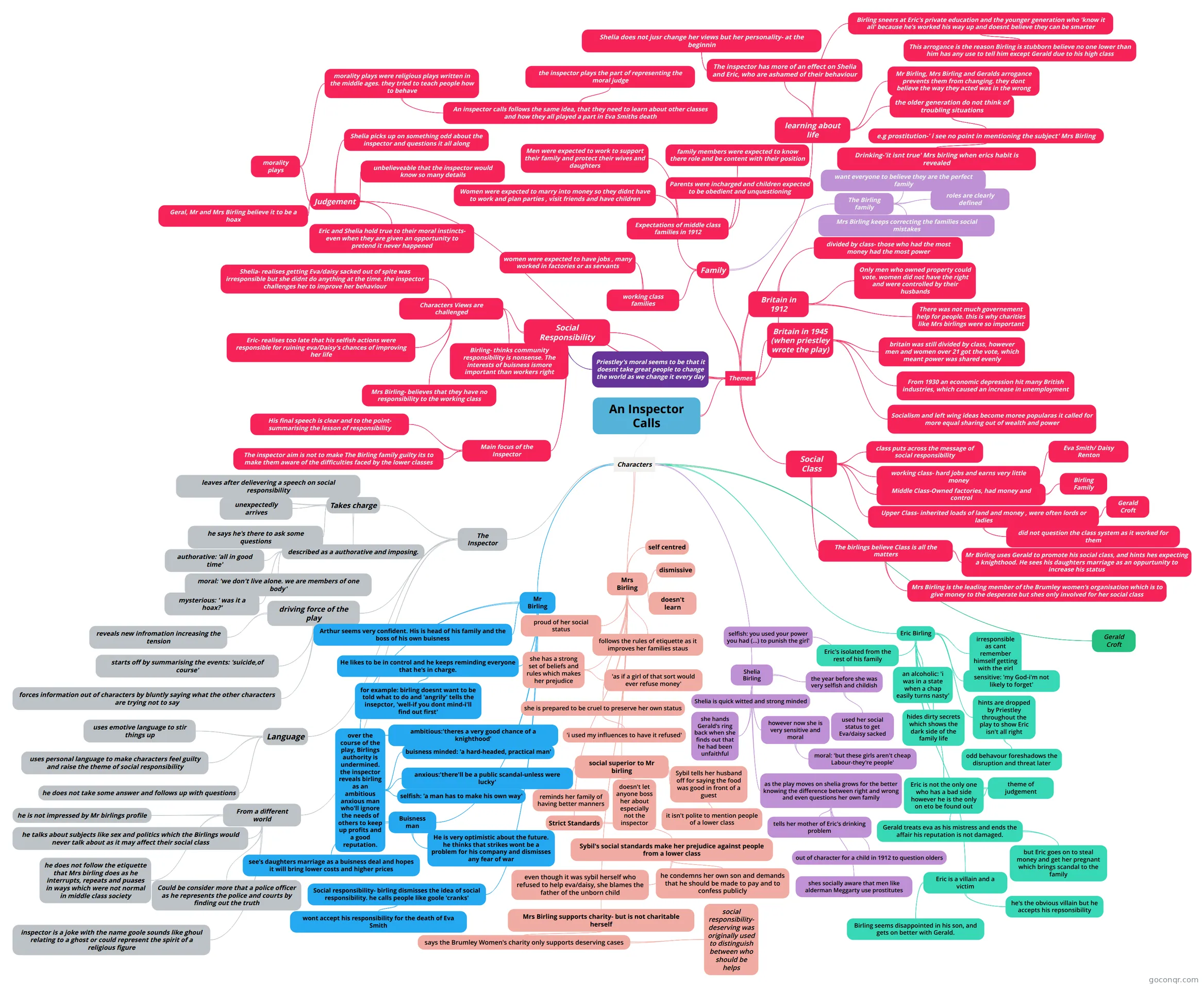
Mind map: An Inspector Calls
Conteúdo do mapa
An Inspector Calls
Characters
- Mr Birling
- Arthur seems very confident. His is head of his family and the boss of his own buisness
- He likes to be in control and he keeps reminding everyone that he's in charge.
- for example: birling doesnt want to be told what to do and 'angrily' tells the insepctor, 'well-if you dont mind-i'll find out first'
- over the course of the play, Birlings authority is undermined. the inspector reveals birling as an ambitious anxious man who'll ignore the needs of others to keep up profits and a good reputation.
- ambitious:'theres a very good chance of a knighthood'
- buisness minded: 'a hard-headed, practical man'
- anxious:'there'll be a public scandal-unless were lucky'
- selfish: 'a man has to make his own way'
- Buisness man
- see's daughters marriage as a buisness deal and hopes it will bring lower costs and higher prices
- He is very optimistic about the future. he thinks that strikes wont be a problem for his company and dismisses any fear of war
- Social responsibility- birling dismisses the idea of social responsibility. he calls people like goole 'cranks'
- wont accept his responsibility for the death of Eva Smith
- Mrs Birling
- proud of her social status
- follows the rules of etiquette as it improves her families staus
- she has a strong set of beliefs and rules which makes her prejudice
- 'as if a girl of that sort would ever refuse money'
- she is prepared to be cruel to preserve her own status
- 'i used my influences to have it refused'
- social superior to Mr birling
- Sybil tells her husband off for saying the food was good in front of a guest
- it isn't polite to mention people of a lower class
- reminds her family of having better manners
- doesn't let anyone boss her about especially not the inspector
- Sybil tells her husband off for saying the food was good in front of a guest
- Strict Standards
- Sybil's social standards make her prejudice against people from a lower class
- even though it was sybil herself who refused to help eva/daisy, she blames the father of the unborn child
- he condemns her own son and demands that he should be made to pay and to confess publicly
- Sybil's social standards make her prejudice against people from a lower class
- Mrs Birling supports charity- but is not charitable herself
- says the Brumley Women's charity only supports deserving cases
- social responsibility- deserving was originally used to distinguish between who should be helps
- says the Brumley Women's charity only supports deserving cases
- self centred
- dismissive
- doesn't learn
- Shelia Birling
- Shelia is quick witted and strong minded
- she hands Gerald's ring back when she finds out that he had been unfaithful
- the year before she was very selfish and childish
- used her social status to get Eva/daisy sacked
- selfish: you used your power you had (...) to punish the girl'
- however now she is very sensitive and moral
- moral: 'but these girls aren't cheap Labour-they're people'
- as the play moves on shelia grows for the better knowing the difference between right and wrong and even questions her own family
- tells her mother of Eric's drinking problem
- out of character for a child in 1912 to question olders
- shes socially aware that men like alderman Meggarty use prostitutes
- Shelia is quick witted and strong minded
- Eric Birling
- Eric's isolated from the rest of his family
- irresponsible as cant remember himself getting with the girl
- sensitive: 'my God-i'm not likely to forget'
- an alcoholic: 'i was in a state when a chap easily turns nasty'
- hints are dropped by Priestley throughout the play to show Eric isn't all right
- odd behavour foreshadows the disruption and threat later
- hides dirty secrets which shows the dark side of the family life
- Eric is not the only one who has a bad side however he is the only on eto be found out
- theme of judgement
- Gerald treats eva as his mistress and ends the affair his reputation is not damaged.
- but Eric goes on to steal money and get her pregnant which brings scandal to the family
- Gerald treats eva as his mistress and ends the affair his reputation is not damaged.
- theme of judgement
- Eric is a villain and a victim
- Birling seems disappointed in his son, and gets on better with Gerald.
- he's the obvious villain but he accepts his repsonsibility
- Gerald Croft
- The Inspector
- Takes charge
- unexpectedly arrives
- he says he's there to ask some questions
- leaves after delievering a speech on social responsibility
- described as a authorative and imposing.
- authorative: 'all in good time'
- mysterious: ' was it a hoax?'
- moral: 'we don't live alone. we are members of one body'
- driving force of the play
- starts off by summarising the events: 'suicide,of course'
- forces information out of characters by bluntly saying what the other characters are trying not to say
- reveals new infromation increasing the tension
- Language
- uses emotive language to stir things up
- uses personal language to make characters feel guilty and raise the theme of social responsibility
- he does not take some answer and follows up with questions
- From a different world
- he is not impressed by Mr birlings profile
- he talks about subjects like sex and politics which the Birlings would never talk about as it may affect their social class
- he does not follow the etiquette that Mrs birling does as he interrupts, repeats and puases in ways which were not normal in middle class society
- Could be consider more that a police officer as he represents the police and courts by finding out the truth
- inspector is a joke with the name goole sounds like ghoul relating to a ghost or could represent the spirit of a religious figure
- Takes charge
- Mr Birling
Themes
- Britain in 1912
- divided by class- those who had the most money had the most power
- Only men who owned property could vote. women did not have the right and were controlled by their husbands
- There was not much governement help for people. this is why charities like Mrs birlings were so important
- Britain in 1945 (when priestley wrote the play)
- britain was still divided by class, however men and women over 21 got the vote, which meant power was shared evenly
- From 1930 an economic depression hit many British industries, which caused an increase in unemployment
- Socialism and left wing ideas become moree popularas it called for more equal sharing out of wealth and power
- Family
- Expectations of middle class families in 1912
- family members were expected to know there role and be content with their position
- Parents were incharged and children expected to be obedient and unquestioning
- Men were expected to work to support their family and protect their wives and daughters
- Women were expected to marry into money so they didnt have to work and plan parties , visit friends and have children
- working class families
- women were expected to have jobs , many worked in factories or as servants
- The Birling family
- want everyone to believe they are the perfect family
- roles are clearly defined
- Mrs Birling keeps correcting the families social mistakes
- Expectations of middle class families in 1912
- Social Class
- class puts across the message of social responsibility
- working class- hard jobs and earns very little money
- Eva Smith/ Daisy Renton
- Middle Class-Owned factories, had money and control
- Birling Family
- Upper Class- inherited loads of land and money , were often lords or ladies
- Gerald Croft
- did not question the class system as it worked for them
- The birlings believe Class is all the matters
- Mr Birling uses Gerald to promote his social class, and hints hes expecting a knighthood. He sees his daughters marriage as an oppurtunity to increase his status
- Mrs Birling is the leading member of the Brumley women's organisation which is to give money to the desperate but shes only involved for her social class
- Social Responsibility
- Characters Views are challenged
- Birling- thinks community responsibility is nonsense. The interests of buisness ismore important than workers right
- Mrs Birling- believes that they have no responsibility to the working class
- Shelia- realises getting Eva/daisy sacked out of spite was irresponsible but she didnt do anything at the time. the inspector challenges her to improve her behaviour
- Eric- realises too late that his selfish actions were responsible for ruining eva/Daisy's chances of improving her life
- Main focus of the Inspector
- His final speech is clear and to the point- summarising the lesson of responsibility
- The inspector aim is not to make The Birling family guilty its to make them aware of the difficulties faced by the lower classes
- Priestley's moral seems to be that it doesnt take great people to change the world as we change it every day
- Characters Views are challenged
- Judgement
- morality plays
- morality plays were religious plays written in the middle ages. they tried to teach people how to behave
- An inspector calls follows the same idea, that they need to learn about other classes and how they all played a part in Eva Smiths death
- the inspector plays the part of representing the moral judge
- An inspector calls follows the same idea, that they need to learn about other classes and how they all played a part in Eva Smiths death
- morality plays were religious plays written in the middle ages. they tried to teach people how to behave
- Shelia picks up on something odd about the inspector and questions it all along
- unbelieveable that the inspector would know so many details
- Geral, Mr and Mrs Birling believe it to be a hoax
- Eric and Shelia hold true to their moral instincts- even when they are given an opportunity to pretend it never happened
- morality plays
- learning about life
- Birling sneers at Eric's private education and the younger generation who 'know it all' because he's worked his way up and doesnt believe they can be smarter
- This arrogance is the reason Birling is stubborn believe no one lower than him has any use to tell him except Gerald due to his high class
- Mr Birling, Mrs Birling and Geralds arrogance prevents them from changing. they dont believe the way they acted was in the wrong
- The inspector has more of an effect on Shelia and Eric, who are ashamed of their behaviour
- Shelia does not jusr change her views but her personality- at the beginnin
- the older generation do not think of troubling situations
- e.g prostitution-' i see no point in mentioning the subject' Mrs Birling
- Drinking-'it isnt true' Mrs birling when erics habit is revealed
- e.g prostitution-' i see no point in mentioning the subject' Mrs Birling
- Birling sneers at Eric's private education and the younger generation who 'know it all' because he's worked his way up and doesnt believe they can be smarter
- Britain in 1912
Informações
- Descrição
- Mapa Mental sobre An Inspector Calls, criado por natasha hainsworth em 25-04-2015.
- Criado por
- natasha hainsworth
- Visualizações
- 41
- Avaliação