
Mapa mental
Unit 4 Cultural Diversity - Case Study: Japan
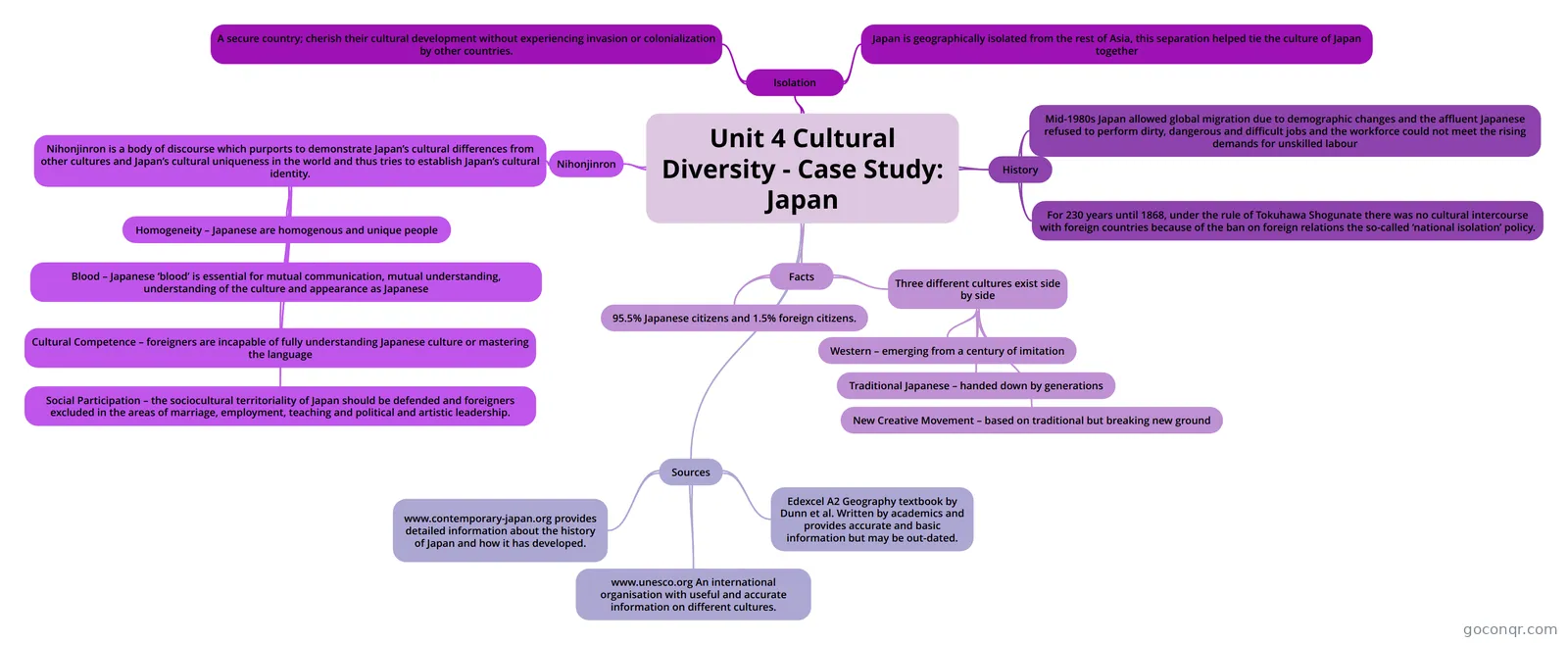
Mind map: Cultural diversity case study Japan
Conteúdo do mapa
Unit 4 Cultural Diversity - Case Study: Japan
Nihonjinron
- Nihonjinron is a body of discourse which purports to demonstrate Japan’s cultural differences from other cultures and Japan’s cultural uniqueness in the world and thus tries to establish Japan’s cultural identity.
- Homogeneity – Japanese are homogenous and unique people
- Blood – Japanese ‘blood’ is essential for mutual communication, mutual understanding, understanding of the culture and appearance as Japanese
- Cultural Competence – foreigners are incapable of fully understanding Japanese culture or mastering the language
- Social Participation – the sociocultural territoriality of Japan should be defended and foreigners excluded in the areas of marriage, employment, teaching and political and artistic leadership.
- Nihonjinron is a body of discourse which purports to demonstrate Japan’s cultural differences from other cultures and Japan’s cultural uniqueness in the world and thus tries to establish Japan’s cultural identity.
History
- Mid-1980s Japan allowed global migration due to demographic changes and the affluent Japanese refused to perform dirty, dangerous and difficult jobs and the workforce could not meet the rising demands for unskilled labour
- For 230 years until 1868, under the rule of Tokuhawa Shogunate there was no cultural intercourse with foreign countries because of the ban on foreign relations the so-called ‘national isolation’ policy.
Isolation
- A secure country; cherish their cultural development without experiencing invasion or colonialization by other countries.
- Japan is geographically isolated from the rest of Asia, this separation helped tie the culture of Japan together
Facts
- 95.5% Japanese citizens and 1.5% foreign citizens.
- Three different cultures exist side by side
- Western – emerging from a century of imitation
- Traditional Japanese – handed down by generations
- New Creative Movement – based on traditional but breaking new ground
Sources
- www.contemporary-japan.org provides detailed information about the history of Japan and how it has developed.
- www.unesco.org An international organisation with useful and accurate information on different cultures.
- Edexcel A2 Geography textbook by Dunn et al. Written by academics and provides accurate and basic information but may be out-dated.
Informações
- Descrição
- Japan case study for Unit 4 Geography Exam.
- Criado por
- savah97
- Visualizações
- 214
- Tags
- Avaliação
Mais sobre Cultural Diversity and Identity