
Mapa mental
Fiscal Policy
Conteúdo do mapa
Fiscal Policy
Involves the government changing levels of Taxation and Government spending in order to influence AD and the level of economic activity
- AD is the total level of planned expenditure in an economy (AD = C+ I + G + X – M)
- Government spending
- Investment
- Consumer spending
- eXports-iMports
- AD is the total level of planned expenditure in an economy (AD = C+ I + G + X – M)
PURPOSE
- Stimulate economic growth in a period of recession
- Keep inflation low (>2% target)
- Stabilise economic growth
- Avoid a boom and bust economic cycle
EXPANSIONARY
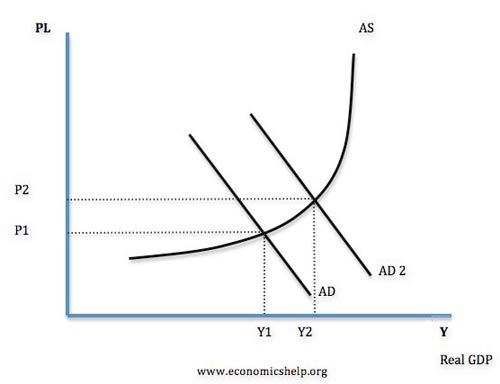
- Increasing AD
- Increasing G or reducing T
- Reducing T will increase C as consumers will have more disposable Y
- This will tend worsen the government budget deficit and the government will need to increase borrowing.
- Reducing T will increase C as consumers will have more disposable Y
- Increasing G or reducing T
- Increasing AD
DEFLATIONARY
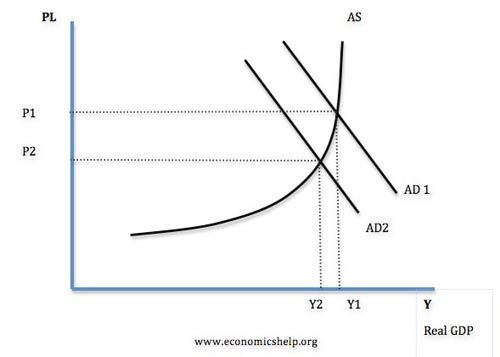
- Decreasing AD
- Cut G and Increase T
- Higher T will decrease C
- Deflationary Fiscal policy will tend to cause an improvement in the government budget deficit.
- Higher T will decrease C
- Cut G and Increase T
- Decreasing AD
In 2009, the government pursued expansionary fiscal policy. In response to a deep recession (GDP fell 6%) the government cut VAT in a bid to boost consumer spending. This caused a big rise in government borrowing (2009-10).
- (Government borrowing also rose because of the recession leading to lower tax revenue)
- When the new coalition government came into power in May 2010, they argued the deficit was too high and then announced plans to reduce government borrowing.
- This involved spending limits. This austerity measures were a factor in causing lower economic growth in 2011 and 2012.
- When the new coalition government came into power in May 2010, they argued the deficit was too high and then announced plans to reduce government borrowing.
- (Government borrowing also rose because of the recession leading to lower tax revenue)
The multiplier effect.
- When an increase in injections causes a bigger final increase in Real GDP.
- Injections (J) – This is an increase of expenditure into the circular flow, it includes govt spending(G), Exports (X) and Investment (I)
- Withdrawals (W) – This is leakages from the circular flow This is household income that is not spent on the circular flow. It includes: Net savings (S) + Net Taxes (T) + Net Imports (M)
- When an increase in injections causes a bigger final increase in Real GDP.
CRITICISMS
- The government may have poor information about the state of the economy so may not be able to identify what it needs
- Time lags
- Crowding out
- An expansionary policy involves the government borrowing from the private sector to finance the increase in G. This depletes the private sector's funds and may reduce private investment.
- Inefficient
- Free market economists argue that higher government spending will tend to be wasted on inefficient spending projects. Also, it can then be difficult to reduce spending in the future
- Higher borrowing costs. Debt repayment
EVALUATION
- It depends on the size of the multiplier.
- It depends on the state of the economy. Fiscal policy is most effective in a deep recession where monetary policy is insufficient to boost demand.
- Higher government spending will not cause crowding out because the private sector saving has increased substantially.
- It depends on other factors in the economy. .
- For example, if the government pursue expansionary fiscal policy, but interest rates rise and the global economy is in a recession, it may be insufficient to boost demand
- Bond yields
Imagens e arquivos do mapa
Informações
- Descrição
- Mind Map of fiscal policy in unit 2 of AQA economics course. Made from Economics Help website information.
- Criado por
- alicemarsden
- Visualizações
- 1.349
- Tags
- Avaliação