
Mapa mental
Globalisation
Conteúdo do mapa
Globalisation
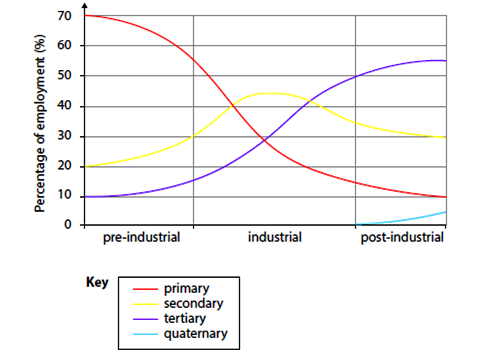
Changing employment patterns
- Clark Fisher Model
- Pre-industrial stage
- Most people employed in primary industries
- Industrial stage
- New factories and industries develop which provide jobs
- Chemical and vehicle industries develop
- Secondary industries dominate the economy
- Tertiary sector begins to grow
- Post-industrial stage
- Tertiary sector grows to provide services for increasing population
- Tertiary sector employment becomes more important than the secondary sector
- After post-industrial stage
- Employment in quaternary sector begins to grow
- Quaternary sector - based on research, IT and communications
Employment sectors
- LICs (Ethiopia)
- Primary sector 75% - mostly subsistence farmers, long hours and hard work
- Secondary sector - very small
- Tertiary sector 15%
- MICs (China)
- Primary sector - largest but less dominant than in LICs
- Secondary sector - medium, but dominates economy
- Tertiary sector - large, with long working hours but good conditions and wages
- HICs (UK)
- Primary sector - very small, mechanisation means fewer workers
- Secondary sector - small due to automation and relocation
- Tertiary sector - dominates due to a large variety of employment
- Quaternary sector - growing
- Good working conditions and wages in all sectors
- LICs (Ethiopia)
Impacts of globalisation
- Developed world e.g. Leeds
- Positives
- Wages have improved
- Everyone benefits from global goods/services
- Good working conditions
- More flexibility/choice in working times/location
- Higher prices can be charged for goods and services
- Negatives
- Some jobs are lost as companies outsource
- Positives
- Developing world e.g. Vietnam
- Positives
- Produce/services can be provided to more people
- Those who own land/resources benefit
- Negatives
- Informal sector continues
- The cost of products/services from the developed world is high
- Lower prices for their products than the developed world
- Low wages/exploitation of workers
- Positives
- Worldwide
- Increase in women working
- Better working conditions
- Goods available everywhere
- More skills
- Institutions
- World Trade Organisation (WTO) - aims to encourage global trade and reduce import duties
- International Monetary Fund (IMF) - aims to provide the financial stability required for trade
- Developed world e.g. Leeds
International trade and capital flows
- What has happened?
- International trade has grown massively
- 2010 - 48 times larger than in 1970
- Growth of TNCs, companies which expand into and invest in countries all over the world
- Banking, insurance and finance companies have also become globalised, meaning they can offer services all over the world
- International trade has grown massively
- Why has this happened?
- Transport
- Container ships & air transport make trade faster and cheaper
- Communication
- IT has made it easier for countries to communicate
- International Monetary Fund (IMF)
- Made it easier for state-led investment in many countries
- TNCs
- Increased trade between countries
- Trade agreements
- Agreements between countries (e.g. EU) make trade between these countries easier
- Transport
- Foreign Direct Investment (FDI)
- The investment which flows from one country to another (often by TNCs)
- Can involve buying a business/factory in the country or by expanding an existing business
- Mostly done to take advantage of cheaper labour or resources
- What has happened?
TNCs: Secondary sector (e.g. Nike)
- Headquarters usually in a HIC
- Why TNCs operate globally
- Reduce labour/land costs
- To sell inside trade barriers
- To be close to markets
- Large workforce
- TNCs in developing countries
- Advantages
- Local people able to earn higher/regular wages
- Can bring new skills
- Bring investment, e.g. in new factories or call centres
- TNCs pay taxes which boost the local economy
- Disadvantages
- Low pay for workers
- Training only in low-level skills
- Long shifts and poor working conditions/abuse
- Factories can cause pollution
- Advantages
TNCs: Tertiary sector (e.g. BT)
- BT Case study
- Outsourcing
- English speaking foreign nationals take over services like call centres
- Software development skills in India enable BT to develop
- Locations with administrative skills manage services like company accounting
- Why Bangalore attracted investment
- English speaking Universities provide science and technology graduates
- It has attracted software development companies, creating India's own 'Silicon valley'
- It offers reduced taxes
- Companies don't have to pay as much as they would in the UK
- Outsourcing
- How tertiary TNCs differ from secondary TNCs
- Often administration companies, with call centres relocated to cheaper locations
- Often chain retail outlets located across the world
- Working conditions often better than those in the secondary sector
- The new economy
- Based on the sale of services
- Most HICs have moved to it
- They are 'footloose' - they can locate anywhere
- BT Case study