
Mapa mental
Cognitive Structural Theories
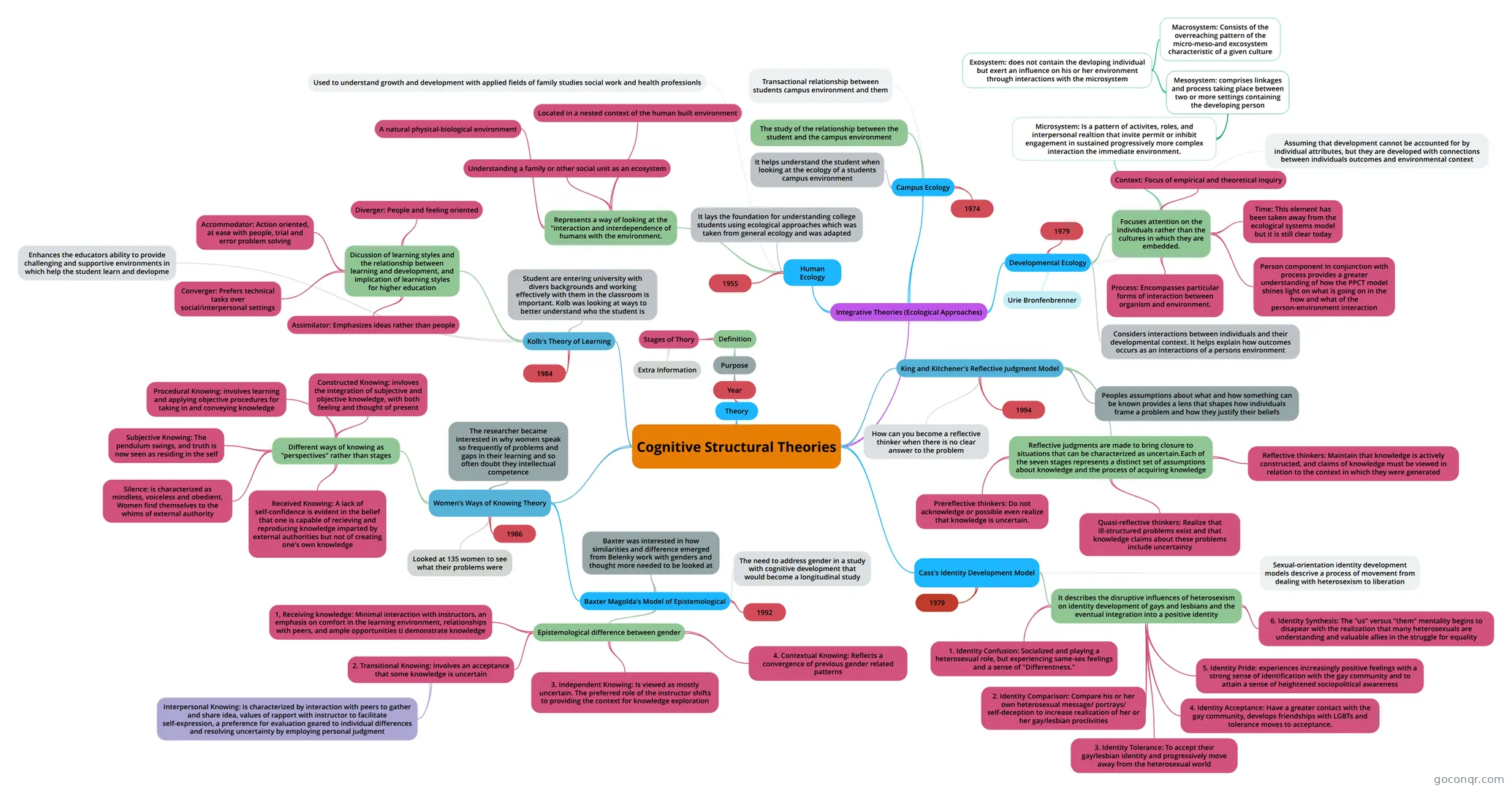
Mind map: Cognitive structural theories
Conteúdo do mapa
Cognitive Structural Theories
Women's Ways of Knowing Theory
- Baxter Magolda's Model of Epistemological
- 1992
- Epistemological difference between gender
- 1, Receiving knowledge: Minimal interaction with instructors, an emphasis on comfort in the learning environment, relationships with peers, and ample opportunities ti demonstrate knowledge
- 2. Transitional Knowing: Involves an acceptance that some knowledge is uncertain
- Interpersonal Knowing: is characterized by interaction with peers to gather and share idea, values of rapport with instructor to facilitate self-expression, a preference for evaluation geared to individual differences and resolving uncertainty by employing personal judgment
- 3. Independent Knowing: Is viewed as mostly uncertain. The preferred role of the instructor shifts to providing the context for knowledge exploration
- 4. Contextual Knowing: Reflects a convergence of previous gender related patterns
- Baxter was interested in how similarities and difference emerged from Belenky work with genders and thought more needed to be looked at
- The need to address gender in a study with cognitive development that would become a longitudinal study
- 1986
- Different ways of knowing as "perspectives" rather than stages
- Silence: is characterized as mindless, voiceless and obedient. Women find themselves to the whims of external authority
- Received Knowing: A lack of self-confidence is evident in the belief that one is capable of recieving and reproducing knowledge imparted by external authorities but not of creating one's own knowledge
- Subjective Knowing: The pendulum swings, and truth is now seen as residing in the self
- Procedural Knowing: involves learning and applying objective procedures for taking in and conveying knowledge
- Constructed Knowing: invloves the integration of subjective and objective knowledge, with both feeling and thought of present
- The researcher became interested in why women speak so frequently of problems and gaps in their learning and so often doubt they intellectual competence
- Looked at 135 women to see what their problems were
- Baxter Magolda's Model of Epistemological
King and Kitchener's Reflective Judgment Model
- 1994
- Reflective judgments are made to bring closure to situations that can be characterized as uncertain.Each of the seven stages represents a distinct set of assumptions about knowledge and the process of acquiring knowledge
- Prereflective thinkers: Do not acknowledge or possible even realize that knowledge is uncertain.
- Quasi-reflective thinkers: Realize that ill-structured problems exist and that knowledge claims about these problems include uncertainty
- Reflective thinkers: Maintain that knowledge is actively constructed, and claims of knowledge must be viewed in relation to the context in which they were generated
- Peoples assumptions about what and how something can be known provides a lens that shapes how individuals frame a problem and how they justify their beliefs
- How can you become a reflective thinker when there is no clear answer to the problem
Kolb's Theory of Learning
- 1984
- Dicussion of learning styles and the relationship between learning and development, and implication of learning styles for higher education
- Accommodator: Action oriented, at ease with people, trial and error problem solving
- Diverger: People and feeling oriented
- Converger: Prefers technical tasks over social/interpersonal settings
- Assimilator: Emphasizes ideas rather than people
- Student are entering university with divers backgrounds and working effectively with them in the classroom is important. Kolb was looking at ways to better understand who the student is
- Enhances the educators ability to provide challenging and supportive environments in which help the student learn and devlopme
Integrative Theories (Ecological Approaches)
- Human Ecology
- 1955
- Represents a way of looking at the "interaction and interdependence of humans with the environment.
- Understanding a family or other social unit as an ecosystem
- Located in a nested context of the human built environment
- A natural physical-biological environment
- It lays the foundation for understanding college students using ecological approaches which was taken from general ecology and was adapted
- Used to understand growth and development with applied fields of family studies social work and health professionls
- Developmental Ecology
- 1979
- Focuses attention on the individuals rather than the cultures in which they are embedded.
- Process: Encompasses particular forms of interaction between organism and environment.
- Person component in conjunction with process provides a greater understanding of how the PPCT model shines light on what is going on in the how and what of the person-environment interaction
- Context: Focus of empirical and theoretical inquiry
- Time: This element has been taken away from the ecological systems model but it is still clear today
- Microsystem: Is a pattern of activites, roles, and interpersonal realtion that invite permit or inhibit engagement in sustained progressively more complex interaction the immediate environment.
- Mesosystem: comprises linkages and process taking place between two or more settings containing the developing person
- Exosystem: does not contain the devloping individual but exert an influence on his or her environment through interactions with the microsystem
- Macrosystem: Consists of the overreaching pattern of the micro-meso-and excosystem characteristic of a given culture
- Exosystem: does not contain the devloping individual but exert an influence on his or her environment through interactions with the microsystem
- Mesosystem: comprises linkages and process taking place between two or more settings containing the developing person
- Urie Bronfenbrenner
- Considers interactions between individuals and their developmental context. It helps explain how outcomes occurs as an interactions of a persons environment
- Assuming that development cannot be accounted for by individual attributes, but they are developed with connections between individuals outcomes and environmental context
- Campus Ecology
- 1974
- The study of the relationship between the student and the campus environment
- It helps understand the student when looking at the ecology of a students campus environment
- Transactional relationship between students campus environment and them
- Human Ecology
Theory
- Year
- Purpose
- Definition
- Stages of Thory
- Extra Information
- Stages of Thory
- Definition
- Purpose
- Year
Cass's Identity Development Model
- 1979
- It describes the disruptive influences of heterosexism on identity development of gays and lesbians and the eventual integration into a positive identity
- 1. Identity Confusion: Socialized and playing a heterosexual role, but experiencing same-sex feelings and a sense of "Differentness."
- 2. Identity Comparison: Compare his or her own heterosexual message/ portrays/ self-deception to increase realization of her or her gay/lesbian proclivities
- 3. Identity Tolerance: To accept their gay/lesbian identity and progressively move away from the heterosexual world
- 4. Identity Acceptance: Have a greater contact with the gay community, develops friendships with LGBTs and tolerance moves to acceptance.
- 5. Identity Pride: experiences increasingly positive feelings with a strong sense of identification with the gay community and to attain a sense of heightened sociopolitical awareness
- 6. Identity Synthesis: The "us" versus "them" mentality begins to disapear with the realization that many heterosexuals are understanding and valuable allies in the struggle for equality
- Sexual-orientation identity development models descrive a process of movement from dealing with heterosexism to liberation
Informações
- Descrição
- Please visit www.julianbranch.com
- Criado por
- Julian N Branch
- Visualizações
- 82
- Tags
- Avaliação