
Mapa mental
VON NEUMANN ARCHITECTURE
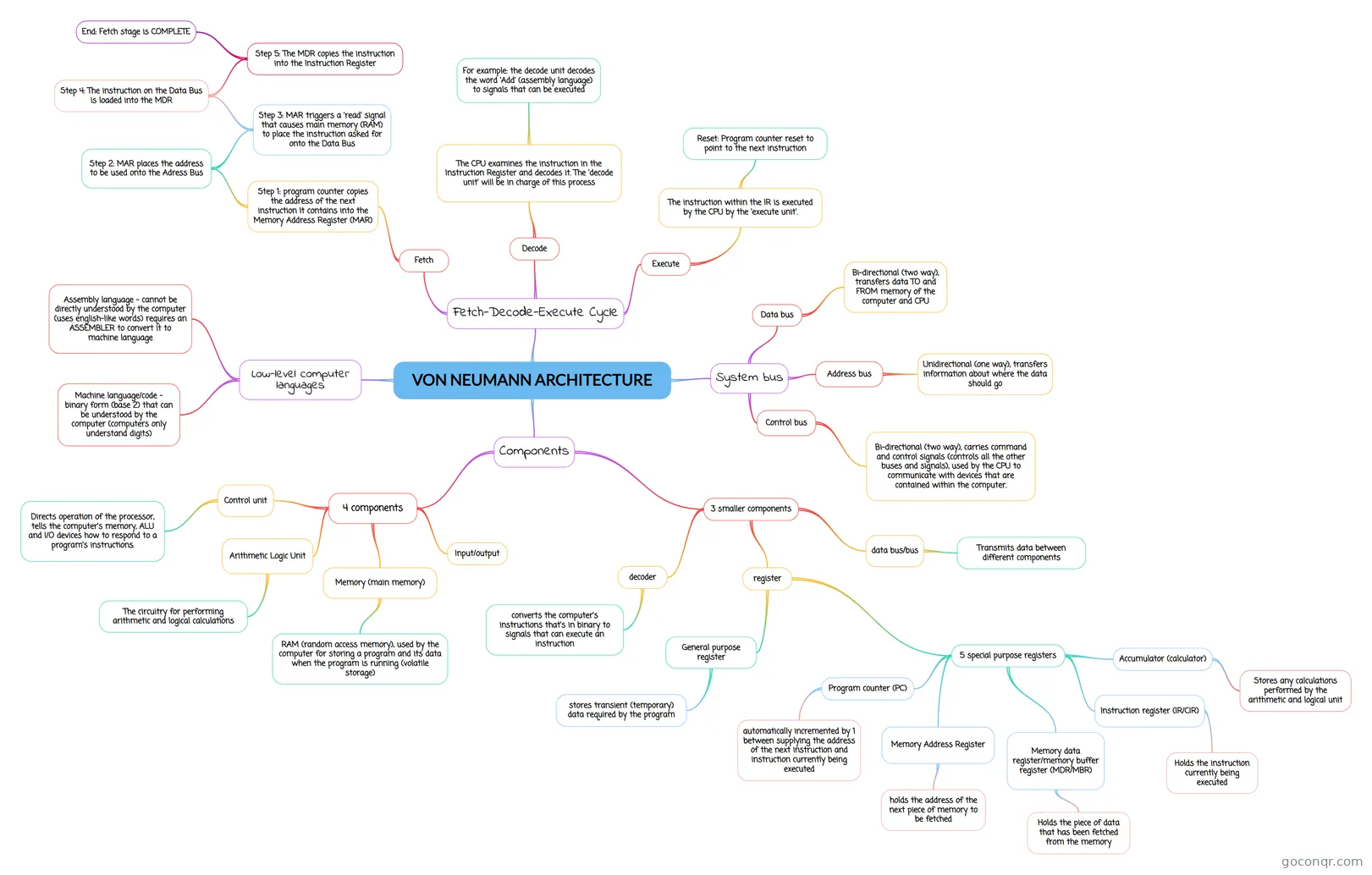
Mind map: Von Neumann architecture
Conteúdo do mapa
VON NEUMANN ARCHITECTURE
Low-level computer languages
- Assembly language - cannot be directly understood by the computer (uses english-like words) requires an ASSEMBLER to convert it to machine language
- Machine language/code - binary form (base 2) that can be understood by the computer (computers only understand digits)
Components
- 4 components
- Control unit
- Directs operation of the processor, tells the computer's memory, ALU and I/O devices how to respond to a program's instructions.
- Input/output
- Input - responsible for getting data FROM user to computer Output - responsible for getting data FROM computer to user
- Arithmetic Logic Unit
- The circuitry for performing arithmetic and logical calculations
- Memory (main memory)
- RAM (random access memory), used by the computer for storing a program and its data when the program is running (volatile storage)
- Control unit
- 3 smaller components
- register
- registers DO NOT move!! - small, fast unit of memory, - speeds up calculations for ALU - the more registers a CPU has, the faster it can work - used temporarily for storing data
- 5 special purpose registers
- Program counter (PC)
- Program counter fetches data by copying address of next instruction
- automatically incremented by 1 between supplying the address of the next instruction and instruction currently being executed
- Memory Address Register
- holds the address of the next piece of memory to be fetched
- Memory data register/memory buffer register (MDR/MBR)
- Holds the piece of data that has been fetched from the memory
- Instruction register (IR/CIR)
- Holds the instruction currently being executed
- Accumulator (calculator)
- Stores any calculations performed by the arithmetic and logical unit
- Program counter (PC)
- General purpose register
- stores transient (temporary) data required by the program
- decoder
- converts the computer's instructions that's in binary to signals that can execute an instruction
- data bus/bus
- Transmits data between different components
- register
- 4 components
Fetch-Decode-Execute Cycle
- Present in every sequential processing computer
- Execute
- The instruction within the IR is executed by the CPU by the 'execute unit'.
- Reset: Program counter reset to point to the next instruction
- The instruction within the IR is executed by the CPU by the 'execute unit'.
- Decode
- The CPU examines the instruction in the Instruction Register and decodes it. The 'decode unit' will be in charge of this process
- For example: the decode unit decodes the word 'Add' (assembly language) to signals that can be executed
- The CPU examines the instruction in the Instruction Register and decodes it. The 'decode unit' will be in charge of this process
- Fetch
- Step 1: program counter copies the address of the next instruction It contains into the Memory Address Register (MAR)
- Step 2: MAR places the address to be used onto the Adress Bus
- Step 3: MAR triggers a 'read' signal that causes main memory (RAM) to place the instruction asked for onto the Data Bus
- Step 4: The instruction on the Data Bus is loaded into the MDR
- Step 5: The MDR copies the instruction into the Instruction Register
- End: Fetch stage is COMPLETE
- Step 5: The MDR copies the instruction into the Instruction Register
- Step 4: The instruction on the Data Bus is loaded into the MDR
- Step 3: MAR triggers a 'read' signal that causes main memory (RAM) to place the instruction asked for onto the Data Bus
- Step 2: MAR places the address to be used onto the Adress Bus
- Step 1: program counter copies the address of the next instruction It contains into the Memory Address Register (MAR)
System bus
- Definition: A single computer bus of a collection of wires going from one component to another, comprising of: data bus, address bus and control bus. --> Buses act as transporters of data - The buses fetch and transport the instructions so REGISTERS DO NOT MOVE
- Data bus
- Bi-directional (two way), transfers data TO and FROM memory of the computer and CPU
- Address bus
- Unidirectional (one way), transfers information about where the data should go
- Control bus
- Bi-directional (two way), carries command and control signals (controls all the other buses and signals), used by the CPU to communicate with devices that are contained within the computer.
Informações
- Descrição
- IGCSE Computer science Mapa Mental sobre VON NEUMANN ARCHITECTURE, criado por its someone em 05-06-2021.
- Criado por
- its someone
- Visualizações
- 1
- Avaliação
Mais sobre Von Neumann and Harvard architectures