
Mapa mental
DKE Part 3: Information Econ
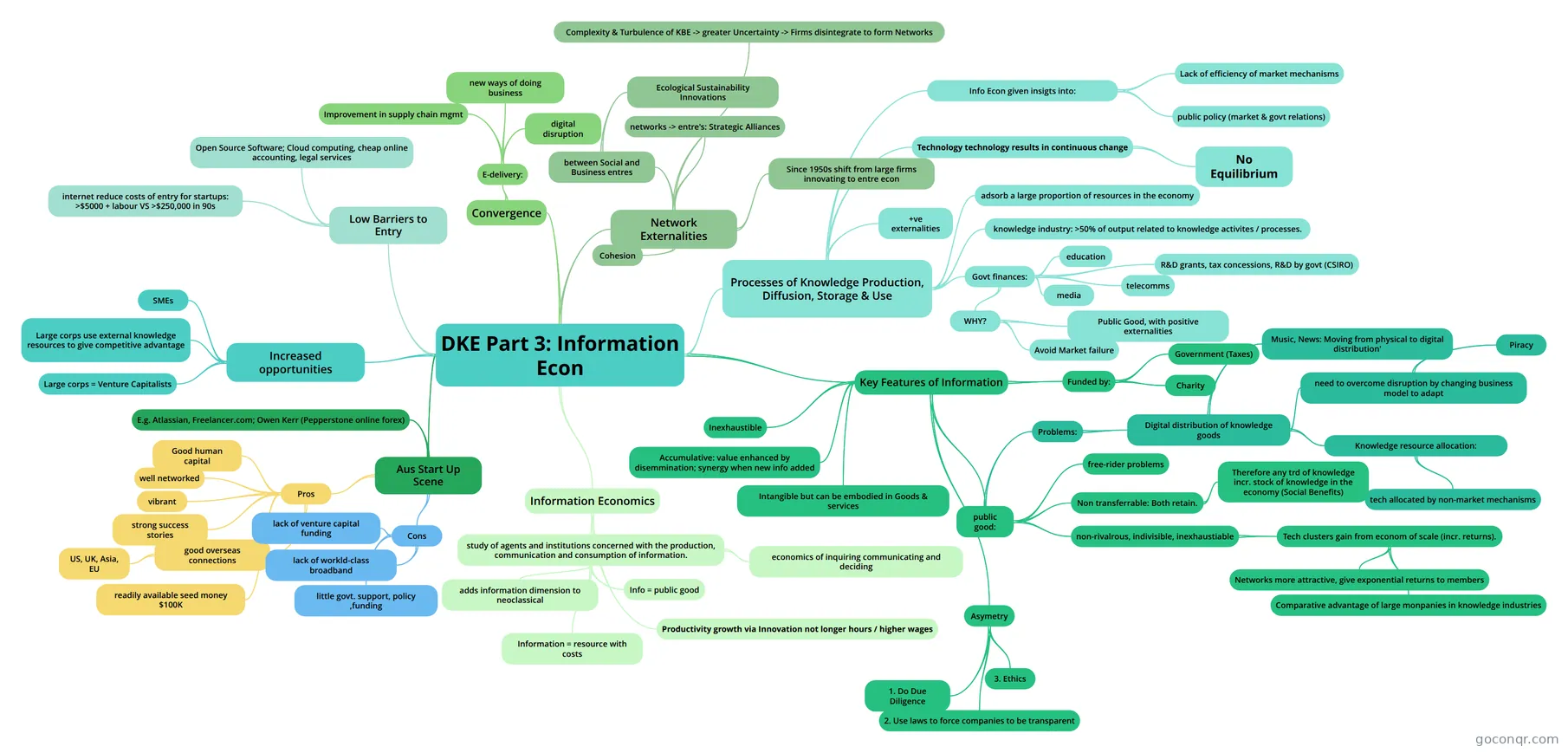
Mind map: Information economics knowledge economy
Conteúdo do mapa
DKE Part 3: Information Econ
Increased opportunities
- SMEs
- Large corps use external knowledge resources to give competitive advantage
- Large corps = Venture Capitalists
Low Barriers to Entry
- internet reduce costs of entry for startups: >$5000 + labour VS >$250,000 in 90s
- Open Source Software; Cloud computing, cheap online accounting, legal services
Convergence
- E-delivery:
- Improvement in supply chain mgmt
- new ways of doing business
- digital disruption
- E-delivery:
Network Externalities
- networks -> entre's: Strategic Alliances
- between Social and Business entres
- Ecological Sustainability Innovations
- Since 1950s shift from large firms innovating to entre econ
- Complexity & Turbulence of KBE -> greater Uncertainty -> Firms disintegrate to form Networks
- Cohesion
Aus Start Up Scene
- E.g. Atlassian, Freelancer.com; Owen Kerr (Pepperstone online forex)
- Pros
- well networked
- vibrant
- strong success stories
- good overseas connections
- US, UK, Asia, EU
- readily available seed money $100K
- Good human capital
- Cons
- lack of venture capital funding
- lack of workld-class broadband
- little govt. support, policy ,funding
Information Economics
- study of agents and institutions concerned with the production, communication and consumption of information.
- adds information dimension to neoclassical
- Information = resource with costs
- economics of inquiring communicating and deciding
- Info = public good
- Productivity growth via Innovation not longer hours / higher wages
- study of agents and institutions concerned with the production, communication and consumption of information.
Processes of Knowledge Production, Diffusion, Storage & Use
- adsorb a large proportion of resources in the economy
- knowledge industry: >50% of output related to knowledge activites / processes.
- +ve externalities
- Govt finances:
- education
- media
- R&D grants, tax concessions, R&D by govt (CSIRO)
- telecomms
- WHY?
- Public Good, with positive externalities
- Avoid Market failure
- Technology technology results in continuous change
- No Equilibrium
- Info Econ given insigts into:
- Lack of efficiency of market mechanisms
- public policy (market & govt relations)
Key Features of Information
- Inexhaustible
- Accumulative: value enhanced by disemmination; synergy when new info added
- Intangible but can be embodied in Goods & services
- public good:
- non-rivalrous, indivisible, inexhaustiable
- Tech clusters gain from econom of scale (incr. returns).
- Comparative advantage of large monpanies in knowledge industries
- Networks more attractive, give exponential returns to members
- Tech clusters gain from econom of scale (incr. returns).
- free-rider problems
- Problems:
- Digital distribution of knowledge goods
- Music, News: Moving from physical to digital distribution'
- need to overcome disruption by changing business model to adapt
- Piracy
- Knowledge resource allocation:
- tech allocated by non-market mechanisms
- Digital distribution of knowledge goods
- Non transferrable: Both retain.
- Therefore any trd of knowledge incr. stock of knowledge in the economy (Social Benefits)
- non-rivalrous, indivisible, inexhaustiable
- Funded by:
- Government (Taxes)
- Charity
- Asymetry
- 1. Do Due Diligence
- 2. Use laws to force companies to be transparent
- 3. Ethics