
Mapa mental
Socialisation
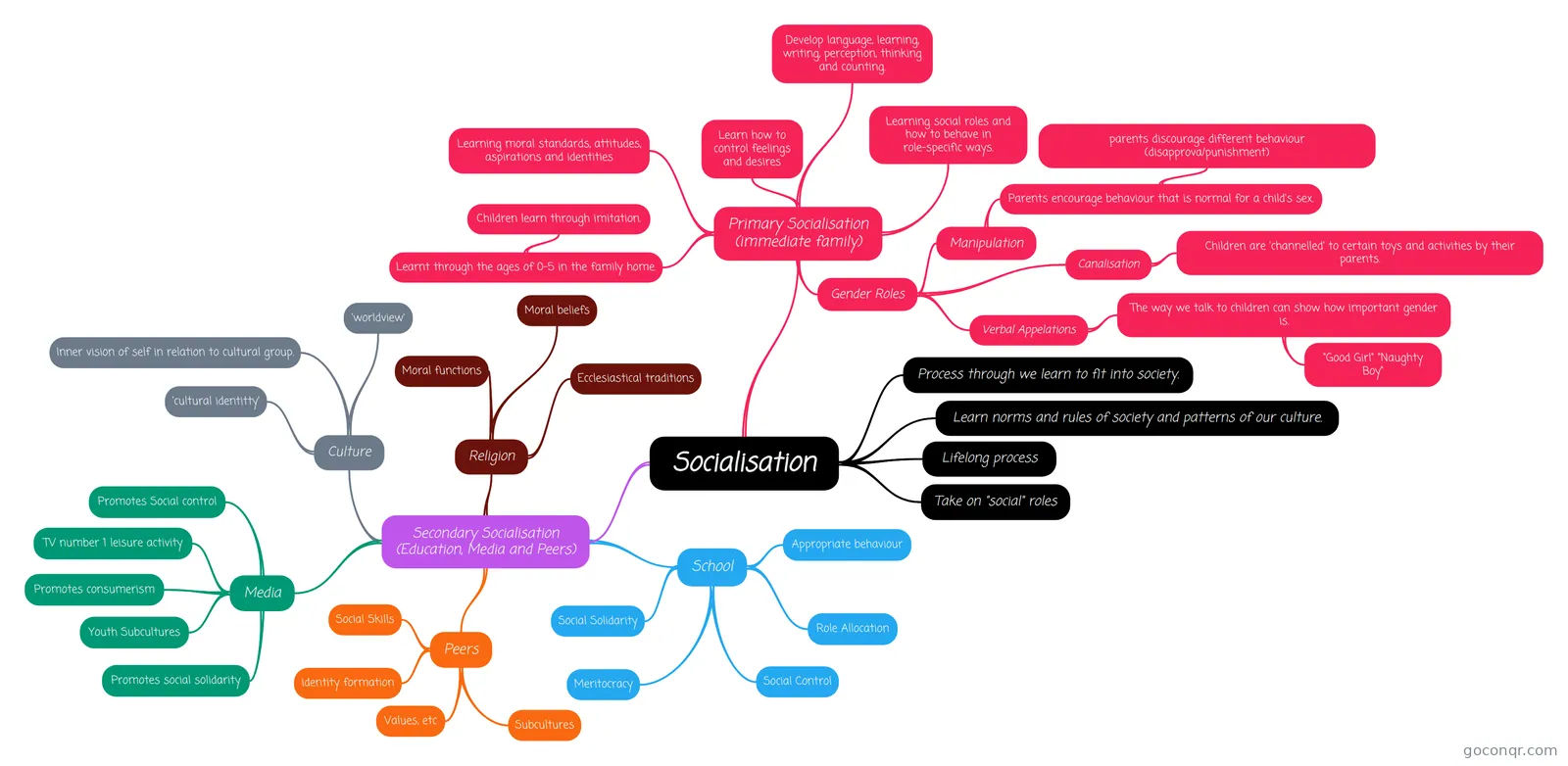
Mind map: Socialisation
Conteúdo do mapa
Socialisation
Primary Socialisation (immediate family)
- Learn how to control feelings and desires
- Develop language, learning, writing, perception, thinking and counting.
- Learning moral standards, attitudes, aspirations and identities
- Learning social roles and how to behave in role-specific ways.
- Learnt through the ages of 0-5 in the family home.
- Children learn through imitation.
- Gender Roles
- Manipulation
- Parents encourage behaviour that is normal for a child's sex.
- parents discourage different behaviour (disapprova/punishment)
- Parents encourage behaviour that is normal for a child's sex.
- Canalisation
- Children are 'channelled' to certain toys and activities by their parents.
- Verbal Appelations
- The way we talk to children can show how important gender is.
- "Good Girl" "Naughty Boy"
- The way we talk to children can show how important gender is.
- Manipulation
Secondary Socialisation (Education, Media and Peers)
- Media
- TV number 1 leisure activity
- Promotes consumerism
- Youth Subcultures
- Promotes social solidarity
- Promotes Social control
- School
- Appropriate behaviour
- Role Allocation
- Meritocracy
- Social Solidarity
- Social Control
- Peers
- identity formation
- Social Skills
- Values, etc
- Subcultures
- Culture
- 'cultural identitty'
- Inner vision of self in relation to cultural group.
- 'worldview'
- Religion
- Ecclesiastical traditions
- Moral beliefs
- Moral functions
- Media
Process through we learn to fit into society.
Learn norms and rules of society and patterns of our culture.
Take on "social" roles
Lifelong process