
Mapa mental
Theories of Romantic Relationships
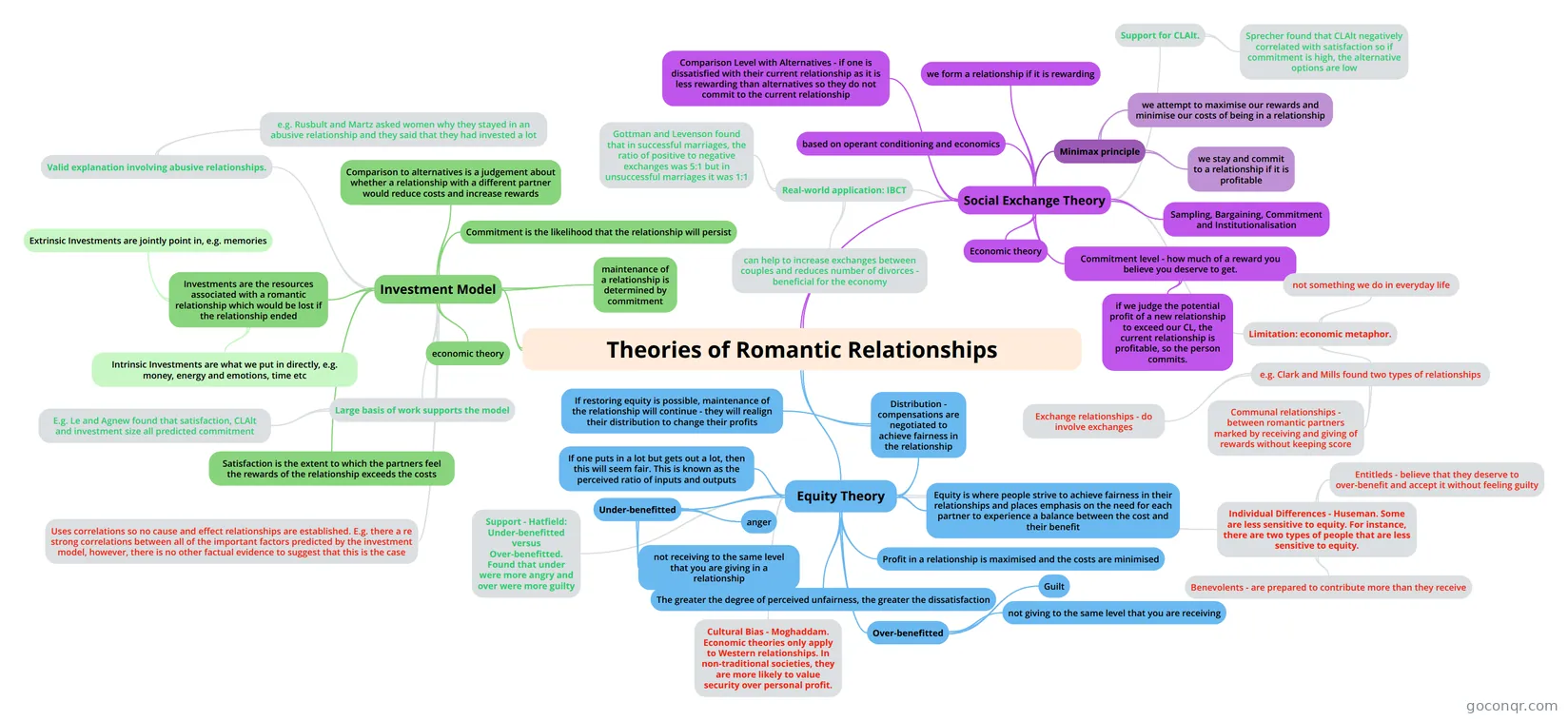
Mind map: Theories of romantic relationships
Conteúdo do mapa
Theories of Romantic Relationships
Social Exchange Theory
- Economic theory
- based on operant conditioning and economics
- we form a relationship if it is rewarding
- Minimax principle
- we attempt to maximise our rewards and minimise our costs of being in a relationship
- we stay and commit to a relationship if it is profitable
- Sampling, Bargaining, Commitment and Institutionalisation
- Commitment level - how much of a reward you believe you deserve to get.
- if we judge the potential profit of a new relationship to exceed our CL, the current relationship is profitable, so the person commits.
- Comparison Level with Alternatives - if one is dissatisfied with their current relationship as it is less rewarding than alternatives so they do not commit to the current relationship
- Support for CLAlt.
- Sprecher found that CLAlt negatively correlated with satisfaction so if commitment is high, the alternative options are low
- Real-world application: IBCT
- Gottman and Levenson found that in successful marriages, the ratio of positive to negative exchanges was 5:1 but in unsuccessful marriages it was 1:1
- can help to increase exchanges between couples and reduces number of divorces - beneficial for the economy
- Limitation: economic metaphor.
- e.g. Clark and Mills found two types of relationships
- Exchange relationships - do involve exchanges
- Communal relationships - between romantic partners marked by receiving and giving of rewards without keeping score
- not something we do in everyday life
- e.g. Clark and Mills found two types of relationships
Equity Theory
- Equity is where people strive to achieve fairness in their relationships and places emphasis on the need for each partner to experience a balance between the cost and their benefit
- Profit in a relationship is maximised and the costs are minimised
- Distribution - compensations are negotiated to achieve fairness in the relationship
- If restoring equity is possible, maintenance of the relationship will continue - they will realign their distribution to change their profits
- The greater the degree of perceived unfairness, the greater the dissatisfaction
- If one puts in a lot but gets out a lot, then this will seem fair. This is known as the perceived ratio of inputs and outputs
- Under-benefitted
- anger
- not receiving to the same level that you are giving in a relationship
- Over-benefitted
- not giving to the same level that you are receiving
- Guilt
- Support - Hatfield: Under-benefitted versus Over-benefitted. Found that under were more angry and over were more guilty
- Cultural Bias - Moghaddam. Economic theories only apply to Western relationships. In non-traditional societies, they are more likely to value security over personal profit.
- Individual Differences - Huseman. Some are less sensitive to equity. For instance, there are two types of people that are less sensitive to equity.
- Benevolents - are prepared to contribute more than they receive
- Entitleds - believe that they deserve to over-benefit and accept it without feeling guilty
Investment Model
- maintenance of a relationship is determined by commitment
- Commitment is the likelihood that the relationship will persist
- economic theory
- Satisfaction is the extent to which the partners feel the rewards of the relationship exceeds the costs
- Investments are the resources associated with a romantic relationship which would be lost if the relationship ended
- Intrinsic Investments are what we put in directly, e.g. money, energy and emotions, time etc
- Extrinsic Investments are jointly point in, e.g. memories
- Comparison to alternatives is a judgement about whether a relationship with a different partner would reduce costs and increase rewards
- Valid explanation involving abusive relationships.
- e.g. Rusbult and Martz asked women why they stayed in an abusive relationship and they said that they had invested a lot
- Large basis of work supports the model
- E.g. Le and Agnew found that satisfaction, CLAlt and investment size all predicted commitment
- Uses correlations so no cause and effect relationships are established. E.g. there a re strong correlations between all of the important factors predicted by the investment model, however, there is no other factual evidence to suggest that this is the case
Informações
- Descrição
- A level Psychology Mapa Mental sobre Theories of Romantic Relationships, criado por Caitlin Hazelton em 19-04-2022.
- Criado por
- Caitlin Hazelton
- Visualizações
- 130
- Tags
- Avaliação