
Mapa mental
Clauses
Conteúdo do mapa
Clauses
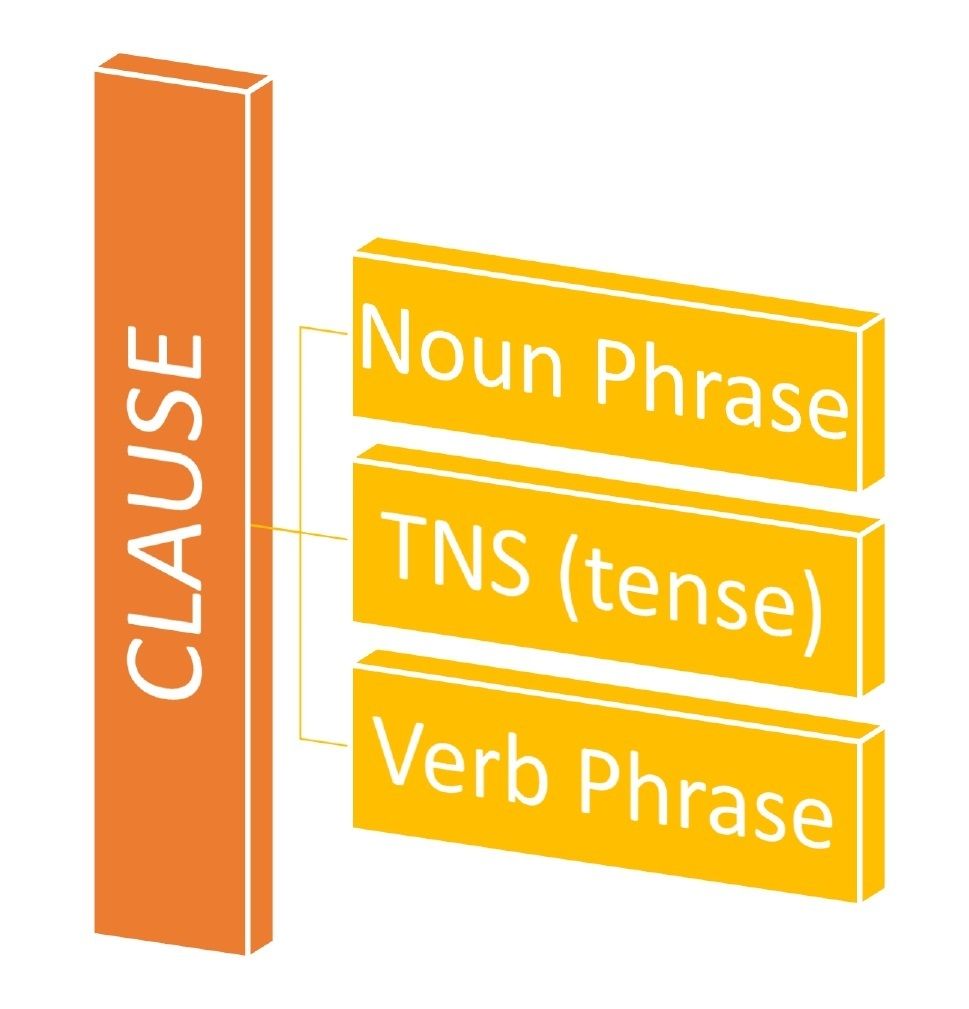
Clauses are syntactic units of the following structure:
- Types of clauses
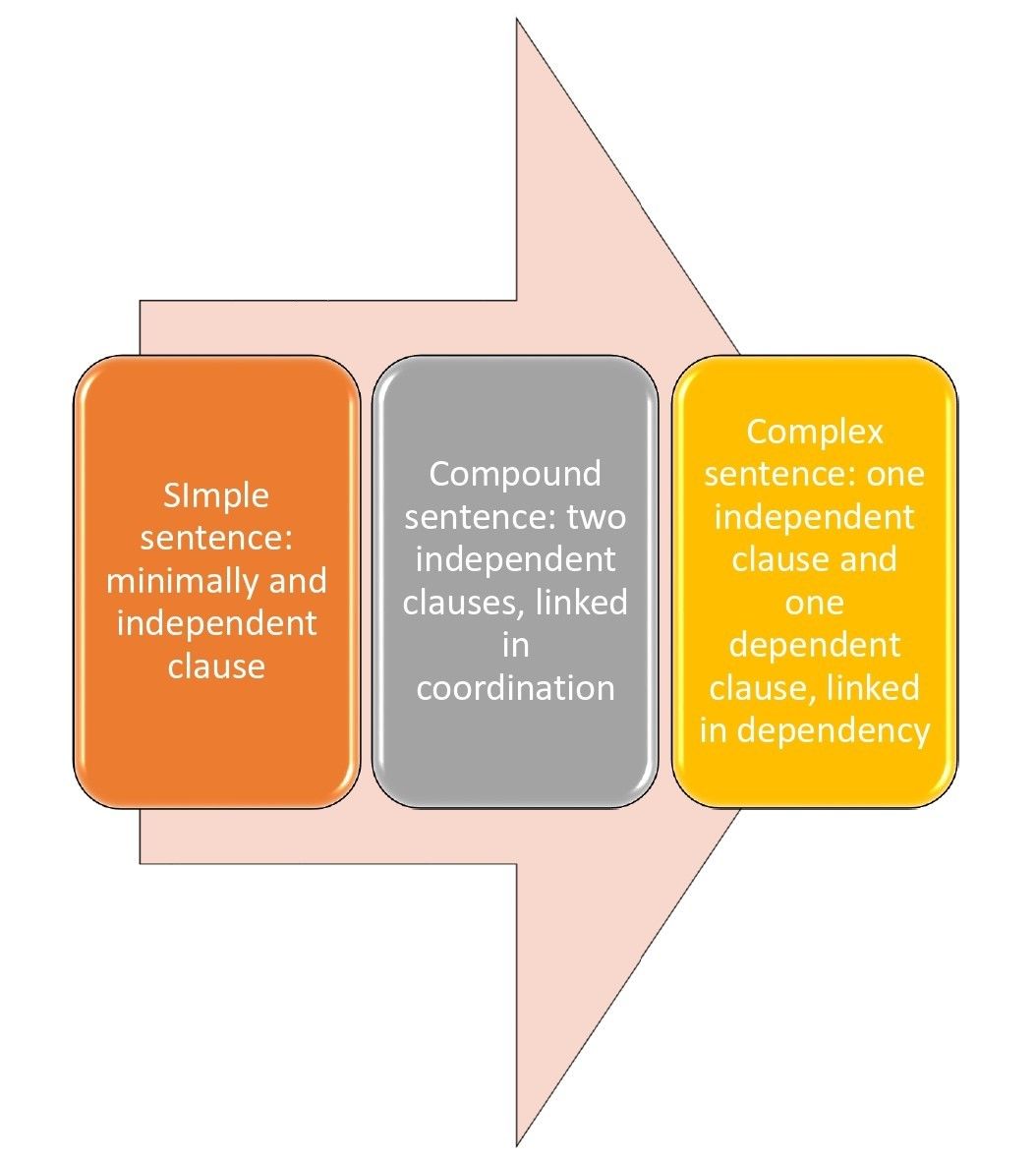
- INDEPENDENT CLAUSE (tensed)➩ It is complete on itself, it is not dependent on another constituent, and it comprise minimal completeness and unity.
- DEPENDENT CLAUSE ➩ It is syntactically dependent on the main clause or another dependent clause.
- Types of clauses
SENTENCE
- Sentence fragments: any phrase that is not an independent clause.
Coordination
- Clauses are either equivalent in status or non-equivalent.
- Coordination displays relationships of equivalence, while dependency is based on non-equivalence.
- Ways to coordinate two clauses:
- By one of the FANBOYS, a conjuctive adverb ( accordingly, futhermore, still, then), a prepositional phrase or through unlinked coordination ( a comma, a semicolon or a dash).
- Ways to coordinate two clauses:
- Non-equivalent
- Sentence relative clause: it has as anticident the firts clause or its complement, is usually introduced by a relative pronoun (which, where, why. what)
- Its subordinate status is signalled by the relative pronoun, and it is used to make a comment or a justification about somenthing
- Non-finite supplementive clauses: the non-finite participial forms -ing (e.g they drove on, wondering how long...) and -ed (e.g. the mountains were invisible, enveloped in a ...) are used to elaborate on the main clause.
- Contrastive dependency: Meanings of contrast and exception can be expressed by dependency, using while, whereas, but for the fact that.
- Sentence relative clause: it has as anticident the firts clause or its complement, is usually introduced by a relative pronoun (which, where, why. what)
- Coordination displays relationships of equivalence, while dependency is based on non-equivalence.
- Clauses are either equivalent in status or non-equivalent.
Subordination
- In subordination one clause is contained within another, and it is dominated by another constituent.
- A subordinate clause is a clause that begins with:
- Subordinator: they are of 3 types: simple (one word), conjuctive group (e.g. even though, as if ect) and complex (derives from verbs or phrases, such as: provided, granted or as long as)
- An adverbial clauses of time, concecission, reason, purpose, result and manner.
- A subordinate clause is a clause that begins with:
- Conditional clauses: open (real), hypothetical (less likely to be fulfilled but not impossible), and counterfactual (a counter to reality: it didn't happen).
- In subordination one clause is contained within another, and it is dominated by another constituent.
Complementizers
- Verbs are not the only heads that select complements, for example: certain adjetives can select tensed complements (e.g. She is happy that Lucas won the award)
- There is a small set of words that introduces different types of subordiante clauses, and we can use them as clues to identify complement types
- Tensed clause complement, bare infinitival clause complements, to-infinitival, participial clause complements, wh-clause complements.
Clausal Subjects
- Clauses can also be subjects, in addition, the complementizers "that" and "for" are obligatory in clausal subjects.
Reporting speech and thought
- Direct speech: resporting the exact words that someone said or wrote.
- Indirect speech: reporting gives the meaning or gist of the content.
- Some verbs used to introduce quoted speech: say, tell. remark, observe, demand, complain, reply, scream, chuckle, sob and choke.
- Direct reporting of thought: thoughts can be quoted (e.g. think, wonder, muse, ponder).
Imagens e arquivos do mapa
Informações
- Descrição
- Mapa Mental sobre Clauses, criado por Micaela Magali Aguirres em 17-05-2022.
- Criado por
- Micaela Magali Aguirres
- Visualizações
- 0
- Avaliação