
Mapa mental
Personal Finance
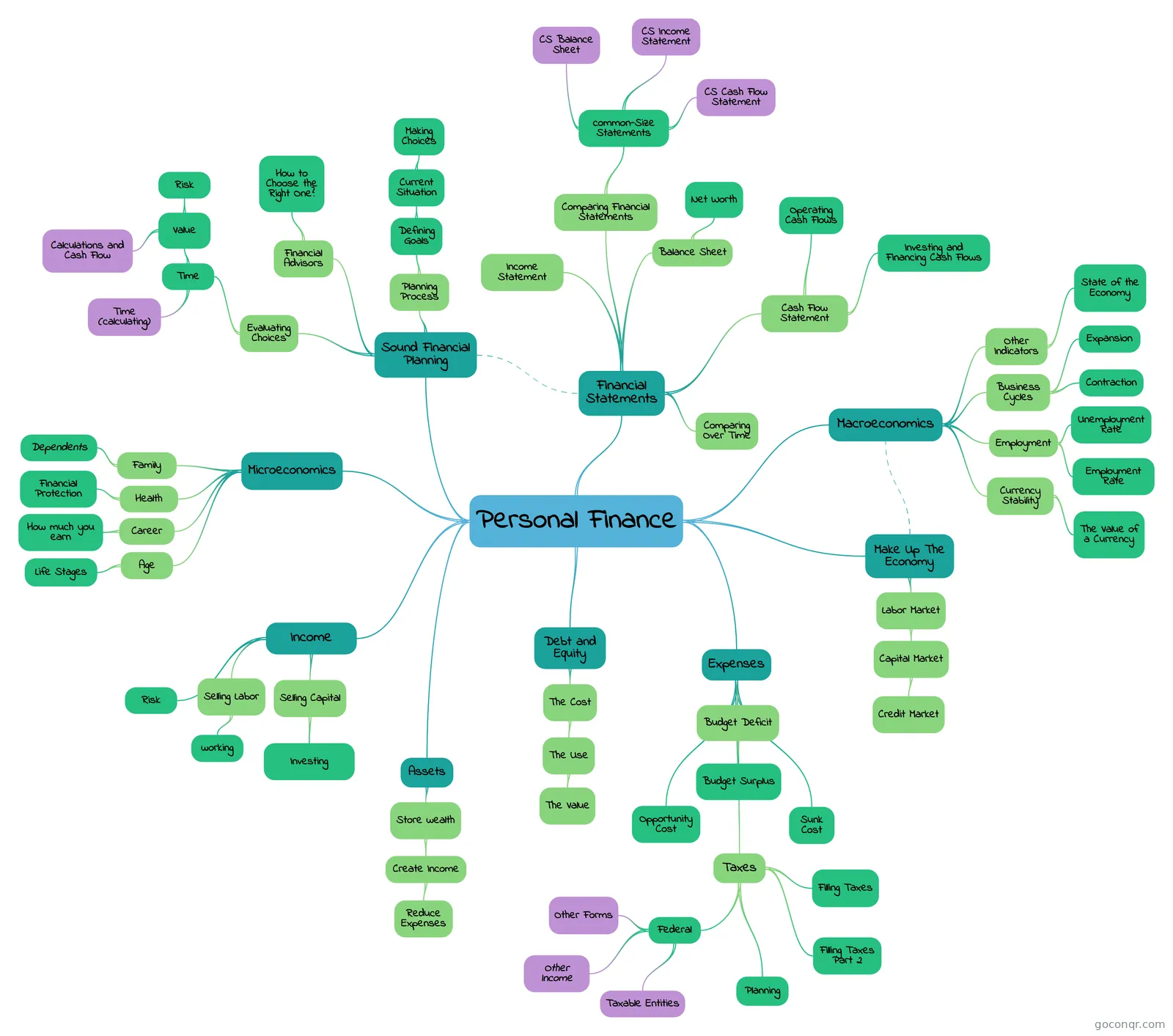
Mind map: Personal finance
Conteúdo do mapa
Personal Finance
Microeconomics
- Family
- Dependents
- Income will cater towards dependents.
- Income needs will increase as well as risk tolerance decreases because you want to protect and provide for your loved ones.
- Wealth will most likely increase because people with dependents will want to have financial protection like life insurance.
- Dependents
- Health
- Financial Protection
- Income will go towards expenses or insurances to prevent future cost.
- Income needs will increase because people desire the need to protect themselves or others from accidents, injuries, or diseases.
- Risk tolerance will decrease because of your desire to be protected just in case something happens in the future.
- Wealth will also go down because your spending more money on your health.
- Financial Protection
- Career
- How much you earn
- Income will depend on your career choice as well as extra earnings like bonuses.
- Income needs will also differ because of how much you can afford.
- Risk tolerance will most like differ because of how much you earn.
- Wealth will also be different depending on pay and expenses (like a required college education).
- How much you earn
- Age
- Life Stages
- Young Adulthood: When starting out in the workforce, a young adults' salary will start out low. Income needs will also be low since they are independent from their parents and have no dependents to take care off. Risk tolerance will be low because you will have very little consequences. Young adults will have very little wealth since they are starting they're just starting in life.
- During middle adulthood we could see an increase in income and investments. This is because adults during this stage would be far enough in their career to start thinking about retirement and since they're so far in the their career they'll also see a higher pay increase. You could also see the risk tolerance increasing because they'll most likely want to build their family as well as the need to increase their income needs. Middle adults are also accumulating wealth because they would want to start buying a house and a new car.
- Later adulthood you would have less income coming in and more on wealth and investments. You will also have less income needs because your children are now grown and parents are most likely passed. Risk tolerance decreases as you want to protect your assets since it's becoming your main source of income. Your wealth will also be your main source of income because you have invested in medicare and life insurance.
- As this point when you hit retirement you will rely on your investments for income. Income needs will just be on you or your spouse since your kids are adults. Risk tolerance will be low because investments is your only income. Your wealth will also be increases because you saved up over time.
- Age and stages of life affect sources of income, asset accumulation, spending needs, and risk tolerance.
- Life Stages
- Family
Macroeconomics
- Business Cycles
- Expansion
- Metaphors: Peaks, boom, growth, etc.
- Contraction
- Metaphors: Troughs, bust, correction, etc.
- Expansion
- Employment
- Unemployment Rate
- The Unemployment is a "natural" rate because transfer between jobs all the time.
- Unemployment should be consistently low because it shows that the economy is not efficient.
- Employment Rate
- The employment rate shows how successful the economy is at selling labor and creating opportunities of human resources.
- The employment rate provides a healthy economy because it creates consumer satisfaction throughout its' markets.
- Workers will sell their labor at a higher cost if there are fewer people in their line of work and vice versa. You may also gain bargaining power in the labor market.
- Unemployment Rate
- Currency Stability
- The Value of a Currency
- The value of a currency is based on how it can be used in trade.
- If the demand is (high/low) then the currency has (lot of/little) value because there's (more/less) use in trade.
- Purchasing power will depend on the currency value and vice versa.
- Currency can be measured by stored wealth and invested. If it is unstable then investment returns are harder to predict, which could create more risk.
- The Value of a Currency
- Other Indicators
- State of the Economy
- An expanding and growing economy will offer more choices to people: labor, capital, income, and less risk.
- A contraction or decrease in the economy will offer less opportunities and could lead to a loss of income or employment.
- State of the Economy
- Business Cycles
Make Up The Economy
- Labor Market
- Capital Market
- Credit Market
- Capital Market
- Labor Market
Sound Financial Planning
- Evaluating Choices
- To project future financial statements, you need to be able to envision the expected results of all the items on them. This can be difficult, for there can be many variables that may affect your income and expenses or cash flows (CF), and some of them may be unpredictable. When making financial decisions, it is helpful to be able to think in terms of their consequences on the financial statements, which provide order to our summary of financial results.
- Time
- It's important to think time because time could affect our finances good or bad. Time will affect the value of cash because time affects liquidity.
- Since liquidity is valuable, we can infer that the liquidity of an asset will affect its' value (the more liquid an asset is, the better).
- Obtaining liquidity for your wealth over time creates transaction costs, opportunity costs, and risk. This takes away the value of your wealth.
- The difference between not-so-liquid wealth and liquidity is time. Cash flows in the past are sunk cost, cash flows in the present are liquidity, and cash flows in the future are not yet liquid. You can only choose to use liquid wealth in the present and not in the past or future.
- If you separate your liquidity and your choices based on time, then you get an opportunity cost (if you have liquidity now, then you can use it for consumption or investing). However, there is a risk because there's an uncertainty about the future.
- The further you are from your future cash flows, the further you are from your liquidity. The more opportunity cost and risk you have, the more that takes away from the present value (PV) of your wealth. Basically, time puts distance between you and your liquidity, which creates costs that take away the value. The more time there is, the larger the effect is on wealth.
- Value
- It's quite common to value a series of future cash flows (like with investments and other deposits). Likewise, the present value of a series of cash flows is equal to the sum of the present value for each cash flow. So you would find the present value of each cash flow and then add them up.
- To calculate the present value of an annuity, you need to know: the amount of the future cash flows (the same for each), the frequency of the cash flows, the number of cash flows (t), and the rate at which time affects value (r).
- Let's say you get a huge amount of inheritance and you have the choice of receiving it now or later. If the discount rate is less than 4%, you won't have any choice of gaining a bigger profit. That means that the annuity is worth more than the original payout. But, if your discount rate is greater than 4%, you would have a higher chance of gaining more profit, which means that the annuity is worth less than the payout.
- When relating to cash flow's present or future values, the greater the rate at which time affects value, the greater the effect on the present value. When the opportunity cost and risk are low, you have nothing better to do with your liquidity. But when the opportunity cost and risk are high, then you can sacrifice your liquidity by not having as much.
- Liquidity is valuable because it allows you to make valuable choices. Without liquidity, you would lose a little just by giving it up. The higher the rate at which time affects value, the more it costs to wait for liquidity, and the more choices pass you by while you wait for liquidity.
- When the risk is high, however, you would want to get more liquidity sooner because it lessens the chance of not getting it at all. The higher the rate at which time affects value, the more risk there is in waiting for liquidity and the more chance that you won’t get it at all. But when risk is low, it is not really important to have your liquidity because you’ll have it sooner or later anyhow. So when the rate increases, the present value of the annuity decreases. If the rate decreases, the present value of the annuity increases.
- As the cash flow increases so do the present value. Same thing if the cash flow decreases, the present value will too. As time increases the distance of liquidity, with an annuity, also increases the number of payments because payments occur periodically. The more periods in the annuity, the more cash flows, and the more liquidity there are, thus increasing the value of the annuity. As time increases, the present value of annuity increases, and as time decreases so does the present value of the annuity.
- Risk
- The probability or likelihood of an independent event can be measured, based on its frequency in the past, and that probability can be used to predict whether it will recur. Independent events can be the result of complex situations. They can be studied to see which confluence of circumstances or conditions makes them more or less likely or affect their probability. But an independent event cannot be determined or chosen.
- The probability of any one outcome for an event is always stated as a percentage of the total outcomes possible. An independent or risky event has at least two possible outcomes: it happens or it does not happen.
- Probabilities can be used in financial decisions to measure the expected result of an independent event. The expected value can be weighed against or compared to the values of other choices.
- Calculations and Cash Flow
- The bigger the effect of time on value, the more value you will end up with because more time has affected the value of your money while it was growing as it waited for you. So if the rate increases, then the future value of the annuity increases. If the rate decreases, then the future value of the annuity decreases as well.
- The more time there is, the more time can affect value. As payments occur periodically, the more cash flows there are, the more liquidity there is. The more periods in an annuity, the more cash flows, which have a greater effect on time, thus increasing the future value of the annuity. If time increases, the future value of an annuity will also increase. If time decreases, then the future value of the annuity decreases.
- Perpetuity can be defined as an infinite annuity. The dividends from a share of corporate stock are perpetuity because as cooperation is around and making a profit, it will keep producing dividends for its' shareholders. The perpetuity represents the maximum value of the annuity, or the value of the annuity with the most cash flows and therefore the most liquidity and therefore the most value.
- The periodic unit used is defined by the frequency of the cash flows and must agree for all variables. Financial calculators are designed for financial calculations and have the equations relating the present and future values, cash flows, the discount rate, and time embedded, for single amounts or for a series of cash flows, so that you can calculate any one of those variables if you know all the others. These tools are usually presented as a “mortgage calculator,” a “loan calculator,” or a “retirement planner”.
- Time (calculating)
- In order to do calculations, you need to understand the relationship between time, risk, opportunity cost, and value. To do this you need to know the following: what will the future cash flows (CF) will be, when will the future cash flows be, and what is the rate at which time affects value (the costs per time period).
- People often use the discount rate when making a judgment on how time will affect money because time discounts value. The discount rate is an opportunity cost because it underwent some choices or sacrificed alternatives.
- At times those alternatives can be clear; your opportunity cost could be a loan you took out or you just purchased a payment, other times, however, your opportunity cost is not so clear (like receiving income in the future).
- The more value you place on having something, the more it “costs” you not to have it, and the more time that you are without it affects its value. Assuming that you receive a large payment today instead of waiting two years, by not waiting you could earn an additional interest rate on it. But if you have to wait two years to receive the income, then you would miss out on additional money.
- Having the choice of receiving the money now or later, or spending or investing the money, is an opportunity cost. The more time (t) separating you from your liquidity, the more time affects value and vice versa. So as time increases, the present value of your future liquidity decreases. If time decreases, then the present value of your future liquidity increases.
- The greater the rate at which time affects value (r), or the greater the opportunity cost and risk, the more time affects value. The less your opportunity cost or risk, the less your value is affected. So as the rate increases, the present value of your future value liquidity decreases. If the rate decreases, the present value of your future value liquidity increases.
- In short, it's more valuable to have liquidity sooner than later. You should also give up liquidity later rather than sooner. If possible, accelerate incoming cash flows and decelerate outgoing cash flows (get paid sooner, but pay out later).
- Financial Advisors
- How to Choose the Right One?
- There are many different types of financial advisors including accountants, investment advisors, tax advisors, estate planners, or insurance agents. Each one has educational and professional experience working in their field. However, each company may differ in training and other areas.
- Certifications play a big role because they determine the area of study they've learned in a certain financial area.
- It's important to understand how a financial advisor is compensated or paid in return for giving advice. Sometimes it's a simple process: advisors give the advice and they receive payment. However, some are selling a product or service and will get paid whenever a certain amount is being used or sold.
- Friends and family can be another good advice to go to sense they know you personally. But they might not have the same problems or experiences in a certain financial field as a professional would. So it's important to diversify your information and think about how will you receive it.
- How to Choose the Right One?
- Planning Process
- Defining Goals
- Figuring out where you want to go is the process of coming up with a goal. You'll usually have short-term goals (1-2 years), intermediate goals (2-10 years), or long term goals (more than 10 years) that must be at least realistic and flexible.
- When setting up goals you should use a popular method called the S.M.A.R.T method. S.M.A.R.T stands for Specific, Measurable, Attainable, Realistic, and Timely.
- Current Situation
- The first step when accessing your current financial situation is to receive a financial statement (explained the other bubble). This will show a list of assets, debts, and annual incomes and expenses.
- Making Choices
- Figuring how to go from here to there is the process of defining choices in your planning process. You must be realistic and a little bit imaginative in your planning process for future goals. You must also consider your microeconomic factors as well the macroeconomic factors.
- The first thing you would want to do in making decisions is finding alternative solutions to your income. Evaluate your solutions by thinking about your cost and benefits as well as the risk in your decision. You should also think about where it will get you. Will you closer to your goal? Will you be further behind? What position will your finances be?
- Defining Goals
- Evaluating Choices
Financial Statements
- Results for a period are shown on the income statement and the cash flow statement. Current conditions are shown on the balance sheet.
- Income Statement
- The income statement shows the relative size of your income and expenses. You can see which expenses has the greater proportion of your finances and see which impacts your income the most.
- Balance Sheet
- Unlike cash flows and income statements, the balance sheet gives out very detailed financial information on a specific date.
- The balance sheet is also a list of assets, debts or liabilities, equity or net worth with their values. "Balance" sheets always balances the debt and equity with the values of the assets.
- Net Worth
- If assets are greater than liabilities, your net worth would be greater than zero which means it's a positive net worth (because it has positive numbers). If assets are less than debt, then your net worth would be negative because your debts outweigh your net worth.
- So for a more simpler version; If net worth is greater than debt, it's positive and you could pay off your liabilities faster. However, if your net worth is negative (you owe more money than the value of your assets), then you would are screwed.
- See part two for more information about net worth and bankruptcy.
- Cash Flow Statement
- Cash flow statements differs from income statements because they may include cash flows that are not from income or expenses.
- Cash flow statements are important because they show how well your creating liquidity as well as net income. So basically, cash flow statements show you how well you're saving your money.
- Operating Cash Flows
- Cash flows regularly and are a result from income and expenses, so they can be expected to occur every year. Operating cash flow could also happened every period with different amounts
- Investing and Financing Cash Flows
- Investing and financing may not occur often because you wouldn't borrow, lend, buy or sell assets every year.
- Comparing Financial Statements
- Common-size statements puts the details of the financial statement in a more simplified way. But each financial statement is related to each other in a way because they all represent the bigger picture of your finances.
- For example, anything that happens in an income and cash flow statement will reflect the balance sheet. This is because your earnings and expenses and other cash flows will affect the values of assets and debts, which would then affect the net worth.
- Cash may be used to buy or pay off a payment that could result in a negative cash flow because your increasing assets while decreasing liabilities. Cash may be received when an asset gets sold or you borrow money that could result in a positive cash flow because your decreasing assets and increasing liabilities.
- You can see from beginning to end of the period in a balance sheet while you see what happens during the period in an income or cash flow statement.
- common-Size Statements
- Each common-size statement shows an items value as a percentage to another. They compare each items' significance as well as their relative size.
- Income statement shows each income and expenses as a listed percentage of the total income. This also shows the diversification in income and the burden of each expenses.
- On a cash flow statement each cash flow can be listed as a total percentage of a positive cash flow. This again shows the diversification and burden of each source/use of cash.
- Balance sheets shows each item as a percentage of the total assets. This shows the significance of assets as well as highlighting the use of debt to finance for assets.
- Common-size statements allows you to look at the size of each item to the percentage of total income (income statement), total positive cash flow (cash flow statement), or total assets (balance sheet).
- The size of each piece can help you figure out which is the smallest or largest expenses or income. Common-size statements can help point out the diversification of income (income statement), cash flow (cash flow statement), and assets and liabilities (balance sheet).
- CS Income Statement
- CS income statement points out large expenses by size and offers insight on which expenses have the largest impact on income. It also gives insight on life style choices and how they can be altered to make up for expenses.
- CS Cash Flow Statement
- When looking at the cs cash flow statement, we can see the use and source of cash as a percentage of a positive cash flow.
- CS Balance Sheet
- On a cs balance sheet, you would see the measurement of how much of the assets’ value is obligated to cover each debt by a percentage of the total asset (how much of the assets' value is claimed by each debt).
- Comparing Over Time
- Another good way of comparing financial statements is looking at the changes over time. Comparisons over time provide insights to past financial decisions, which could help shape future ones.
- By analyzing over time, you can spot trends that may be too slow or too fast within a given period. It is important to keep a closer eye on your finances and review it once a year.
- That insight can guide you in making future financial decisions, particularly in foreseeing the potential costs or benefits of a choice.
Income
- Selling Labor
- working
- Income comes in a form of a paycheck with other benefits such as retirement and insurance.
- working
- Selling Capital
- Investing
- People will pay money to lend a certain amount of money; over time they would pay back that same amount plus the interest depending on how long they lend it. You can invest in different ways such as buying government bonds and buy stocks in the stock market. Banks rely on investments from other people because that's how they make their money (most of the time).
- You can invest in assets alone including items, land, cars, light crude oil, etc. Most people would just stick to selling labor before they invest. Once they have enough assets to sell, they can participate in a buyers' market and try and earn income that way.
- Investing
- Risk
- You don't just need to know how to earn income but you also need to protect it. The more wealth and income you have, the more your at risk to lose it. To prevent from losing your assets, it's recomended that you diversify your investments.
- The more investments you have, the less risk that reduces. An example would be if your only invest in the labor market, then you are at more risk because only your income is coming through work. But is you work while also investing in the stock market and other assets, you are decreasing that risk of losing your income because you have multiple sources.
- The best way to diversify your income is to sell both labor and capital. Because you are trading in more than one market, you are less likely to take a hit if one of the markets isn't doing real well.
- Selling Labor
Expenses
- Budget Deficit
- To fix a budget deficit is to increase your income, reduce expenses, or borrow money to make up the loss income.
- Budget Surplus
- To stabilize a budget surplus would be to consume more or save it. You could choose to work bring home extra income, but the latter two would be your best option. However, if you choose to consume more than your income will dwindle.
- If you choose to save your income then you will most likely invest your money (like depositing in your bank account). You can trade in assets such as stocks, bonds, or real estate.
- You can also increase your wealth in the capital market by depositing your money in a savings account, invest in retirement, purchasing a certificate of deposit (CD), or deposit into a money market account.
- Opportunity Cost
- Opportunity cost can help you decide whether you want to pay something with cash or borrow. Either way, you'll end having to give up something in return. Like if you pay something with cash you'll lose liquidity or if you decide to borrow then you'll have to pay even more money.
- When deciding on opportunity cost it's important to think about what your not getting as well as figuring out the consequences for sunk cost.
- Sunk Cost
- Sunk cost are generally purchases that you can never get back again (once its gone, it's gone). This will help you make a wise decision in your finances once you start thinking about where your money is going.
- Taxes
- Governments tax income because it is a way to tax broadly based on the ability to pay. Most adults have an income from some source, even if it is a government distribution. Those with higher incomes should be able to pay more taxes, and in theory should be willing to do so, for they have been more successful in or have benefited more from the economy that the government protects.
- Income tax is usually in a form of a progressive tax, the more income you earn, the more you'll be taxed. The range of the tax rate is known as a tax bracket. Tax is levied on income from many sources: wages (selling labor)Interest, dividends, and gains from investment (selling capital), self-employment (operating a business or selling a good or service), property rental, royalties (rental of intellectual property), “other” income such as alimony, gambling winnings, or prizes.
- In the United States, sales taxes are imposed by state or local governments; as yet, there is no national sales tax. Sales taxes are said to be more efficient and fair in that consumption reflects income as income determines the ability to consume and therefore level of consumption. Consumption is also hard to hide, making sales tax a good way to collect taxes based on the ability to pay. Consumption taxes typically tax all consumption, including nondiscretionary items such as food, clothing, and housing.
- Value-added tax (VAT) or goods and services tax (GST) is used outside of the United States. It is a consumption tax, but it differs from the sales tax, which is paid only by the consumer as an end-user. With a VAT or GST, the value added to the product is taxed at each stage of production. Governments use a VAT or GST instead of a sales tax to spread the tax burden among producers and consumers and thus reduce the incentive to evade the tax. A consumption tax, like the sales tax, is a regressive tax. When traveling abroad, you should be aware that a VAT may add substantially to the cost of purchase (such as meals, accommodations, events, and transportation).
- Excise tax is taxes on specific consumption items such as alcohol, cigarettes, motor vehicles, fuel, or highway use. Excise taxes are justified by the discretionary nature of the purchases, however, they may be criticized as exercises in social engineering, i.e., using the tax code to encourage or discourage certain social or personal behaviors. Excise taxes tend to be levied on items that people will buy even if a tax increases the price. For example, people who enjoy nicotine or alcohol tend to purchase cigarettes or liquor even if an excise tax increases their cost—and are therefore a reliable source of tax revenue.
- Property taxes are used by more local—state, municipal, provincial, and county—governments, and are most commonly imposed on real property (land and buildings) but also on personal assets such as vehicles and boats. Property values theoretically reflect wealth (accrued income) and thus the ability to pay taxes. Property values are also a matter of public record (real property is deeded, boats or automobiles are licensed, etc.), which allows more efficient tax collection.
- Estate taxes are taxes on the transfer of wealth from the deceased to the living. Estate taxes are usually imposed on the very wealthiest based on their unusual ability to pay. Because death and the subsequent dispersal of property is legally a matter of public record, estate taxes are generally easy to collect. Estate taxes are controversial because they can be seen as a tax on the very idea of ownership and on incomes that have already been taxed and saved or stored as wealth and properties. Still, estate taxes are a substantial source of revenue for the governments that use them, and so they remain.
- The three tax jurisdictions in America are national or federal, provincial or state, and county or municipal. Income, VAT or GST, Excise, and Estate are all federal or national taxes. Income, Sales, VAT or GST, Excise, Property, and Estate are provincial or state taxes. Income, Sales, Excise, and Property are county or municipal taxes.
- Federal
- For individuals, the first step in the process is to calculate total income. Income may come from many sources, and each income must be calculated and declared. The most common source of income is wages or salaries from an employer. Other types of income may require a separate form or schedule to show their more detailed calculations.
- Interest income is income from selling liquidity. For example, the interest that your savings account, certificates of deposit, and bonds earn in a year is income. You are earning interest from lending cash to a bank, a money market mutual fund, a government, or a corporation (though not all your interest income may be taxable). Dividend income, on the other hand, is income from investing in corporate ownership. Dividends are your share of corporate profits as a shareholder, distributed in proportion to the number of shares of corporate stock you own.
- Business income is income from self-employment or entrepreneurial ventures or business enterprises. For sole proprietors and partners in a partnership, business income may be the primary source of income. Many other individuals rely on wages, but have a small business on the side for extra income. Business expenses can be deducted from business income, including, for example, business use of your car and home. If expenses are greater than income, the business is operating at a loss. Business losses can be deducted from total income, just as business income adds to total income.
- The tax laws distinguish between a business and a hobby that earns or loses money. You are considered to have a business for tax purposes if you earned a profit in three of the past five years including the current year or if you are operating as a registered business with the intention of making a profit. If you are operating your own business, you also must also pay self-employment tax on business income. In addition, the self-employed must pay estimated income taxes in quarterly installments based on expected income.
- Self-employment tax is an additional tax on income from self-employment or business income earned by a sole proprietor. It represents the employer’s contribution to Social Security and to Medicare, which are both mandatory programs of the federal government. Both employers and employees are required to contribute to the employee’s Social Security account. When you are both the employee and the employer, as in self-employment, you must contribute both shares of the contribution.
- The tax code distinguishes between assets held for a short time, less than one year, and assets held for a long time, one year or more. Short-term capital gains or losses are taxed at a different rate than long-term capital gains or losses. Short-term capital gains are taxed as regular income. Long-term capital gains are taxed at 0%, 15%, or 20%, depending on the investor’s income tax bracket, and thus long-term capital gains are taxed at lower rates than short-term capital gains or regular income.
- Taxable Entities
- There are four taxable entities in the federal system: the individual or family unit, the corporation, the nonprofit corporation, and the trust. Personal financial planning focuses on your decisions as an individual or family unit, but other tax entities can affect individual income. Corporate profit may be distributed to individuals as a dividend, for example, which then becomes the individual’s taxable income. Likewise, funds established for a specific purpose may distribute money to an individual that is taxable as individual income.
- The definition of the taxable individual or family unit is further classified by filing status: Single, never married, widowed, or divorced; Married, in which case two adults file as one taxable “unit,” combining all taxable activities and incomes, deductions, exemptions, and credits; Married filing separately, in which case two married adults file as two separate taxable individuals, individually declaring and defining incomes, deductions, exemptions, and credits, Head-of-household, for a family of one adult with dependents.
- All taxable entities have to file a declaration of incomes and pay any tax obligations annually. Not everyone who files a return actually pays taxes, however. For individuals with low incomes and tax exempt, nonprofit corporations typically do not. All potential taxpayers nevertheless must declare income and show their obligations to the government. For the individual filing in the United States, that declaration is filed on Form 1040. Although it has been revised and alternative versions (1040A, 1040EZ) have been created over the years, Form 1040 has been in use since the income tax was initiated in the United States in 1913.
- Other Forms
- Deductions and exemptions reduce taxable income, while credits reduce taxes. Deductions are tax breaks for incurring certain expenditures or for living in certain circumstances that the government thinks you should not have to include in your taxable income. There are deductions for age and for blindness. For other deductions, there is a standard, lump-sum deduction that you can take, or you may choose to itemize your deductions, that is, detail each one separately and then calculate the total. If your itemized deductions are more than your standard deduction, it makes sense to itemize. Other deductions involve financial choices that the government encourages by rewarding with an extra incentive in the form of a tax break. For example, charitable donations are deductible to encourage charitable giving.
- Deductions are also created for expenditures that may be considered nondiscretionary, such as medical and dental expenses or state and local income and property taxes. As with income adjustments, you have to read the instructions carefully, however, to know what expenditures qualify as deductions. Some deductions only qualify if they amount to more than a certain percentage of income and some deductions are capped at a maximum amount, while others may be deducted regardless. Some deductions require an additional form to calculate specifics, such as charitable gifts not given in cash, investment interest, and some mortgage interest.
- There are exemptions based on the number of your dependents, who are usually children but may be elderly parents or disabled siblings, that is, relatives who generally cannot care for themselves financially. Exemptions are made for dependents as nondiscretionary expenditures, but the government also encourages individuals to care for their financially dependent children, parents, and siblings because without such care they might become dependents of a government safety net or a charity.
- Your tax is based on your taxable income, on a progressive scale. You may have additional taxes, such as self-employment tax, and you may be able to apply for credits against your taxes, such as the earned income credit for lower-income taxpayers with children. Deductions, exemptions, and credits are some of the more disputed areas of the tax code. Because of the depth of dispute about them, they tend to change more frequently than other areas of the tax code.
- You pay taxes during the tax year by having them withheld from your paycheck if you earn income through wages, or by making quarterly estimated tax payments if you have other kinds of income. When you begin employment, you fill out a form (Form W-4) that determines the taxes to be withheld from your regular pay. You may adjust this amount, within limits, at any time. If you have both wages and other incomes, but your wage income is your primary source of income, you may be able to increase the taxes withheld from your wages to cover the taxes on your other income, and thus avoid having to make estimated payments. However, if your nonwage income is substantial, you will have to make estimated payments to avoid a penalty and/or interest.
- The government requires that taxes are withheld or paid quarterly during the tax year because it uses tax revenues to finance its expenditures, so it needs a steady and predictable cash flow. Steady payments also greatly decrease the risk of taxes being uncollectible. State and local income taxes must also be paid during the tax year and are similarly withheld from wages or paid quarterly.
- Besides income taxes, other taxes are withheld from your wages: payments for Social Security and Medicare. Social Security or the Federal Insurance Contributions Act (FICA) and Medicare are federal government programs. Social Security is insurance against loss of income due to retirement, disability, or loss of a spouse or parent. Individuals are eligible for benefits based on their own contributions—or their spouse’s or parents’—during their working lives, so technically, the Social Security payment withheld from your current wages is not a tax but a contribution to your own deferred income.
- If you have paid more during the tax year than your actual obligation, then you are due a refund of the difference. You may have that amount directly deposited into a bank account, or the government will send you a check. If you have paid less during the tax year than your actual obligation, then you will have to pay the difference (by check or credit card) and you may have to pay a penalty and/or interest, depending on the size of your payment. The deadline for filing income tax returns and for paying any necessary amounts is April 15, following the end of the tax year on December 31. You may file to request an extension of that deadline to August 15. Should you miss a deadline without filing for an extension, you will owe penalties and interest, even if your actual tax obligation results in a refund. It really pays to get your return in on time.
- Other Income
- Rental or royalty income is income earned from renting an asset, either real property or a creative work such as a book or a song. This can be a primary source of income, although many individuals rely on wages and have some rental or royalty income on the side. Homeownership may be made more affordable, for example, if the second half of a duplex can be rented for extra income. Rental expenses can also be deducted from rental income, which can create a loss from rental activity rather than a gain. Unlike a business, which must become profitable to remain a business for tax purposes, rental activities may generate losses year after year. Such losses are a tax advantage, as they reduce total income.
- Partnerships and S corporations are alternative business structures for a business with more than one owner. For example, partnerships and S corporations are commonly used by professional practices, such as accounting firms, law firms, medical practices, and the like, as well as by family businesses. The partnership or S corporation is not a taxable entity, but the share of its profits distributed to each owner is taxable income for the owner and must be declared.
- Farm income is income from growing food, livestock, or livestock products, such as wool, to sell. Farmers have a special status in the tax code, stemming from the original agricultural basis of the U.S. economy and the strategic importance of self-sufficiency in food production. Thus, the tax code applies for exemptions specifically to farmers.
- Other taxable income includes alimony, state or local tax refunds, retirement fund distributions from individual retirement accounts (IRAs) and/or pensions, unemployment compensation, and a portion of Social Security benefits. Your total income is then adjusted for items that the government feels should not be taxed under certain circumstances, such as savings in health savings or retirement accounts; a portion of self-employment taxes; student loan interest; tuition and educational fees; and alimony paid. A portion of the income from a qualified business, partnerships, and S corporations may also be deducted.
- Income that is not taxed by the U.S. government and does not have to be reported as income includes the following: welfare benefits, Interest from most municipal bonds, most gifts and inheritance legacy, workers' compensation, veteran’s benefits, federal tax refunds, and some scholarships and fellowships. It’s important to read tax filing instructions carefully, however, because not everything you’d think would qualify actually does. The government allows adjustments to be reported (or not reported) as income only under certain circumstances or up to certain income limits, and some adjustments require special forms. The result of deducting adjustments from your total income is a calculation of your adjusted gross income (AGI). Your AGI is then further adjusted by amounts that may be deducted or exempted from your taxable income and by amounts already credited to your tax obligations.
- Filling Taxes
- The Internal Revenue Code (IRC), the federal tax law, is written by the U.S. Congress and enforced by the Internal Revenue Service (IRS), which is a part of the U.S. Department of Treasury. The IRS is responsible for the collection of tax revenues. To collect revenues, the IRS must inform the public of tax obligations and devise data collection systems that will allow for the collection and verification of tax information so that collectible revenues can be verified. In other words, the IRS has to figure out how to inform the public and collect taxes while also collecting enough information to be able to check that those taxes are correct.
- For most taxpayers, wages represent the primary form of income, and thus most of their tax payments are withheld or paid as wages are earned. Still, everyone has to file to summarize the details of the year’s incomes for the IRS and to calculate the final tax obligation.
- The individual filer must collect and report the information on tax forms and schedules. Fortunately, this is not as difficult as the volume of data would suggest. Employers are required to send Form W-2 to each employee at the end of the year, detailing the total wages earned and taxes and contributions withheld. If you have earned other kinds of income, your clients, customers, retirement fund, or other sources of income may have to file a Form 1099 to report that income to you and to the IRS. Interest and dividend income is also reported by the bank or brokerage firm on Form 1099. The W-2 and the Form 1099 are reported to both the IRS and you.
- For example, your wage data is collected both from you and from your employer, your interest and dividend incomes are reported by both you and the bank or brokerage that paid them, and so on. Those redundancies, wherever practical, allow for a system of cross-references so that the IRS can check the validity of the data it receives. Incomes may be summarized and reported to you, but only you know your expenses. Expenditures are important if they are allowed as deductions, such as charitable gifts, medical and dental expenses, and so on, so data should be collected throughout the tax year.
- Most taxpayers need to complete only a few schedules and forms to supplement their Form 1040. Most taxpayers have the same kinds of taxable events, incomes, and deductions year after year and file the same kinds of schedules and forms. Many taxpayers prefer to consult a professional tax preparer. Professional help is useful if you have a relatively complicated tax situation: unusual sources of income or expenditures that may be deductible under unusual circumstances. Some taxpayers use a tax preparer simply to protect against making a mistake and having the error, however, innocent, prove costly to fix. Fees for tax preparers depend on how complex your return is, the number of forms that need to be completed, and the type of professional you consult.
- Professional tax preparers may be lawyers, accountants, personal financial planners, or tax consultants. You may have an ongoing relationship with your tax preparer who may also be your accountant or financial planner, working with you on other financial decisions. Or you may consult a tax preparer simply on tax issues. You may want your tax preparer to fill out and file the forms for you, or you may be looking for advice about future financial decisions that have tax consequences.
- If your situation involves more complications, especially involving other entities such as businesses or trusts, or unusual circumstances such as a gain, gift, or distribution, you may want to consult a professional with a range of expertise, such as an accountant or a lawyer who specializes in taxes. Many professionals also offer a “guarantee,” that is, they will also help you if the information on your return is later questioned by the IRS.
- Whether you prepare your tax return by yourself or with a professional, it is you who must sign the return and assume responsibility for its details. You should be sure to review your return with your tax preparer so that you understand and can explain any of the information found on it. You should question anything that you cannot understand or that seems contrary to your original information. You should also know your tax return because understanding how and why tax obligations are created or avoided can help you plan for tax consequences in future financial decisions.
- Planning
- Generally, you can expect your income to increase during your middle adult life, but that is when many people typically have dependents and are more likely to have deductions to offset increased tax obligations. As you age, and especially when you retire, you can expect less income and your deductions may also change, for example, you can expect fewer dependents but more medical expenses.
- The bigger picture is that at the stages of your life when income is increasing, so are your deductions and exemptions. Although your incomes and your tax obligations change over your lifetime, your taxes should remain somewhat stable relative to your ability to pay. Generally, you can expect your income to increase during your middle adult life, but that is when many people typically have dependents and are more likely to have deductions to offset increased tax obligations. As you age, and especially when you retire, you can expect less income and your deductions may also change, for example, you can expect fewer dependents but more medical expenses.
- When an individual creates a tax-advantaged pension plan, they don't have to pay for those obligations. The deposits made to those plans may be used to reduce taxable income, although there are limits to the amount of those deposits. There are also retirement savings strategies that do not create tax advantages, such as saving outside of a tax-advantaged account. There are limited tax-advantaged savings accounts for education savings and health care expenses as well. Taxes affect the value of your alternatives, so recognizing tax implications should inform your choices.
- Unanticipated events such as an inheritance, a gift, lottery winnings, or medical expenses can also have tax consequences. They are often unusual events (and therefore unanticipated) and may be unfamiliar and financially complicated. In those circumstances, it may be wise to consult an expert. Your financial plans should reflect your vision for your life: what you want to have, how you want to get it, and how you want to protect it. You will want to be aware of tax advantages or disadvantages, but tax consequences should not drive your vision.
- Like any cost, you want to minimize your tax costs of living and of life events, but tax avoidance is only a means to an end. You should make your life choices for better reasons than avoiding taxes.
- Filling Taxes Part 2
- The software can be useful in that it automatically calculates unusual circumstances, limitations, or exceptions to rules using your complete data. Some programs even prompt you for additional information based on the data you submit. Overlooking exceptions is a common error that software programs can help you avoid. The programs have all the forms and schedules, but if you choose to file hard copy versions, you can download them directly from the IRS website, or you can call the IRS and request that they be sent to you. Once your return is completed, you must file it with the IRS, either by mail or by e-file, which has become increasingly popular.
- After you file your tax return, it will be processed and reviewed by the IRS. If you are owed a refund, it will be mailed to you or direct deposited to an account you specify; if you made a payment, it will be received by the U.S. Treasury. The IRS reviews returns for accuracy, based on redundant reporting and its “sense” of your data. For example, the IRS may investigate any discrepancies between the wages you report and the wages your employer reports.
- In any case, you will be asked to produce records or receipts that will verify your reported data. Therefore, it is important to save a copy of your return and the records and receipts that you used to prepare it. If you have made errors, and if those errors result in a larger tax obligation (if you owe more), you may have to pay penalties and interest in addition to the tax you owe. You may be able to negotiate a payment schedule with the IRS.
- Timing can affect the value of taxable incomes or deductible expenses. If you anticipate a significant increase in income—and therefore in your tax rate—in the next tax year, you may try to defer a deductible expense. When you have more income and it is taxed at a higher rate, a deductible expense may be worth more as tax savings to offset your income. Likewise, if you anticipate a decrease in income that will decrease your tax rate, you may want to defer receipt of income until the next year when it will be taxed at a lower rate. In addition, some kinds of incomes are taxed at different rates than others, so how your income is created may bear on how much tax it creates.
- The definition of expenses and the way you claim them can affect the tax they save. You may be able to deduct more expenses if you itemize your deductions than if you do not, or it may not make a difference. Also, there may be some discretion in classifying expenses.
- An income that is not taxed or taxed at a lower rate is more valuable than an income that is taxed or taxed at a higher rate. An expense that is fully deductible is more valuable than an expense that is not. Taxes deferred—by delaying income or accelerating expense—create more liquidity and thus more value. However, taxable income is still income, and a deductible expense is still an expense. Tax consequences should not obscure the benefits of enjoying income and the costs of incurring expenses.
- In truth, with the increased sophistication of computerization, the review process is much better at noticing real discrepancies and at choosing audits randomly. Time and effort (and cost) invested in outsmarting a possible audit is usually wasted. The best protection against a possible audit is to have verification: a receipt or a bill or a canceled check for all the incomes and expenses that you report.
- Budget Deficit
Assets
- Store wealth
- If you buy an asset at a lower price then resell it at a higher price, then it is CAPITAL GAIN. If the asset sells at a lower price then the original cost, then it is a CAPITAL LOSS.
- Create Income
- Some assets create income by owning something that can generate money when you sell it back to investors.
- Reduce Expenses
- Some assets can be used to reduce future expenses like owning a car instead of using public transportation. Even though it won't store in wealth (depending on some cars) your own personal vehicle can save you from having to pay additional expenses to ride transit.
- But some assets can store you wealth as well as prevent future expenses. In this case it would be your house if the value is in good condition because it stores wealth and it's often cheaper then renting a home.
- Store wealth
Debt and Equity
- The Cost
- The cost of equity would be a shareholder buying a portion of an asset and either sharing the profit or loss of that assets value. So there's only a cost in equity if there's and increase in income or wealth.
- The cost of debt would be borrowing or renting someone else's assets for a period of time. During that time, the payment for borrowing the money must be paid back on principal plus interest.
- The Use
- Debt is another way to make an investment that can't be paid up front (like a house or a car). By borrowing you are able to earn an asset sooner or later, the problem is whether going into debt is worth it or not.
- If the asset is expected to provide enough value in return for covering the cost, then it's worth it. Usually though, the benefit does not always come up right away. For an example, if you take out a mortgage out for a house and a couple years later the housing market plummets, then the debt would be worth more than the house. So in the end, their are risk to be made when investing in a loan.
- Another use in loaning would be to decrease your budget deficit. However, in the long run that could create more expenses unless you increase your income earnings.
- The Value
- Like in the use of debt, the value of debt comes down to the benefits of having an asset sooner than later. An alternative would be to rent, but you often pay more expenses than buy or loaning it out.
- Another value is borrowing money to finance for education. With education you will have more benefits as you will likely be hired for a more higher paying job compared to someone who hasn't gone through college.
- An alternative to that would be to go into the workforce after high school. Though you would earn less income in the long run, selling your labor could also decrease value in the labor market; therefore, you would have a harder time finding a job.
- The Cost
Informações
- Descrição
- 12th grade Personal Finance Mapa Mental sobre Personal Finance, criado por Emma Ward em 13-06-2022.
- Criado por
- Emma Ward
- Visualizações
- 2
- Avaliação