
Mapa mental
Right/Left Realism
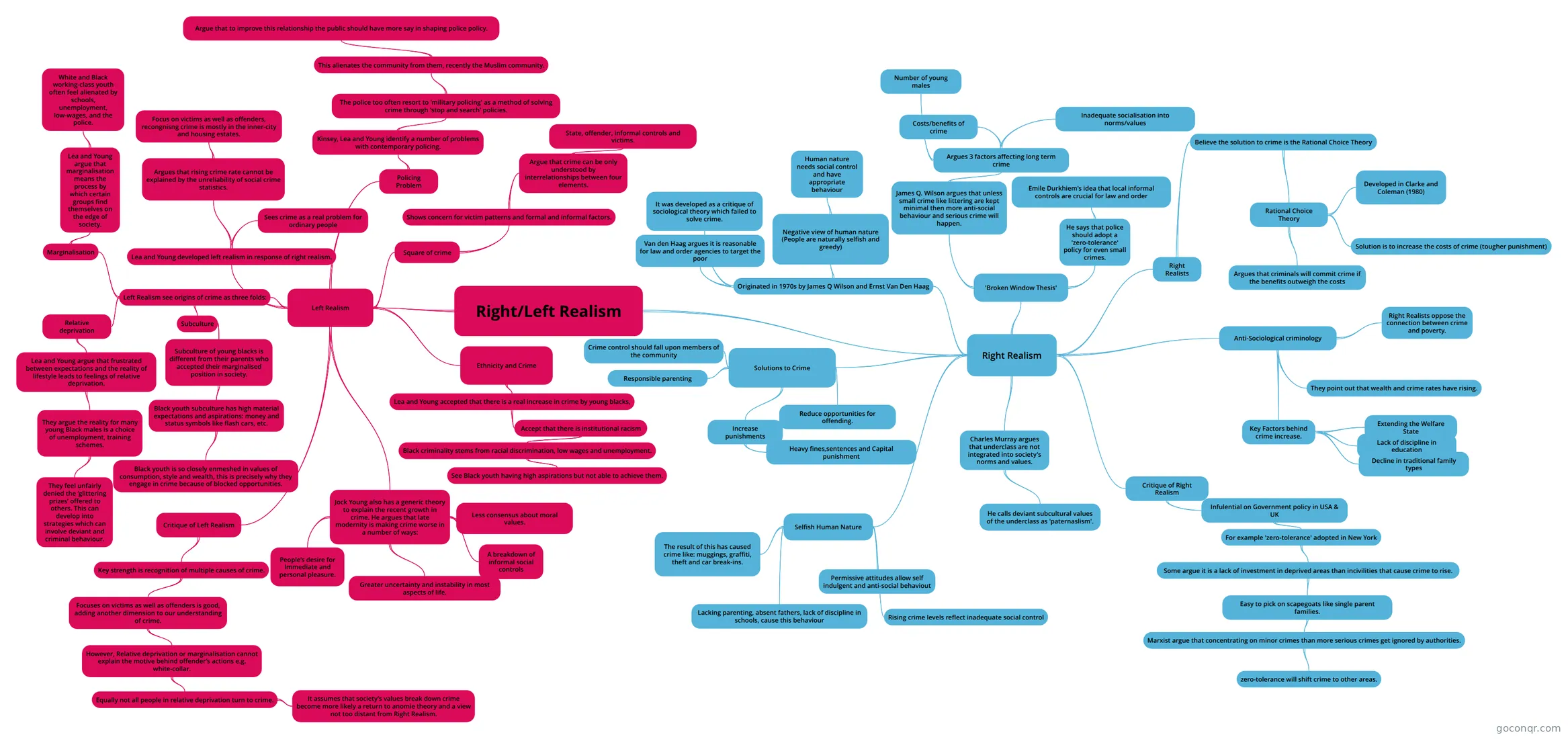
Mind map: Right and left realism criminology
Conteúdo do mapa
Right/Left Realism
Right Realism
- Originated in 1970s by James Q Wilson and Ernst Van Den Haag
- It was developed as a critique of sociological theory which failed to solve crime.
- Negative view of human nature (People are naturally selfish and greedy)
- Human nature needs social control and have appropriate behaviour
- Van den Haag argues it is reasonable for law and order agencies to target the poor
- Right Realists
- Believe the solution to crime is the Rational Choice Theory
- Rational Choice Theory
- Developed in Clarke and Coleman (1980)
- Argues that criminals will commit crime if the benefits outweigh the costs
- Solution is to increase the costs of crime (tougher punishment)
- Rational Choice Theory
- Believe the solution to crime is the Rational Choice Theory
- Anti-Sociological criminology
- Right Realists oppose the connection between crime and poverty.
- They point out that wealth and crime rates have rising.
- Key Factors behind crime increase.
- Extending the Welfare State
- Lack of discipline in education
- Decline in traditional family types
- Selfish Human Nature
- Rising crime levels reflect inadequate social control
- Permissive attitudes allow self indulgent and anti-social behaviout
- The result of this has caused crime like: muggings, graffiti, theft and car break-ins.
- Lacking parenting, absent fathers, lack of discipline in schools, cause this behaviour
- Solutions to Crime
- Reduce opportunities for offending.
- Increase punishments
- Heavy fines,sentences and Capital punishment
- Crime control should fall upon members of the community
- Responsible parenting
- 'Broken Window Thesis'
- James Q. Wilson argues that unless small crime like littering are kept minimal then more anti-social behaviour and serious crime will happen.
- Argues 3 factors affecting long term crime
- Number of young males
- Costs/benefits of crime
- Inadequate socialisation into norms/values
- Argues 3 factors affecting long term crime
- He says that police should adopt a 'zero-tolerance' policy for even small crimes.
- Emile Durkhiem's idea that local informal controls are crucial for law and order
- James Q. Wilson argues that unless small crime like littering are kept minimal then more anti-social behaviour and serious crime will happen.
- Charles Murray argues that underclass are not integrated into society's norms and values.
- He calls deviant subcultural values of the underclass as 'paternaslism'.
- Critique of Right Realism
- Infulential on Government policy in USA & UK
- For example 'zero-tolerance' adopted in New York
- Some argue it is a lack of investment in deprived areas than incivilities that cause crime to rise.
- Easy to pick on scapegoats like single parent families.
- Marxist argue that concentrating on minor crimes than more serious crimes get ignored by authorities.
- zero-tolerance will shift crime to other areas.
- Marxist argue that concentrating on minor crimes than more serious crimes get ignored by authorities.
- Easy to pick on scapegoats like single parent families.
- Some argue it is a lack of investment in deprived areas than incivilities that cause crime to rise.
- For example 'zero-tolerance' adopted in New York
- Infulential on Government policy in USA & UK
- Originated in 1970s by James Q Wilson and Ernst Van Den Haag
Left Realism
- Lea and Young developed left realism in response of right realism.
- Sees crime as a real problem for ordinary people
- Argues that rising crime rate cannot be explained by the unreliability of social crime statistics.
- Focus on victims as well as offenders, recongnisng crime is mostly in the inner-city and housing estates.
- Ethnicity and Crime
- Lea and Young accepted that there is a real increase in crime by young blacks,
- Accept that there is institutional racism
- Black criminality stems from racial discrimination, low wages and unemployment.
- See Black youth having high aspirations but not able to achieve them.
- Black criminality stems from racial discrimination, low wages and unemployment.
- Accept that there is institutional racism
- Lea and Young accepted that there is a real increase in crime by young blacks,
- Left Realism see origins of crime as three folds:
- Relative deprivation
- Lea and Young argue that frustrated between expectations and the reality of lifestyle leads to feelings of relative deprivation.
- They argue the reality for many young Black males is a choice of unemployment, training schemes.
- They feel unfairly denied the ‘glittering prizes’ offered to others. This can develop into strategies which can involve deviant and criminal behaviour.
- They argue the reality for many young Black males is a choice of unemployment, training schemes.
- Lea and Young argue that frustrated between expectations and the reality of lifestyle leads to feelings of relative deprivation.
- Marginalisation
- Lea and Young argue that marginalisation means the process by which certain groups find themselves on the edge of society.
- White and Black working-class youth often feel alienated by schools, unemployment, low-wages, and the police.
- Lea and Young argue that marginalisation means the process by which certain groups find themselves on the edge of society.
- Subculture
- Subculture of young blacks is different from their parents who accepted their marginalised position in society.
- Black youth subculture has high material expectations and aspirations: money and status symbols like flash cars, etc.
- Black youth is so closely enmeshed in values of consumption, style and wealth, this is precisely why they engage in crime because of blocked opportunities.
- Black youth subculture has high material expectations and aspirations: money and status symbols like flash cars, etc.
- Subculture of young blacks is different from their parents who accepted their marginalised position in society.
- Relative deprivation
- Policing Problem
- Kinsey, Lea and Young identify a number of problems with contemporary policing.
- The police too often resort to 'military policing' as a method of solving crime through 'stop and search' policies.
- This alienates the community from them, recently the Muslim community.
- Argue that to improve this relationship the public should have more say in shaping police policy.
- This alienates the community from them, recently the Muslim community.
- The police too often resort to 'military policing' as a method of solving crime through 'stop and search' policies.
- Kinsey, Lea and Young identify a number of problems with contemporary policing.
- Square of crime
- Shows concern for victim patterns and formal and informal factors.
- Argue that crime can be only understood by interrelationships between four elements.
- State, offender, informal controls and victims.
- Argue that crime can be only understood by interrelationships between four elements.
- Shows concern for victim patterns and formal and informal factors.
- Jock Young also has a generic theory to explain the recent growth in crime. He argues that late modernity is making crime worse in a number of ways:
- Greater uncertainty and instability in most aspects of life.
- People’s desire for Immediate and personal pleasure.
- Less consensus about moral values.
- A breakdown of informal social controls
- Critique of Left Realism
- Key strength is recognition of multiple causes of crime.
- Focuses on victims as well as offenders is good, adding another dimension to our understanding of crime.
- However, Relative deprivation or marginalisation cannot explain the motive behind offender’s actions e.g. white-collar.
- Equally not all people in relative deprivation turn to crime.
- It assumes that society’s values break down crime become more likely a return to anomie theory and a view not too distant from Right Realism.
- Equally not all people in relative deprivation turn to crime.
- However, Relative deprivation or marginalisation cannot explain the motive behind offender’s actions e.g. white-collar.
- Focuses on victims as well as offenders is good, adding another dimension to our understanding of crime.
- Key strength is recognition of multiple causes of crime.
- Lea and Young developed left realism in response of right realism.