
Mapa mental
Computing Data Structures 1
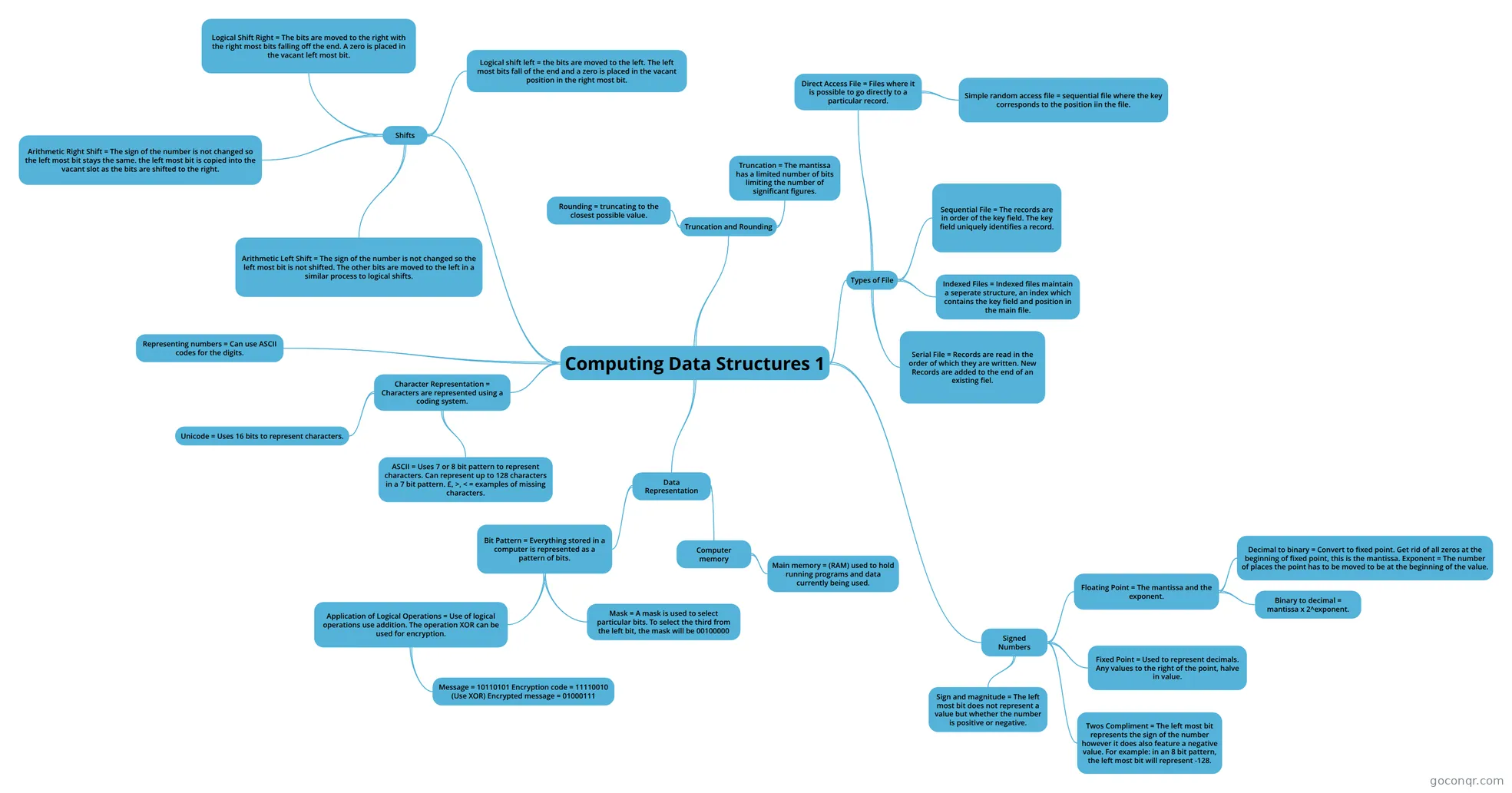
Mind map: Computing data structures
Conteúdo do mapa
Computing Data Structures 1
Types of File
- Serial File = Records are read in the order of which they are written. New Records are added to the end of an existing fiel.
- Sequential File = The records are in order of the key field. The key field uniquely identifies a record.
- Direct Access File = Files where it is possible to go directly to a particular record.
- Simple random access file = sequential file where the key corresponds to the position iin the file.
- Indexed Files = Indexed files maintain a seperate structure, an index which contains the key field and position in the main file.
Data Representation
- Computer memory
- Main memory = (RAM) used to hold running programs and data currently being used.
- Bit Pattern = Everything stored in a computer is represented as a pattern of bits.
- Mask = A mask is used to select particular bits. To select the third from the left bit, the mask will be 00100000
- Application of Logical Operations = Use of logical operations use addition. The operation XOR can be used for encryption.
- Message = 10110101 Encryption code = 11110010 (Use XOR) Encrypted message = 01000111
- Computer memory
Character Representation = Characters are represented using a coding system.
- ASCII = Uses 7 or 8 bit pattern to represent characters. Can represent up to 128 characters in a 7 bit pattern. £, >, < = examples of missing characters.
- Unicode = Uses 16 bits to represent characters.
Representing numbers = Can use ASCII codes for the digits.
Signed Numbers
- Sign and magnitude = The left most bit does not represent a value but whether the number is positive or negative.
- Twos Compliment = The left most bit represents the sign of the number however it does also feature a negative value. For example: in an 8 bit pattern, the left most bit will represent -128.
- Fixed Point = Used to represent decimals. Any values to the right of the point, halve in value.
- Floating Point = The mantissa and the exponent.
- Binary to decimal = mantissa x 2^exponent.
- Decimal to binary = Convert to fixed point. Get rid of all zeros at the beginning of fixed point, this is the mantissa. Exponent = The number of places the point has to be moved to be at the beginning of the value.
Truncation and Rounding
- Truncation = The mantissa has a limited number of bits limiting the number of significant figures.
- Rounding = truncating to the closest possible value.
Shifts
- Logical shift left = the bits are moved to the left. The left most bits fall of the end and a zero is placed in the vacant position in the right most bit.
- Logical Shift Right = The bits are moved to the right with the right most bits falling off the end. A zero is placed in the vacant left most bit.
- Arithmetic Left Shift = The sign of the number is not changed so the left most bit is not shifted. The other bits are moved to the left in a similar process to logical shifts.
- Arithmetic Right Shift = The sign of the number is not changed so the left most bit stays the same. the left most bit is copied into the vacant slot as the bits are shifted to the right.
Informações
- Descrição
- A-Level Computing Mapa Mental sobre Computing Data Structures 1, criado por elliot9678 em 09-01-2016.
- Criado por
- elliot9678
- Visualizações
- 3
- Avaliação