
Mapa mental
Introduction to Social Psych
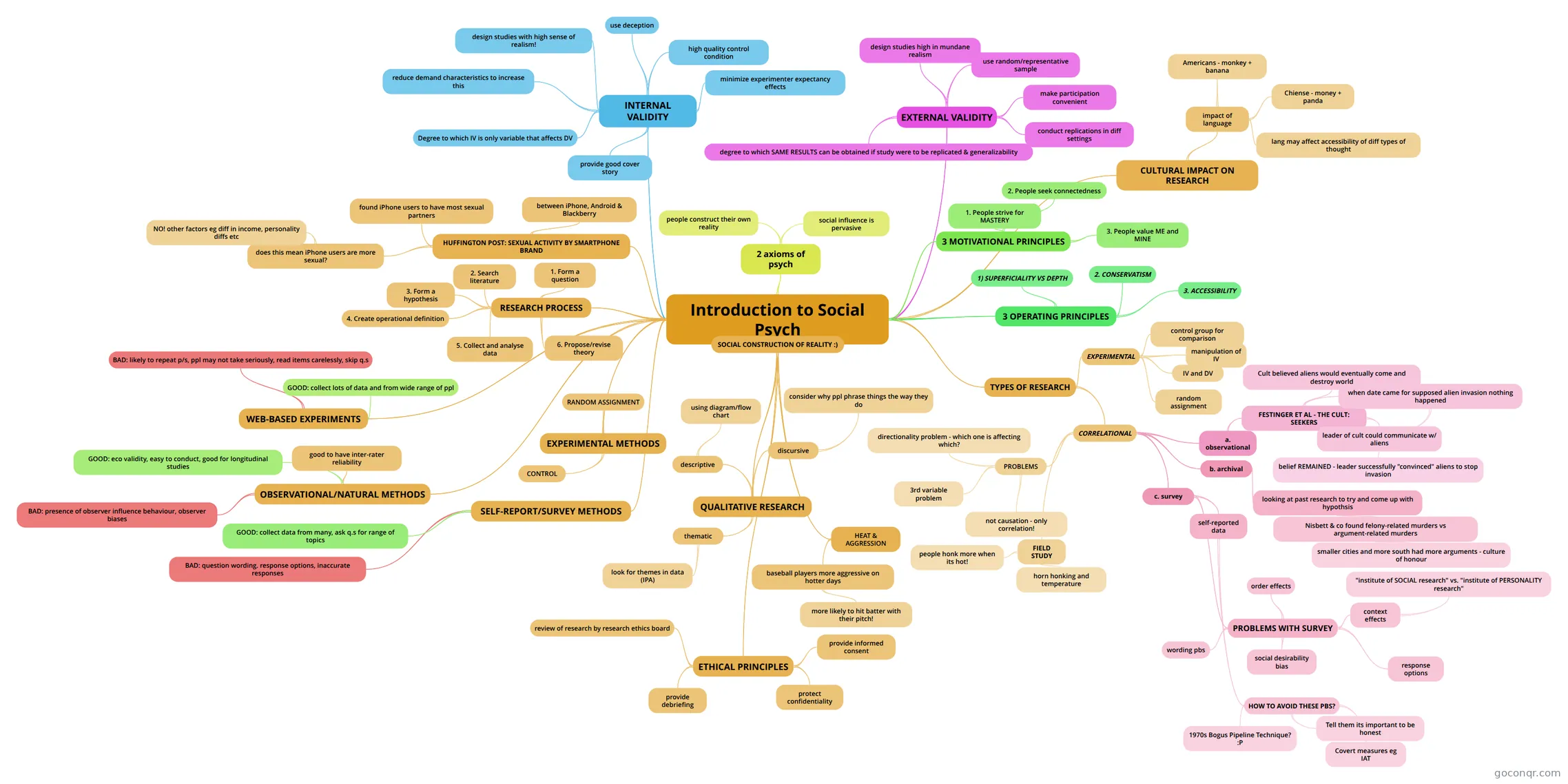
Mind map: Introduction to social psychology
Conteúdo do mapa
Introduction to Social Psych
2 axioms of psych
- social influence is pervasive
- people construct their own reality
3 MOTIVATIONAL PRINCIPLES
- 1. People strive for MASTERY
- 2. People seek connectedness
- 3. People value ME and MINE
3 OPERATING PRINCIPLES
- 1) SUPERFICIALITY VS DEPTH
- 2. CONSERVATISM
- 3. ACCESSIBILITY
TYPES OF RESEARCH
- CORRELATIONAL
- a. observational
- FESTINGER ET AL - THE CULT: SEEKERS
- Cult believed aliens would eventually come and destroy world
- leader of cult could communicate w/ aliens
- when date came for supposed alien invasion nothing happened
- belief REMAINED - leader successfully "convinced" aliens to stop invasion
- FESTINGER ET AL - THE CULT: SEEKERS
- b. archival
- looking at past research to try and come up with hypothsis
- Nisbett & co found felony-related murders vs argument-related murders
- smaller cities and more south had more arguments - culture of honour
- Nisbett & co found felony-related murders vs argument-related murders
- looking at past research to try and come up with hypothsis
- c. survey
- self-reported data
- HOW TO AVOID THESE PBS?
- Tell them its important to be honest
- 1970s Bogus Pipeline Technique? :P
- Covert measures eg IAT
- HOW TO AVOID THESE PBS?
- PROBLEMS WITH SURVEY
- wording pbs
- order effects
- context effects
- "institute of SOCIAL research" vs. "institute of PERSONALITY research"
- response options
- social desirability bias
- self-reported data
- PROBLEMS
- not causation - only correlation!
- directionality problem - which one is affecting which?
- 3rd variable problem
- FIELD STUDY
- horn honking and temperature
- people honk more when its hot!
- a. observational
- EXPERIMENTAL
- IV and DV
- random assignment
- control group for comparison
- manipulation of IV
- CORRELATIONAL
SOCIAL CONSTRUCTION OF REALITY :)
HUFFINGTON POST: SEXUAL ACTIVITY BY SMARTPHONE BRAND
- between iPhone, Android & Blackberry
- found iPhone users to have most sexual partners
- does this mean iPhone users are more sexual?
- NO! other factors eg diff in income, personality diffs etc
HEAT & AGGRESSION
- baseball players more aggressive on hotter days
- more likely to hit batter with their pitch!
- baseball players more aggressive on hotter days
RESEARCH PROCESS
- 1. Form a question
- 2. Search literature
- 3. Form a hypothesis
- 4. Create operational definition
- 5. Collect and analyse data
- 6. Propose/revise theory
WEB-BASED EXPERIMENTS
- GOOD: collect lots of data and from wide range of ppl
- BAD: likely to repeat p/s, ppl may not take seriously, read items carelessly, skip q.s
OBSERVATIONAL/NATURAL METHODS
- GOOD: eco validity, easy to conduct, good for longitudinal studies
- BAD: presence of observer influence behaviour, observer biases
- good to have inter-rater reliability
SELF-REPORT/SURVEY METHODS
- GOOD: collect data from many, ask q.s for range of topics
- BAD: question wording. response options, inaccurate responses
EXPERIMENTAL METHODS
- RANDOM ASSIGNMENT
- CONTROL
INTERNAL VALIDITY
- Degree to which IV is only variable that affects DV
- reduce demand characteristics to increase this
- use deception
- provide good cover story
- high quality control condition
- minimize experimenter expectancy effects
- design studies with high sense of realism!
EXTERNAL VALIDITY
- degree to which SAME RESULTS can be obtained if study were to be replicated & generalizability
- design studies high in mundane realism
- use random/representative sample
- make participation convenient
- conduct replications in diff settings
QUALITATIVE RESEARCH
- descriptive
- using diagram/flow chart
- thematic
- look for themes in data (IPA)
- discursive
- consider why ppl phrase things the way they do
- descriptive
ETHICAL PRINCIPLES
- review of research by research ethics board
- provide informed consent
- protect confidentiality
- provide debriefing
CULTURAL IMPACT ON RESEARCH
- impact of language
- Americans - monkey + banana
- Chiense - money + panda
- lang may affect accessibility of diff types of thought
- impact of language