
Mapa mental
Secular perspectives
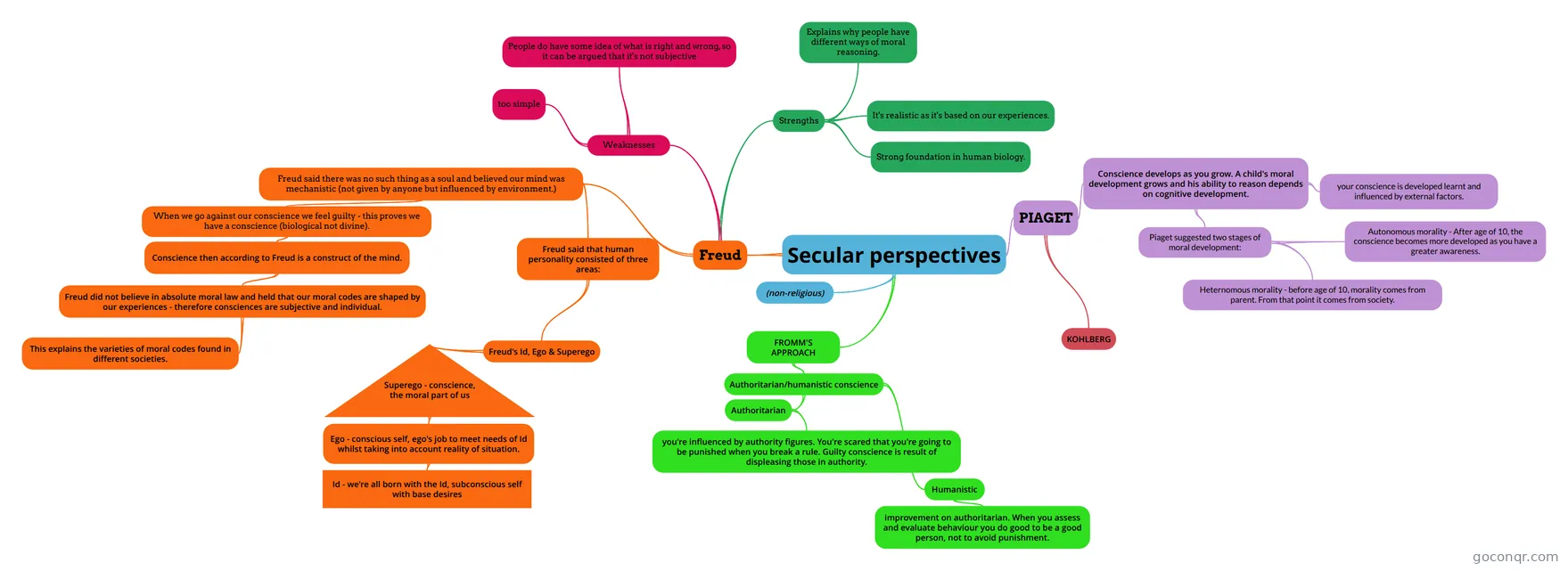
Mind map: Secular perspectives
Conteúdo do mapa
Secular perspectives
Freud
- Weaknesses
- too simple
- People do have some idea of what is right and wrong, so it can be argued that it's not subjective
- Strengths
- Explains why people have different ways of moral reasoning.
- It's realistic as it's based on our experiences.
- Strong foundation in human biology.
- Freud said there was no such thing as a soul and believed our mind was mechanistic (not given by anyone but influenced by environment.)
- When we go against our conscience we feel guilty - this proves we have a conscience (biological not divine).
- Conscience then according to Freud is a construct of the mind.
- Freud did not believe in absolute moral law and held that our moral codes are shaped by our experiences - therefore consciences are subjective and individual.
- This explains the varieties of moral codes found in different societies.
- Freud did not believe in absolute moral law and held that our moral codes are shaped by our experiences - therefore consciences are subjective and individual.
- Conscience then according to Freud is a construct of the mind.
- Freud said that human personality consisted of three areas:
- Freud's Id, Ego & Superego
- Superego - conscience, the moral part of us
- Ego - conscious self, ego's job to meet needs of Id whilst taking into account reality of situation.
- Id - we're all born with the Id, subconscious self with base desires
- Ego - conscious self, ego's job to meet needs of Id whilst taking into account reality of situation.
- Superego - conscience, the moral part of us
- Freud's Id, Ego & Superego
- When we go against our conscience we feel guilty - this proves we have a conscience (biological not divine).
- Weaknesses
PIAGET
- Conscience develops as you grow. A child's moral development grows and his ability to reason depends on cognitive development.
- your conscience is developed learnt and influenced by external factors.
- Piaget suggested two stages of moral development:
- Heternomous morality - before age of 10, morality comes from parent. From that point it comes from society.
- Autonomous morality - After age of 10, the conscience becomes more developed as you have a greater awareness.
- KOHLBERG
- Conscience develops as you grow. A child's moral development grows and his ability to reason depends on cognitive development.
(non-religious)
FROMM'S APPROACH
- Authoritarian/humanistic conscience
- Authoritarian
- you're influenced by authority figures. You're scared that you're going to be punished when you break a rule. Guilty conscience is result of displeasing those in authority.
- Humanistic
- improvement on authoritarian. When you assess and evaluate behaviour you do good to be a good person, not to avoid punishment.
- Authoritarian
- Authoritarian/humanistic conscience
Informações
- Descrição
- A-Level Religious Studies (Conscience) Mapa Mental sobre Secular perspectives, criado por Shpat Agushi em 02-02-2016.
- Criado por
- Shpat Agushi
- Visualizações
- 1
- Avaliação
Mais sobre Secular Approaches to Conscience