
Mapa mental
Chemistry 1
Conteúdo do mapa
Chemistry 1
Fundamentals of Chemsitry
- An element is an a substance made up of only one type of atom.
- Metals are located on the left hand side of the periodic table and non metals on the right.
- Atoms are the building blocks of everything. They are made up of a nucleus (containing protons and neutrons) surrounded by electrons.
- Protons have a positive charge and neutrons have no charge meaning that the nucleus is overall positivly charged.
- Electrons move around the nucleus, they are negatively charged. They occupy shells around the nucleus.
- The number of protons is equal to the number of electrons meaning that atoms have no overall charge.
- If some electrons are added or removed the atom becomes charged and is then an Ion.
- The top number is the Mass number. This represents the total number of protons and neutrons. (as electrons have virtually no weight so they aren't included.)
- The bottom number is the Proton number (Atomic number) this tells you the number of protons. And of course the number of electrons.
- The number of protons is equal to the number of electrons meaning that atoms have no overall charge.
- Electrons move around the nucleus, they are negatively charged. They occupy shells around the nucleus.
- Protons have a positive charge and neutrons have no charge meaning that the nucleus is overall positivly charged.
- Different atoms have different numbers of Protons, Neutrons and Electrons. Its the number of protons which defines what type of atom it is.
- There are about 100 different elements in the periodic table.
- The Periodic Table puts elements with similar properties together.
- It is laid out so that elements with similar proporties form columns.
- These vertical columns are called groups. They are often represented with Roman Numerals.
- All the elements in the same group share the same number of electrons in their outer shells. This is why they have similar properties.
- This means that you can predict the properties of another element from the same group.
- For example, all the group 1 metals react with water to form an alkali solution and hydrogen gas. And they all react with oxygen to form an oxide.
- The elements in group 0 are all noble gasses. They have eight electron in their outer shell which means that they are stable and unreactive.
- The electron structure is dictated by 2,8,8. Meaning that the first shell can take 2 electrons and the second and third shells can take 8 each.
- The elements in group 0 are all noble gasses. They have eight electron in their outer shell which means that they are stable and unreactive.
- For example, all the group 1 metals react with water to form an alkali solution and hydrogen gas. And they all react with oxygen to form an oxide.
- This means that you can predict the properties of another element from the same group.
- All the elements in the same group share the same number of electrons in their outer shells. This is why they have similar properties.
- These vertical columns are called groups. They are often represented with Roman Numerals.
- It is laid out so that elements with similar proporties form columns.
- Atoms can join together to form compounds.
- When different elements react, they form chemical bonds to form compounds. It is difficult to separate the two out again.
- Making bonds involves giving atoms away, taking atoms or sharing atoms.
- This is only ever the electrons.
- A compound that is made from a metal and a non-metal consists of ions. The metal atoms lose electrons to become positive ions and the non-metal gains those electrons to form negative ions.
- These opposing charges cause the two to become strongly attracted to eachother. This is called IONIC BONDING.
- A compound consisting of non-metals consists of molecules.
- Atoms SHARE an electron, this is called a COVALENT BOND.
- Each atom needs to make enough covalent bonds to fill up its outer shell.
- The properties of the compound are completely different to the original elements.
- Compounds can be small molecules like water or large lattices like sodium chloride.
- A formula shows what atoms are in a compound.
- CO2 is a compound of 1 carbon atom and 2 oxygen atoms.
- A formula shows what atoms are in a compound.
- Compounds can be small molecules like water or large lattices like sodium chloride.
- The properties of the compound are completely different to the original elements.
- Each atom needs to make enough covalent bonds to fill up its outer shell.
- Atoms SHARE an electron, this is called a COVALENT BOND.
- A compound consisting of non-metals consists of molecules.
- These opposing charges cause the two to become strongly attracted to eachother. This is called IONIC BONDING.
- A compound that is made from a metal and a non-metal consists of ions. The metal atoms lose electrons to become positive ions and the non-metal gains those electrons to form negative ions.
- This is only ever the electrons.
- Making bonds involves giving atoms away, taking atoms or sharing atoms.
- When different elements react, they form chemical bonds to form compounds. It is difficult to separate the two out again.
Limestone
- Limestone is mainly Calcium Carbonate.
- Limestone is quarried out of the ground and is used for building, usually for fine old buildings like cathedrals.
- When limestone is heated, it thermally decomposes to make calcium oxide and carbon dioxide.
- Calcium oxide reacts with water to produce calcium hydroxide.
- Calcium Hydroxide is an alkali which can be used to neutralise acidic soil. Powdered calcium carbonate can be used for this but calcium hydroxide is faster.
- Powdered limestone can be heated in a kiln with powdered clay to make cement.
- Cement can be mixed with sand and water to make mortar. (calcium hydroxide can also be added here).
- Quarrying limestone makes a mess of the landscape, large holes, noise and dust from blasts, destroys habitats, the lorries transporting it produce noise and pollution and waste materials cause unsightly tips.
- Cement factories cause a lot of dust and it requires a lot of energy to produce cement and quicklime which is likely to have come from fossil fuels which causes pollution.
- Limestone provides things like houses and roads that people need.
- Limestone can be used in chimneys to neutralise sulfur dioxide fumes which cause acid rain.
- Limestone is good because its widely available, hard wearing, doesn't rot, and can be reinforced with steel.
- Limestone can be used in chimneys to neutralise sulfur dioxide fumes which cause acid rain.
- Limestone provides things like houses and roads that people need.
- Cement factories cause a lot of dust and it requires a lot of energy to produce cement and quicklime which is likely to have come from fossil fuels which causes pollution.
- Quarrying limestone makes a mess of the landscape, large holes, noise and dust from blasts, destroys habitats, the lorries transporting it produce noise and pollution and waste materials cause unsightly tips.
- Cement can be mixed with sand and water to make mortar. (calcium hydroxide can also be added here).
- Powdered limestone can be heated in a kiln with powdered clay to make cement.
- Calcium Hydroxide is an alkali which can be used to neutralise acidic soil. Powdered calcium carbonate can be used for this but calcium hydroxide is faster.
- Thermal decompostition is when one substance chemically changes into at least two new substances when heated.
- Calcium oxide reacts with water to produce calcium hydroxide.
- When limestone is heated, it thermally decomposes to make calcium oxide and carbon dioxide.
- Limestone is quarried out of the ground and is used for building, usually for fine old buildings like cathedrals.
- Limestone is mainly Calcium Carbonate.
Metals and their Uses
- Some unreactive metals like gold are found in the Earth as the metal itself but the rest are obtained by extracting them from rocks.
- A metal ore is a rock which contains enough of a metal to make it worth extracting them.
- In many cases, the ore is an oxide of the metal.
- Most metals are extracted by a chemical reaction.
- The profitability of metal extraction can change over time meaning that if the market price of a metal drops a lot, it might not be worth extracting it and if the price rises, it will be worth extracting more of it.
- And as technology improves, it will be cheaper to extract more metals so it will be more worth it.
- Metals can be extracted by reduction or electrolysis. The metals have to be concentrated before the metal is extracted. Electrolysis can be used to purify the extracted metals.
- Reduction is a method of extracting metals using carbon.When the ore is reduced, oxygen is removed from it.
- The position of the metal in the reactivity series determines whether it can be extracted by reduction.
- Metals below Carbon on the reactivity series can be extracted by reduction using carbon as it can only take the oxygen (from the oxide part) away from the metals that are less reactive than carbon.
- Metals above carbon in the reactivity series must be extracted by electrolysis of molten compounds
- Electrolysis is more expensive than reduction as high temperatures are needed to make the metals molten.
- Copper can be extracted by reduction, but the copper from this is impure so it must be purified by electrolysis.
- Electrolysis is expensive but produces very pure copper which is a much better conductor.
- Electrolysis is the process of "splitting things up with electricity".
- Electrolysis requires a liquid to conduct electricity, this is called the electrolyte. These are often metal salt solutions made from the ore or molten metal oxides.
- The electrolyte has free ions which allow it to conduct electricity.
- Electrons are taken away from the (positive) anode and given away by the (negative) cathode, As ions lose or gain electrons, they become atoms or molecules and are released.
- This is because opposites attract.
- Copper can be extracted from a solution using a displacement reaction. The more reactive metal will push the copper out and take its place.
- This is because more reactive metals form stronger bonds to the non-metal and so pushes out the less reactive metal.
- Copper ores are in short supply so it is important that copper is recycled.
- Scientists have come up with two different methods of extracting copper, Phytomining and bioleaching.
- Phytomining involves growing plants in soil that contains copper, the plants can't use the copper so it just builds up in the leaves.
- Plants can be harvested, dried and burnt then the copper can be collected from the ash.
- Bioleaching uses bacteria to separate copper from copper sulfide. The bacteria get energy from the bond between copper and sulfur.
- The Leachate (liquid which is produced) contains copper which can be extracted by filtering.
- Metal extraction can be bad for the environment as it causes noise, scars the landscape and causes habitat loss.
- But mining is good because it means that useful products can be made, it provides local people with jobs and brings money into the area meaning that healthcare and transport can be improved.
- Recycling metals is important as it takes a lot of energy to produce them in the first place, usually from fossil fuels, which are running out and have a big negative impact on the environment.
- Recycling metals saves energy which saves money from production costs.
- There are finite amounts of metals so they need to be reused, this also reduces the amount going into landfill.
- A metals exact properties decide how best it should be used for example copper is a good conductor of electricity so it is good for drawing out into wires and it is flexible so it is suitable for wires.
- Aluminium is corrosion resistant and is low density. Pure aluminium isn't particularly strong but it forms strong alloys.
- Alloys are stronger than pure metals.
- Different elements have different sized atoms so adding different sized atoms upsets the layers making it more difficult for them so slide over each other meaning that alloys are harder than pure metals.
- Alloys are stronger than pure metals.
- Aluminium is corrosion resistant and is low density. Pure aluminium isn't particularly strong but it forms strong alloys.
- A metals exact properties decide how best it should be used for example copper is a good conductor of electricity so it is good for drawing out into wires and it is flexible so it is suitable for wires.
- There are finite amounts of metals so they need to be reused, this also reduces the amount going into landfill.
- Recycling metals saves energy which saves money from production costs.
- Recycling metals is important as it takes a lot of energy to produce them in the first place, usually from fossil fuels, which are running out and have a big negative impact on the environment.
- But mining is good because it means that useful products can be made, it provides local people with jobs and brings money into the area meaning that healthcare and transport can be improved.
- Metal extraction can be bad for the environment as it causes noise, scars the landscape and causes habitat loss.
- The Leachate (liquid which is produced) contains copper which can be extracted by filtering.
- Phytomining involves growing plants in soil that contains copper, the plants can't use the copper so it just builds up in the leaves.
- Scientists have come up with two different methods of extracting copper, Phytomining and bioleaching.
- Copper ores are in short supply so it is important that copper is recycled.
- This is because more reactive metals form stronger bonds to the non-metal and so pushes out the less reactive metal.
- Copper can be extracted from a solution using a displacement reaction. The more reactive metal will push the copper out and take its place.
- Electrolysis of copper happens when electrons are pulled off the copper atoms at the anode causing them to become Cu^2+ atoms, when these atoms are near the cathode, they gain electrons and turn back into copper.
- The impurities are dropped at the anode as a sludge.
- This is because opposites attract.
- Electrons are taken away from the (positive) anode and given away by the (negative) cathode, As ions lose or gain electrons, they become atoms or molecules and are released.
- The electrolyte has free ions which allow it to conduct electricity.
- Electrolysis requires a liquid to conduct electricity, this is called the electrolyte. These are often metal salt solutions made from the ore or molten metal oxides.
- Electrolysis is the process of "splitting things up with electricity".
- Electrolysis is expensive but produces very pure copper which is a much better conductor.
- Copper can be extracted by reduction, but the copper from this is impure so it must be purified by electrolysis.
- Electrolysis is more expensive than reduction as high temperatures are needed to make the metals molten.
- Metals above carbon in the reactivity series must be extracted by electrolysis of molten compounds
- Metals below Carbon on the reactivity series can be extracted by reduction using carbon as it can only take the oxygen (from the oxide part) away from the metals that are less reactive than carbon.
- The position of the metal in the reactivity series determines whether it can be extracted by reduction.
- Reduction is a method of extracting metals using carbon.When the ore is reduced, oxygen is removed from it.
- The profitability of metal extraction can change over time meaning that if the market price of a metal drops a lot, it might not be worth extracting it and if the price rises, it will be worth extracting more of it.
- Most metals are extracted by a chemical reaction.
- In many cases, the ore is an oxide of the metal.
- A metal ore is a rock which contains enough of a metal to make it worth extracting them.
- Some unreactive metals like gold are found in the Earth as the metal itself but the rest are obtained by extracting them from rocks.
Crude Oil and Fuels
- Crude oil is a mixture of hydrocarbons.
- A mixture is made up of two or more elements or compounds which are not chemically bonded.
- Each different hydrocarbon retains its original properties meaning that the properties of the mixture is just the properties of the separate parts.
- The different hydrocarbons can be separated from crude oil using fractional distillation.
- A fractionating column works constantly, heated crude oil is piped in at the bottom, then vaporised oil rises up the column and the various fractions are tapped off at the sides at the different levels where they condense.
- All the hydrocarbons which make up crude oil are different lengths and they all have different boiling points meaning that they all evaporate at different temperatures.
- All the fractions of crude oil are hydrocarbons called alkanes.
- Alkanes are made up of chains of carbon atoms surrounded by hydrogen atoms. Different alkanes have different lengths.
- Each carbon atom forms 4 bonds and each hydrogen forms only one.
- The shorter the hydrocarbon, the more runny it is and the lower the boiling point, they are said to be more volatile. Also shorter molecules are more flammable.
- Petrol has longer molecules so it has a higher boiling point. Because petrol is a liquid, it is easily stored in the fuel tank, it can easily flow into the engine where it is easily vaporised before it is ignited.
- Crude oil fractions burn cleanly meaning that they make good fuels and can be used for car fuel or for heating central heating systems.
- Crude oil is big business, many scientists are trying to harvest it from the ground.
- There are alternatives to crude oil such as ethanol fuel.
- However these alternatives need work and require new infrastructure such as improvements to petrol stations.
- Crude oil fractions such as Petrol are often more reliable than solar or wind energy as it doesn't rely on exact weather conditions.
- Crude oil is a finite source of energy, meaning that it will run out one day but no one knows when.
- New reserves are being discovered but it is expensive to start the process of drilling as the technology is expensive.
- Using crude oil brings the risk of oil spills which have a massive effect on the environment. And burning crude oil causes global warming.
- Burning fossil fuels releases carbon dioxide and water vapour. The carbon dioxide contributes to global warming.
- Some fuels also contain sulfur and when it is burnt, the sulfur will be released as sulfur dioxide which causes acid rain.
- This is because it forms weak sulfuric acid with the rain water.
- Most of the sulfur can be removed from the fuels before they are burnt but it is expensive.
- This is because it forms weak sulfuric acid with the rain water.
- Some fuels also contain sulfur and when it is burnt, the sulfur will be released as sulfur dioxide which causes acid rain.
- Burning fossil fuels releases carbon dioxide and water vapour. The carbon dioxide contributes to global warming.
- Using crude oil brings the risk of oil spills which have a massive effect on the environment. And burning crude oil causes global warming.
- New reserves are being discovered but it is expensive to start the process of drilling as the technology is expensive.
- Crude oil is a finite source of energy, meaning that it will run out one day but no one knows when.
- Crude oil fractions such as Petrol are often more reliable than solar or wind energy as it doesn't rely on exact weather conditions.
- However these alternatives need work and require new infrastructure such as improvements to petrol stations.
- There are alternatives to crude oil such as ethanol fuel.
- Crude oil is big business, many scientists are trying to harvest it from the ground.
- Crude oil fractions burn cleanly meaning that they make good fuels and can be used for car fuel or for heating central heating systems.
- Petrol has longer molecules so it has a higher boiling point. Because petrol is a liquid, it is easily stored in the fuel tank, it can easily flow into the engine where it is easily vaporised before it is ignited.
- The shorter the hydrocarbon, the more runny it is and the lower the boiling point, they are said to be more volatile. Also shorter molecules are more flammable.
- Each carbon atom forms 4 bonds and each hydrogen forms only one.
- Alkanes are made up of chains of carbon atoms surrounded by hydrogen atoms. Different alkanes have different lengths.
- All the fractions of crude oil are hydrocarbons called alkanes.
- All the hydrocarbons which make up crude oil are different lengths and they all have different boiling points meaning that they all evaporate at different temperatures.
- A fractionating column works constantly, heated crude oil is piped in at the bottom, then vaporised oil rises up the column and the various fractions are tapped off at the sides at the different levels where they condense.
- The different hydrocarbons can be separated from crude oil using fractional distillation.
- Crude oil is a mixture of hydrocarbons.
Other Useful Substances From Crude Oil
- Long chain hydrocarbons form thick gloopy liquids like Tar, these can be turned into shorter chain hydrocarbons by Cracking.
- Cracking works by using thermal decomposition to break down molecules by heating them.
- Firstly the liquid is vaporised and them passed over a powdered catalyst (aluminium oxide) the long chains crack into smaller molecules.
- Most of the products of cracking are alkanes and unsaturated hydrocarbons called alkenes
- H H H | | | H - C - C - C - H | | | H H H
- Alkane
- H H | | C=C | | H H
- Alkene
- Alkenes contain a carbon double bond ( C = C )
- Alkenes are hydrocarbons which contain a double bond between two carbon atoms. They are said to be unsaturated as they are able to make more bonds.
- This means that the double bond can open up allowing the two carbon atoms with other atoms.
- Alkenes all end in "-ene" such as Ethene and Propene.
- All alkenes have the general formula of C(n)H(2n)
- You can test for alkenes by adding the substance to bromine water, the alkene will decolourise the bromine water turning it from orange to colourless because the double bond opens up and bonds with the bromine.
- Ethene can be hydrated with steam in the presence of a catalyst to form ethanol. This is a fairly cheap process as there is very little waste and ethene is pretty cheap.
- Making ethanol will become more expensive as ethene is from crude oil which could run out soon.
- Ethanol can also be made by fermentation which involves sugar being converted into ethanol using yeast.
- Sugar ~> carbon dioxide + ethanol
- This method uses a lower temperature and simpler equipment than when using ethene. Another advantage is that it comes from a renewable source which can be produced all over the world.
- Ethanol produced like that is quite a cheap fuel as the process if cheaper as it takes less energy to heat it and it can be used in countries which can not afford petrol production.
- However, the ethanol that is produced is not very concentrated so it needs to be distilled to increase its strength and then it needs to be purified.
- The most useful thing about alkenes is the fact that they can be turned into polymers.
- This involves joining together lots of small alkene molecules (monomers) to form very large molecules called polymers.
- Mono - Meaning One Poly - Meaning Many
- See diagram in revision guide, page 33
- For example, many ethene molecules can be joined up to produce Poly(ethene) or "Polythene".
- In the same way, if you join lots of propene moleculess together, you get Poly(propene).
- Different polymers have different physical properties. Its properties are also affected by the temperature and pressure of polymerisation. (The process of making a polymer).
- These properties dictate how it is used for example, light, stretchable polymers such as low-density polyethene are used to make plastic bags.
- Memory foam is an example of a smart material, it is a polymer which becomes softer as it gets warmer.
- Polymers are cheap to make but most do not rot meaning that they are hard to get rid of.
- Polymers are not biodegradable, they cannot be broken down by microorganisms. This means that if they are thrown into landfill sites, they will be there for years to come, so it is important that they are recycled.
- Polymer products are usually cheaper than things made of metal, however as crude oil runs out and prices rise, the price of polymers will also increase.
- Polymers are not biodegradable, they cannot be broken down by microorganisms. This means that if they are thrown into landfill sites, they will be there for years to come, so it is important that they are recycled.
- Polymers are cheap to make but most do not rot meaning that they are hard to get rid of.
- Memory foam is an example of a smart material, it is a polymer which becomes softer as it gets warmer.
- These properties dictate how it is used for example, light, stretchable polymers such as low-density polyethene are used to make plastic bags.
- Different polymers have different physical properties. Its properties are also affected by the temperature and pressure of polymerisation. (The process of making a polymer).
- In the same way, if you join lots of propene moleculess together, you get Poly(propene).
- Mono - Meaning One Poly - Meaning Many
- This involves joining together lots of small alkene molecules (monomers) to form very large molecules called polymers.
- The most useful thing about alkenes is the fact that they can be turned into polymers.
- However, the ethanol that is produced is not very concentrated so it needs to be distilled to increase its strength and then it needs to be purified.
- Ethanol produced like that is quite a cheap fuel as the process if cheaper as it takes less energy to heat it and it can be used in countries which can not afford petrol production.
- This method uses a lower temperature and simpler equipment than when using ethene. Another advantage is that it comes from a renewable source which can be produced all over the world.
- Sugar ~> carbon dioxide + ethanol
- Ethanol can also be made by fermentation which involves sugar being converted into ethanol using yeast.
- Making ethanol will become more expensive as ethene is from crude oil which could run out soon.
- Ethene can be hydrated with steam in the presence of a catalyst to form ethanol. This is a fairly cheap process as there is very little waste and ethene is pretty cheap.
- You can test for alkenes by adding the substance to bromine water, the alkene will decolourise the bromine water turning it from orange to colourless because the double bond opens up and bonds with the bromine.
- All alkenes have the general formula of C(n)H(2n)
- Alkenes all end in "-ene" such as Ethene and Propene.
- This means that the double bond can open up allowing the two carbon atoms with other atoms.
- Alkenes are hydrocarbons which contain a double bond between two carbon atoms. They are said to be unsaturated as they are able to make more bonds.
- Alkenes contain a carbon double bond ( C = C )
- Alkene
- H H H | | | H - C - C - C - H | | | H H H
- Most of the products of cracking are alkanes and unsaturated hydrocarbons called alkenes
- Firstly the liquid is vaporised and them passed over a powdered catalyst (aluminium oxide) the long chains crack into smaller molecules.
- Cracking works by using thermal decomposition to break down molecules by heating them.
- Long chain hydrocarbons form thick gloopy liquids like Tar, these can be turned into shorter chain hydrocarbons by Cracking.
Plant oils and Uses
- Some fruits and seeds contain a lot of oils, these can be extracted and used for food and fuel.
- To get the oil out, the plant material has to be crushed and then pressed between two metal plates to squash the oil out.
- Oil can be separated from the crushed organic material using a centrifuge (like a spin dryer).
- The oil can also be separated from the plant material using a solvent. The oil can then be distilled to refine it by removing water, solvents and impurities.
- Plant oils can be used in food. Vegetable oils provide lots of energy and contain other nutrients too. They also contain essential fatty acids which are required for many metabolic processes.
- Vegetable oils can be used in cooking as they have a higher boiling point that water meaning that food can be cooked at higher temperatures, faster.
- Cooking with vegetable oil gives food different flavours due to the fact that the oil has its own flavor and that many flavours come from chemicals which are soluble in oil. Essentially, the oil carries the flavour.
- Using oil to cook food increases the energy content we get from eating it.
- Vegetable oils such as rapeseed oil can be processed and turned into fuels.
- Because vegetable oils contain a lot of energy, they are suitable for use as fuels.
- Biodiesel is made from vegetable oils and has similar properties to ordinary diesel and it burns the same way meaning that it can be used in diesel engines.
- Unsaturated oils contain C=C double bonds.
- Oils and fats contain long-chain molecules with lots of carbon atoms.
- Oils and fats are either saturated or unsaturated.
- Unsaturated oils contain C=C bonds between some of the carbon atoms.
- An unsaturated oil will decolourise bromine water as the bromine opens up the double bonds and joins with it.
- Monounsaturates contain one C=C bond and polyunsaturates contain multiple C=C bonds.
- Unsaturated oils are liquid at room temperature, they can be hardened by reacting them with hydrogen (in the presence of a nickel catalyst at about 60°C). This is called Hydrogenation. The double bond opens up and the extra hydrogen finds a home.
- Hydrogenated oils have a higher melting point than unsaturated oils meaning that they are more solid at room temperature. These can be used for spreads like margarine.
- Margarine is made from partially hydrogenated vegetable oils so they are more solid at room temperature.
- Partially hydrogenated vegetable oils are also used instead of butter in processed foods like biscuits. This is because the oils and cheaper and keep for longer giving food a longer shelf life.
- Partially hydrogenated vegetable oils means that you end up with a lot of trans-fats, there is evidence to suggest that these are very bad for the body.
- Vegetable fats tend to be unsaturated where as animal fats will tend to be saturated.
- Saturated fats increase the amount of cholesterol in the blood meaning that they are bad for the body and carry the risk of heart disease.
- Naturally unsaturated fats are better for the body as they reduce the amount of cholesterol in the blood.
- Trans-fats increase the amount of cholesterol in the blood as eventhough they are only partially hydrogenated.
- Cooking food in oil, whether saturated, unsaturated or partially hydrogenated increases the fat content.
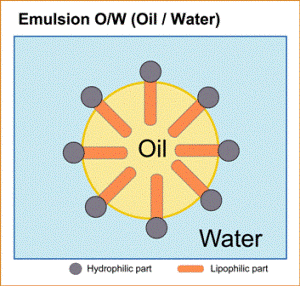
- Oil and water will not naturally mix so an emulsifier must be used.
- An emulsion is made up of lots of water droplets of one liquid suspended in another.
- Emulsions are thicker than either oil or water, the physical properties of emulsions make them good for use as salad dressings and things.
- Generally, the more oil that is in the solution, the thicker it will be.
- Whipped cream and ice cream are oil-in-water solutions with air giving them a soft and fluffy texture.
- Emulsions are also used for moisturising lotions as it gives them a smooth texture.
- Emulsifiers are molecules where one end likes water (Hydrophilic) and the other likes oil (Hydrophobic).
- The Hydrophilic end latches on to the water molecule and the Hydrophobic end latches onto the oil molecules.
- Emulsifiers are molecules where one end likes water (Hydrophilic) and the other likes oil (Hydrophobic).
- Emulsions are also used for moisturising lotions as it gives them a smooth texture.
- Whipped cream and ice cream are oil-in-water solutions with air giving them a soft and fluffy texture.
- Generally, the more oil that is in the solution, the thicker it will be.
- Emulsions are thicker than either oil or water, the physical properties of emulsions make them good for use as salad dressings and things.
- An emulsion is made up of lots of water droplets of one liquid suspended in another.
- Oil and water will not naturally mix so an emulsifier must be used.
- Cooking food in oil, whether saturated, unsaturated or partially hydrogenated increases the fat content.
- Trans-fats increase the amount of cholesterol in the blood as eventhough they are only partially hydrogenated.
- Naturally unsaturated fats are better for the body as they reduce the amount of cholesterol in the blood.
- Saturated fats increase the amount of cholesterol in the blood meaning that they are bad for the body and carry the risk of heart disease.
- Vegetable fats tend to be unsaturated where as animal fats will tend to be saturated.
- Partially hydrogenated vegetable oils means that you end up with a lot of trans-fats, there is evidence to suggest that these are very bad for the body.
- Partially hydrogenated vegetable oils are also used instead of butter in processed foods like biscuits. This is because the oils and cheaper and keep for longer giving food a longer shelf life.
- Margarine is made from partially hydrogenated vegetable oils so they are more solid at room temperature.
- Hydrogenated oils have a higher melting point than unsaturated oils meaning that they are more solid at room temperature. These can be used for spreads like margarine.
- Unsaturated oils are liquid at room temperature, they can be hardened by reacting them with hydrogen (in the presence of a nickel catalyst at about 60°C). This is called Hydrogenation. The double bond opens up and the extra hydrogen finds a home.
- Monounsaturates contain one C=C bond and polyunsaturates contain multiple C=C bonds.
- An unsaturated oil will decolourise bromine water as the bromine opens up the double bonds and joins with it.
- Unsaturated oils contain C=C bonds between some of the carbon atoms.
- Oils and fats are either saturated or unsaturated.
- Oils and fats contain long-chain molecules with lots of carbon atoms.
- Unsaturated oils contain C=C double bonds.
- Biodiesel is made from vegetable oils and has similar properties to ordinary diesel and it burns the same way meaning that it can be used in diesel engines.
- Because vegetable oils contain a lot of energy, they are suitable for use as fuels.
- Vegetable oils such as rapeseed oil can be processed and turned into fuels.
- Using oil to cook food increases the energy content we get from eating it.
- Cooking with vegetable oil gives food different flavours due to the fact that the oil has its own flavor and that many flavours come from chemicals which are soluble in oil. Essentially, the oil carries the flavour.
- Vegetable oils can be used in cooking as they have a higher boiling point that water meaning that food can be cooked at higher temperatures, faster.
- Plant oils can be used in food. Vegetable oils provide lots of energy and contain other nutrients too. They also contain essential fatty acids which are required for many metabolic processes.
- The oil can also be separated from the plant material using a solvent. The oil can then be distilled to refine it by removing water, solvents and impurities.
- Oil can be separated from the crushed organic material using a centrifuge (like a spin dryer).
- To get the oil out, the plant material has to be crushed and then pressed between two metal plates to squash the oil out.
- Some fruits and seeds contain a lot of oils, these can be extracted and used for food and fuel.
Earth's Atmosphere
- Alfred Wegener came across some work listing the similar fossils found on different sides of the Atlantic ocean.
- He found this pattern in other places too.
- Other people had discovered this but had explained it using the theory that there used to be land bridges between continents.
- But Wegener also noticed that the patterns along the coast of South America and Africa seemed to fit together like a jigsaw puzzle.
- This made him wonder whether the continents had once been connected so he looked into it further and discovered the same rock layers on the two continents.
- Wegener published the "Continental Drift" theory in 1915.
- Wegener said that about 300 million years ago, there had been one super continent, this landmass (Called Pangaea) broke into smaller chunks and formed our continents.
- Many scientists didn't believe his theory as he could not explain HOW the continents moved apart very well.
- Wegener thought that the continents were moving through tidal forces and the earth's rotation.
- Other geologists proved this to be impossible.
- Wegener had used inaccurate data and had made some wild predictions about how fast they are moving apart.
- He wasn't a proper geologist so many people didn't support him.
- In the 1950s, people were able to explore the ocean floors which proved Wegeners theory about how they moved was wrong but the idea was there.
- By the 1960s people were convinced and people found out about tectonic plates.
- The earth is almost spherical and it is made up of layers, the crust is the outer most layer, it is very thin and varies between 5km and 50km thick.
- The next layer is the biggest, it is the mantle, it has the properties of a solid but can flow very slowly due to convection currents.
- Within the mantle, radioactive decay takes place producing heat which causes the convection currents
- The centre of the earth is solid iron and nickel.
- The crust is broken into parts called tectonic plates. The plates move around due to convection currents. The plates move at a rate of a few cm per year.
- Over 200 million years the atmosphere has changed a lot.
- Phase one - The earth's surface was originally molten for many millions of years. It was so hot that any atmosphere would have just boiled away.
- Eventually things cooled down and a thin crust formed but volcanoes kept erupting.
- These volcanoes gave out lots of gas, scientists think this was how the oceans and atmosphere formed.
- The early atmosphere was probably mostly CO2 with virtually no oxygen. There was also some water vapour, methane and ammonia. This is similar to the atmosphere on Mars and Venus today.
- The oceans formed when the water vapour condensed.
- The early atmosphere was probably mostly CO2 with virtually no oxygen. There was also some water vapour, methane and ammonia. This is similar to the atmosphere on Mars and Venus today.
- These volcanoes gave out lots of gas, scientists think this was how the oceans and atmosphere formed.
- Eventually things cooled down and a thin crust formed but volcanoes kept erupting.
- Phase two - Green plants and algae evolved over most of the earth and they were quite happy in the CO2 atmosphere.
- A lot of the CO2 dissolved into the ocean. The green plants and algae absorbed some of the CO2 through photosynthesis which started producing O2.
- Plants and algae died and were buried under layers of sediment along with skeletons and shells of marine animals which had slowly evolved from single celled organisms.
- The carbon and hydrocarbons inside these organisms got locked up in sedimentary rocks and limestone and fossil fuels.
- When we burn fossil fuels today, the carbon is released and the concentration of CO2 in the atmosphere increases.
- The carbon and hydrocarbons inside these organisms got locked up in sedimentary rocks and limestone and fossil fuels.
- Plants and algae died and were buried under layers of sediment along with skeletons and shells of marine animals which had slowly evolved from single celled organisms.
- A lot of the CO2 dissolved into the ocean. The green plants and algae absorbed some of the CO2 through photosynthesis which started producing O2.
- Phase three - The build up of oxygen in the atmosphere killed off some organisms that couldn't cope with it. Other more complex organisms evolve and flourish.
- The oxygen created the ozone layer which blocked out harmful rays from the sun allowing more complex organisms to evolve. Now, there is virtually no CO2 in the atmosphere.
- Primordial soup theory states that billions of years ago, the earths atmosphere was rich in nitrogen, hydrogen, ammonia and methane.
- Lightning struck causing a chemical reaction between gasses, resulting in the formation of amino acids.
- The amino acids collected in a "Primordial Soup"- a body of water out of which life gradually crawled.
- These amino acids gradually combined to produce organic matter which eventually evolved into simple living organisms.
- In the 1950's Miller and Urey carried out an experiment to test this theory, they trapped the gasses in their apparatus then heated them and applied an electrical current for a week.
- They found that amino acids were made but not as many as there are on earth. This suggests that the theory is on the right lines but isn't quite right.
- The Earth has all the resources that humans need for life.
- We can fractionally distill air to get a variety of products for use in industry.
- Air is filtered to remove dust, it is then cooled until it becomes a liquid. Water vapour condenses and is removed.
- Carbon dioxide freezes and is removed, the liquified air then enters the fractioning column and is heated slowly. The remaining gasses are separated by fractional distillation. Oxygen and argon then have to be separated.
- Air is filtered to remove dust, it is then cooled until it becomes a liquid. Water vapour condenses and is removed.
- We can fractionally distill air to get a variety of products for use in industry.
- The Earth has all the resources that humans need for life.
- They found that amino acids were made but not as many as there are on earth. This suggests that the theory is on the right lines but isn't quite right.
- In the 1950's Miller and Urey carried out an experiment to test this theory, they trapped the gasses in their apparatus then heated them and applied an electrical current for a week.
- These amino acids gradually combined to produce organic matter which eventually evolved into simple living organisms.
- The amino acids collected in a "Primordial Soup"- a body of water out of which life gradually crawled.
- Lightning struck causing a chemical reaction between gasses, resulting in the formation of amino acids.
- Primordial soup theory states that billions of years ago, the earths atmosphere was rich in nitrogen, hydrogen, ammonia and methane.
- The oxygen created the ozone layer which blocked out harmful rays from the sun allowing more complex organisms to evolve. Now, there is virtually no CO2 in the atmosphere.
- Phase one - The earth's surface was originally molten for many millions of years. It was so hot that any atmosphere would have just boiled away.
- Over 200 million years the atmosphere has changed a lot.
- The crust is broken into parts called tectonic plates. The plates move around due to convection currents. The plates move at a rate of a few cm per year.
- The centre of the earth is solid iron and nickel.
- Within the mantle, radioactive decay takes place producing heat which causes the convection currents
- The next layer is the biggest, it is the mantle, it has the properties of a solid but can flow very slowly due to convection currents.
- The earth is almost spherical and it is made up of layers, the crust is the outer most layer, it is very thin and varies between 5km and 50km thick.
- By the 1960s people were convinced and people found out about tectonic plates.
- In the 1950s, people were able to explore the ocean floors which proved Wegeners theory about how they moved was wrong but the idea was there.
- He wasn't a proper geologist so many people didn't support him.
- Wegener had used inaccurate data and had made some wild predictions about how fast they are moving apart.
- Other geologists proved this to be impossible.
- Wegener thought that the continents were moving through tidal forces and the earth's rotation.
- Many scientists didn't believe his theory as he could not explain HOW the continents moved apart very well.
- Wegener said that about 300 million years ago, there had been one super continent, this landmass (Called Pangaea) broke into smaller chunks and formed our continents.
- Wegener published the "Continental Drift" theory in 1915.
- This made him wonder whether the continents had once been connected so he looked into it further and discovered the same rock layers on the two continents.
- But Wegener also noticed that the patterns along the coast of South America and Africa seemed to fit together like a jigsaw puzzle.
- Other people had discovered this but had explained it using the theory that there used to be land bridges between continents.
- He found this pattern in other places too.
- Alfred Wegener came across some work listing the similar fossils found on different sides of the Atlantic ocean.
Imagens e arquivos do mapa
Informações
- Descrição
- Mapa Mental sobre Chemistry 1, criado por Catherine Foreman em 09-03-2016.
- Criado por
- Catherine Foreman
- Visualizações
- 0
- Avaliação