
Mapa mental
Human Memory
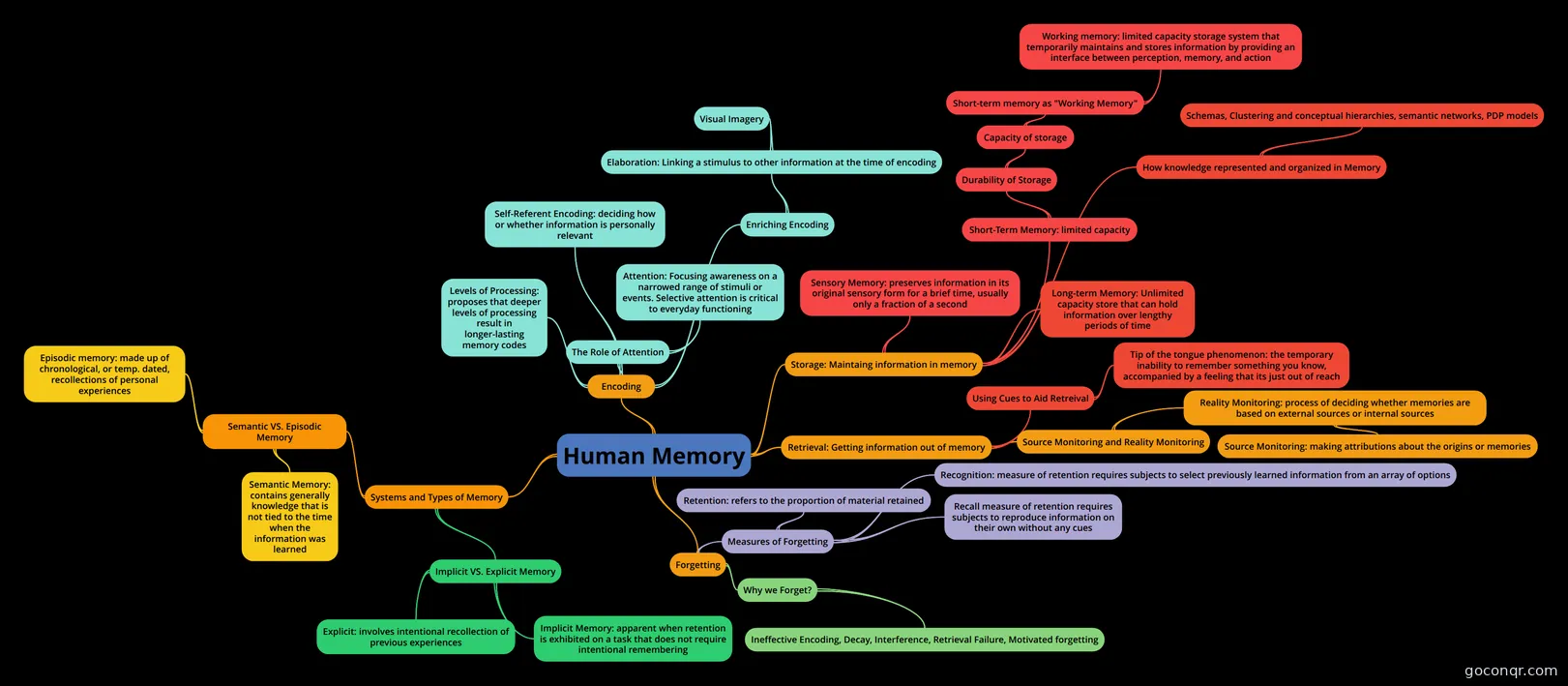
Mind map: Human Memory
Conteúdo do mapa
Human Memory
Encoding
- The Role of Attention
- Attention: Focusing awareness on a narrowed range of stimuli or events. Selective attention is critical to everyday functioning
- Levels of Processing: proposes that deeper levels of processing result in longer-lasting memory codes
- Enriching Encoding
- Elaboration: Linking a stimulus to other information at the time of encoding
- Visual Imagery
- Elaboration: Linking a stimulus to other information at the time of encoding
- Self-Referent Encoding: deciding how or whether information is personally relevant
- The Role of Attention
Storage: Maintaing information in memory
- Sensory Memory: preserves information in its original sensory form for a brief time, usually only a fraction of a second
- Short-Term Memory: limited capacity
- Durability of Storage
- Capacity of storage
- Short-term memory as "Working Memory"
- Working memory: limited capacity storage system that temporarily maintains and stores information by providing an interface between perception, memory, and action
- Short-term memory as "Working Memory"
- Capacity of storage
- Durability of Storage
- Long-term Memory: Unlimited capacity store that can hold information over lengthy periods of time
- How knowledge represented and organized in Memory
- Schemas, Clustering and conceptual hierarchies, semantic networks, PDP models
Retrieval: Getting information out of memory
- Using Cues to Aid Retreival
- Tip of the tongue phenomenon: the temporary inability to remember something you know, accompanied by a feeling that its just out of reach
- Source Monitoring and Reality Monitoring
- Reality Monitoring: process of deciding whether memories are based on external sources or internal sources
- Source Monitoring: making attributions about the origins or memories
- Reality Monitoring: process of deciding whether memories are based on external sources or internal sources
- Using Cues to Aid Retreival
Forgetting
- Measures of Forgetting
- Retention: refers to the proportion of material retained
- Recall measure of retention requires subjects to reproduce information on their own without any cues
- Recognition: measure of retention requires subjects to select previously learned information from an array of options
- Why we Forget?
- Ineffective Encoding, Decay, Interference, Retrieval Failure, Motivated forgetting
- Measures of Forgetting
Systems and Types of Memory
- Implicit VS. Explicit Memory
- Implicit Memory: apparent when retention is exhibited on a task that does not require intentional remembering
- Explicit: involves intentional recollection of previous experiences
- Semantic VS. Episodic Memory
- Episodic memory: made up of chronological, or temp. dated, recollections of personal experiences
- Semantic Memory: contains generally knowledge that is not tied to the time when the information was learned
- Implicit VS. Explicit Memory