
Mapa mental
Topic 3: Electrolytic Processes
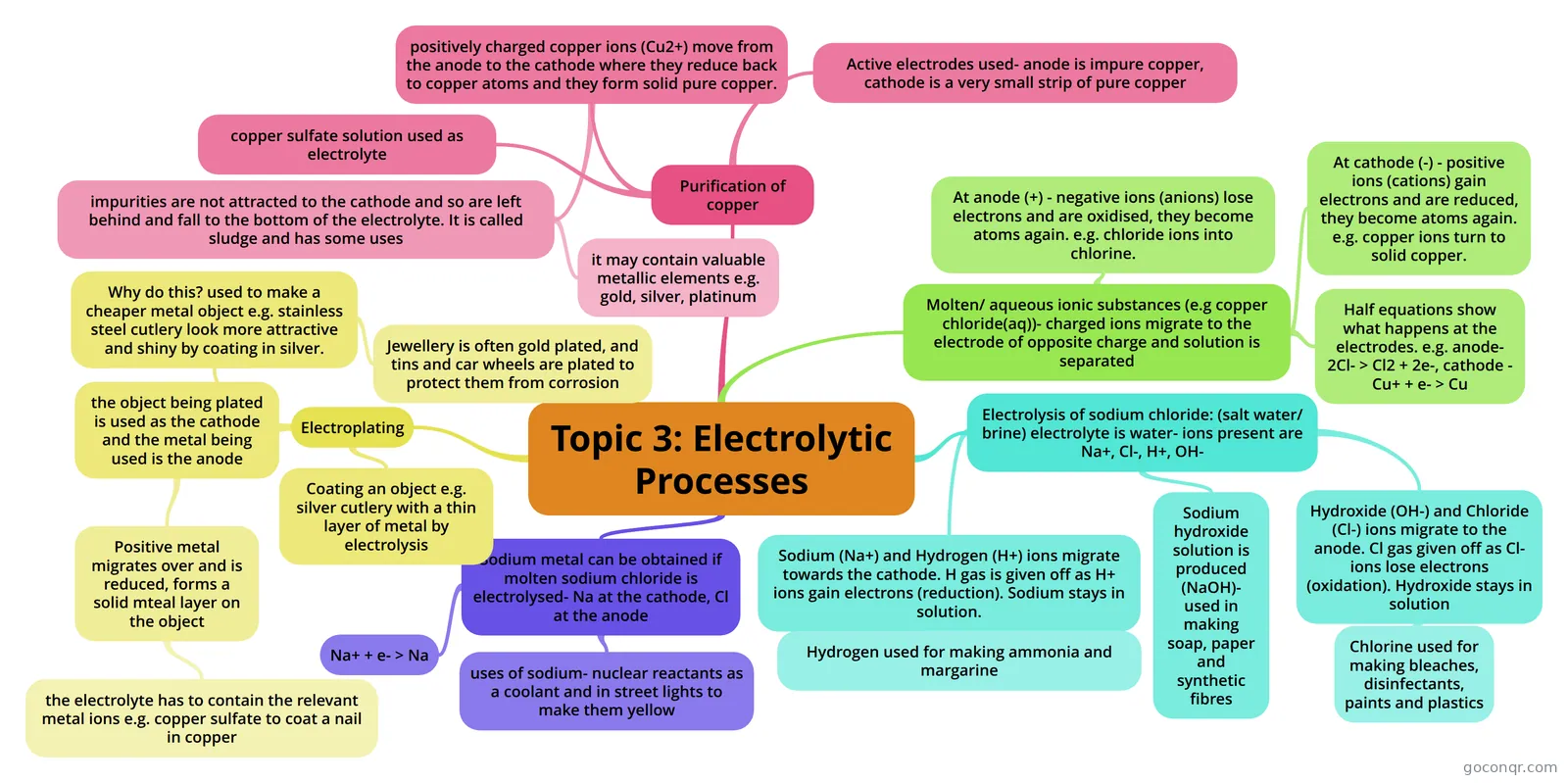
Mind map: electrolytic processes
Conteúdo do mapa
Topic 3: Electrolytic Processes
Molten/ aqueous ionic substances (e.g copper chloride(aq))- charged ions migrate to the electrode of opposite charge and solution is separated
- At anode (+) - negative ions (anions) lose electrons and are oxidised, they become atoms again. e.g. chloride ions into chlorine.
- At cathode (-) - positive ions (cations) gain electrons and are reduced, they become atoms again. e.g. copper ions turn to solid copper.
- Half equations show what happens at the electrodes. e.g. anode- 2Cl- > Cl2 + 2e-, cathode - Cu+ + e- > Cu
Electrolysis of sodium chloride: (salt water/ brine) electrolyte is water- ions present are Na+, Cl-, H+, OH-
- Sodium (Na+) and Hydrogen (H+) ions migrate towards the cathode. H gas is given off as H+ ions gain electrons (reduction). Sodium stays in solution.
- Hydrogen used for making ammonia and margarine
- Hydroxide (OH-) and Chloride (Cl-) ions migrate to the anode. Cl gas given off as Cl- ions lose electrons (oxidation). Hydroxide stays in solution
- Chlorine used for making bleaches, disinfectants, paints and plastics
- Sodium hydroxide solution is produced (NaOH)- used in making soap, paper and synthetic fibres
- Sodium (Na+) and Hydrogen (H+) ions migrate towards the cathode. H gas is given off as H+ ions gain electrons (reduction). Sodium stays in solution.
Sodium metal can be obtained if molten sodium chloride is electrolysed- Na at the cathode, Cl at the anode
- uses of sodium- nuclear reactants as a coolant and in street lights to make them yellow
- Na+ + e- > Na
Electroplating
- Coating an object e.g. silver cutlery with a thin layer of metal by electrolysis
- Why do this? used to make a cheaper metal object e.g. stainless steel cutlery look more attractive and shiny by coating in silver.
- Jewellery is often gold plated, and tins and car wheels are plated to protect them from corrosion
- the object being plated is used as the cathode and the metal being used is the anode
- Positive metal migrates over and is reduced, forms a solid mteal layer on the object
- the electrolyte has to contain the relevant metal ions e.g. copper sulfate to coat a nail in copper
- Positive metal migrates over and is reduced, forms a solid mteal layer on the object
Purification of copper
- Active electrodes used- anode is impure copper, cathode is a very small strip of pure copper
- positively charged copper ions (Cu2+) move from the anode to the cathode where they reduce back to copper atoms and they form solid pure copper.
- impurities are not attracted to the cathode and so are left behind and fall to the bottom of the electrolyte. It is called sludge and has some uses
- it may contain valuable metallic elements e.g. gold, silver, platinum
- impurities are not attracted to the cathode and so are left behind and fall to the bottom of the electrolyte. It is called sludge and has some uses
- copper sulfate solution used as electrolyte
Informações
- Descrição
- Chemistry Mapa Mental sobre Topic 3: Electrolytic Processes, criado por Alice Clayden em 25-04-2013.
- Criado por
- Alice Clayden
- Visualizações
- 118
- Tags
- Avaliação