
Mapa mental
Cell adaptations
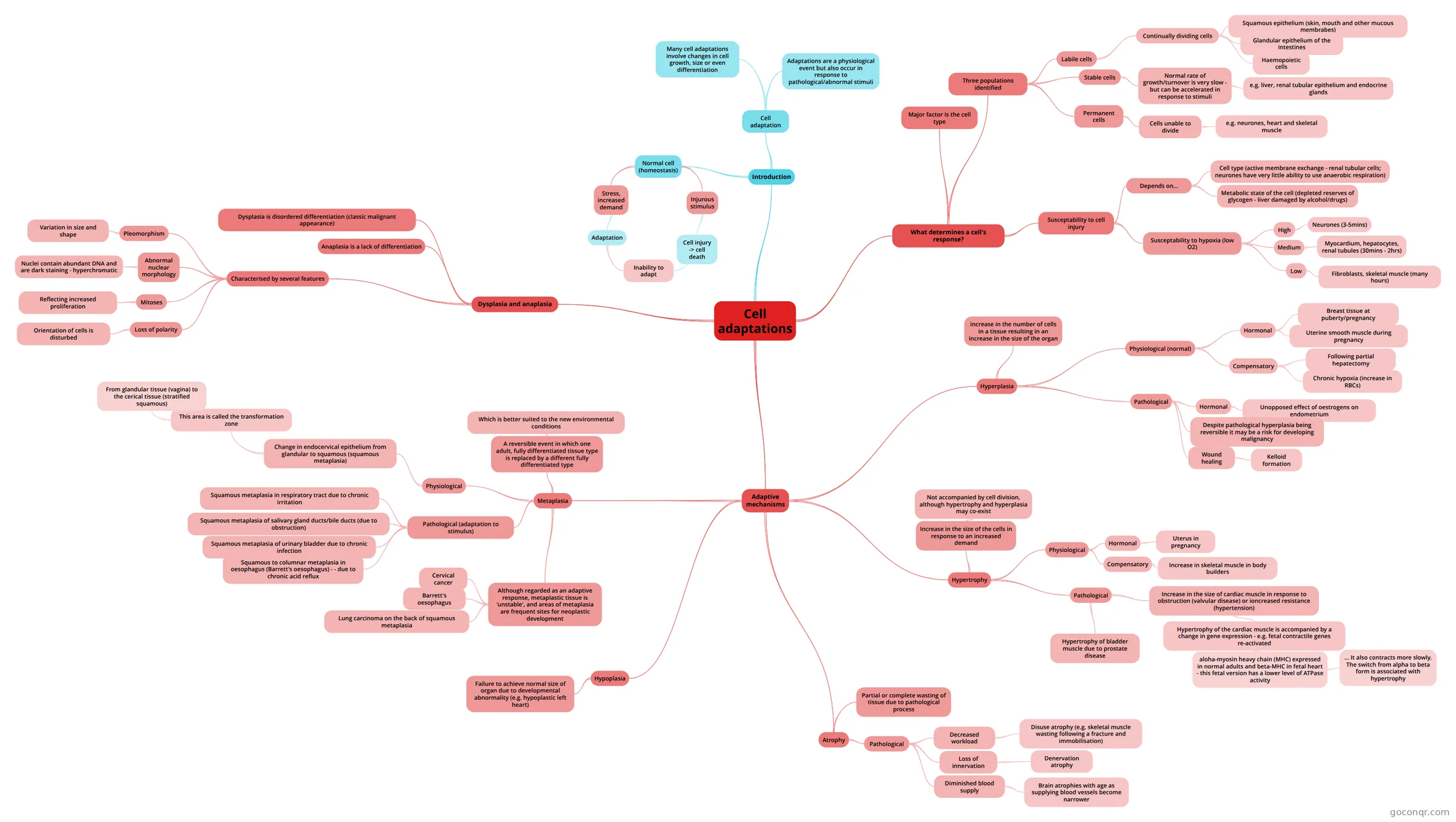
Mind map: Cell adaptations
Conteúdo do mapa
Cell adaptations
Introduction
- Normal cell (homeostasis)
- Stress, increased demand
- Adaptation
- Inability to adapt
- Inability to adapt
- Adaptation
- Injurous stimulus
- Cell injury -> cell death
- Stress, increased demand
- Cell adaptation
- Many cell adaptations involve changes in cell growth, size or even differentiation
- Adaptations are a physiological event but also occur in response to pathological/abnormal stimuli
- Normal cell (homeostasis)
Adaptive mechanisms
- Hyperplasia
- Increase in the number of cells in a tissue resulting in an increase in the size of the organ
- Physiological (normal)
- Hormonal
- Breast tissue at puberty/pregnancy
- Uterine smooth muscle during pregnancy
- Compensatory
- Following partial hepatectomy
- Chronic hypoxia (increase in RBCs)
- Hormonal
- Pathological
- Hormonal
- Unopposed effect of oestrogens on endometrium
- Despite pathological hyperplasia being reversible it may be a risk for developing malignancy
- Wound healing
- Kelloid formation
- Hormonal
- Hypertrophy
- Physiological
- Hormonal
- Uterus in pregnancy
- Compensatory
- Increase in skeletal muscle in body builders
- Hormonal
- Increase in the size of the cells in response to an increased demand
- Not accompanied by cell division, although hypertrophy and hyperplasia may co-exist
- Pathological
- Increase in the size of cardiac muscle in response to obstruction (valvular disease) or ioncreased resistance (hypertension)
- Hypertrophy of the cardiac muscle is accompanied by a change in gene expression - e.g. fetal contractile genes re-activated
- aloha-myosin heavy chain (MHC) expressed in normal adults and beta-MHC in fetal heart - this fetal version has a lower level of ATPase activity
- ... It also contracts more slowly. The switch from alpha to beta form is associated with hypertrophy
- aloha-myosin heavy chain (MHC) expressed in normal adults and beta-MHC in fetal heart - this fetal version has a lower level of ATPase activity
- Hypertrophy of the cardiac muscle is accompanied by a change in gene expression - e.g. fetal contractile genes re-activated
- Hypertrophy of bladder muscle due to prostate disease
- Increase in the size of cardiac muscle in response to obstruction (valvular disease) or ioncreased resistance (hypertension)
- Physiological
- Atrophy
- Pathological
- Decreased workload
- Disuse atrophy (e.g. skeletal muscle wasting following a fracture and immobilisation)
- Loss of innervation
- Denervation atrophy
- Diminished blood supply
- Brain atrophies with age as supplying blood vessels become narrower
- Decreased workload
- Partial or complete wasting of tissue due to pathological process
- Pathological
- Hypoplasia
- Failure to achieve normal size of organ due to developmental abnormality (e.g. hypoplastic left heart)
- Metaplasia
- A reversible event in which one adult, fully differentiated tissue type is replaced by a different fully differentiated type
- Which is better suited to the new environmental conditions
- Physiological
- Change in endocervical epithelium from glandular to squamous (squamous metaplasia)
- This area is called the transformation zone
- From glandular tissue (vagina) to the cerical tissue (stratified squamous)
- This area is called the transformation zone
- Change in endocervical epithelium from glandular to squamous (squamous metaplasia)
- Pathological (adaptation to stimulus)
- Squamous metaplasia in respiratory tract due to chronic irritation
- Squamous metaplasia of salivary gland ducts/bile ducts (due to obstruction)
- Squamous metaplasia of urinary bladder due to chronic infection
- Squamous to columnar metaplasia in oesophagus (Barrett's oesophagus) - - due to chronic acid reflux
- Although regarded as an adaptive response, metaplastic tissue is 'unstable', and areas of metaplasia are frequent sites for neoplastic development
- Cervical cancer
- Barrett's oesophagus
- Lung carcinoma on the back of squamous metaplasia
- A reversible event in which one adult, fully differentiated tissue type is replaced by a different fully differentiated type
- Hyperplasia
Dysplasia and anaplasia
- Dysplasia is disordered differentiation (classic malignant appearance)
- Anaplasia is a lack of differentiation
- Characterised by several features
- Pleomorphism
- Variation in size and shape
- Abnormal nuclear morphology
- Nuclei contain abundant DNA and are dark staining - hyperchromatic
- Mitoses
- Reflecting increased proliferation
- Loss of polarity
- Orientation of cells is disturbed
- Pleomorphism
What determines a cell's response?
- Major factor is the cell type
- Three populations identified
- Labile cells
- Continually dividing cells
- Squamous epithelium (skin, mouth and other mucous membrabes)
- Glandular epithelium of the intestines
- Haemopoietic cells
- Continually dividing cells
- Stable cells
- Normal rate of growth/turnover is very slow - but can be accelerated in response to stimuli
- e.g. liver, renal tubular epithelium and endocrine glands
- Normal rate of growth/turnover is very slow - but can be accelerated in response to stimuli
- Permanent cells
- Cells unable to divide
- e.g. neurones, heart and skeletal muscle
- Cells unable to divide
- Labile cells
- Susceptability to cell injury
- Depends on...
- Cell type (active membrane exchange - renal tubular cells; neurones have very little ability to use anaerobic respiration)
- Metabolic state of the cell (depleted reserves of glycogen - liver damaged by alcohol/drugs)
- Susceptability to hypoxia (low O2)
- High
- Neurones (3-5mins)
- Medium
- Myocardium, hepatocytes, renal tubules (30mins - 2hrs)
- Low
- Fibroblasts, skeletal muscle (many hours)
- High
- Depends on...
Informações
- Descrição
- Blood Science Mapa Mental sobre Cell adaptations, criado por maisie_oj em 28-04-2013.
- Criado por
- maisie_oj
- Visualizações
- 173
- Tags
- Avaliação