
Mapa mental
Ecosystems
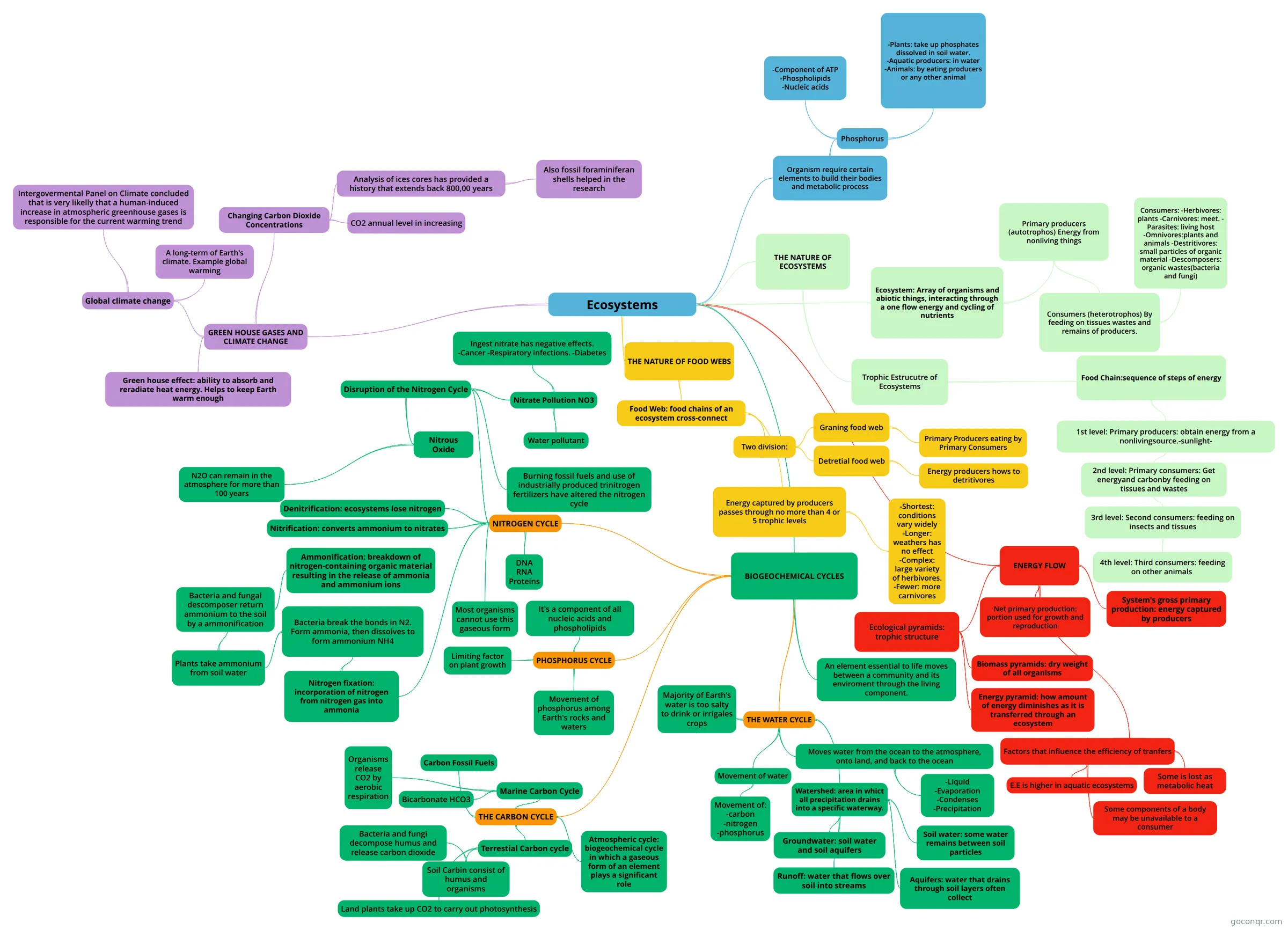
Mind map: Ecosystems
Conteúdo do mapa
Ecosystems
Organism require certain elements to build their bodies and metabolic process
- Phosphorus
- -Plants: take up phosphates dissolved in soil water. -Aquatic producers: in water -Animals: by eating producers or any other animal
- -Component of ATP -Phospholipids -Nucleic acids
- Phosphorus
Ecosystem: Array of organisms and abiotic things, interacting through a one flow energy and cycling of nutrients
- Primary producers (autotrophos) Energy from nonliving things
- Consumers (heterotrophos) By feeding on tissues wastes and remains of producers.
- Consumers: -Herbivores: plants -Carnivores: meet. - Parasites: living host -Omnivores:plants and animals -Destritivores: small particles of organic material -Descomposers: organic wastes(bacteria and fungi)
- Consumers (heterotrophos) By feeding on tissues wastes and remains of producers.
- Primary producers (autotrophos) Energy from nonliving things
THE NATURE OF ECOSYSTEMS
- Trophic Estrucutre of Ecosystems
- Trophic levels: hierarchy of feeding relationship position in Food Chain
- Food Chain:sequence of steps of energy
- 1st level: Primary producers: obtain energy from a nonlivingsource.-sunlight-
- 2nd level: Primary consumers: Get energyand carbonby feeding on tissues and wastes
- 3rd level: Second consumers: feeding on insects and tissues
- 4th level: Third consumers: feeding on other animals
- 3rd level: Second consumers: feeding on insects and tissues
- 2nd level: Primary consumers: Get energyand carbonby feeding on tissues and wastes
- 1st level: Primary producers: obtain energy from a nonlivingsource.-sunlight-
- Food Chain:sequence of steps of energy
- Trophic levels: hierarchy of feeding relationship position in Food Chain
- Trophic Estrucutre of Ecosystems
THE NATURE OF FOOD WEBS
- Food Web: food chains of an ecosystem cross-connect
- Two division:
- Graning food web
- Primary Producers eating by Primary Consumers
- Detretial food web
- Energy producers hows to detritivores
- Graning food web
- Number of tranfers are limited.
- Energy captured by producers passes through no more than 4 or 5 trophic levels
- -Shortest: conditions vary widely -Longer: weathers has no effect -Complex: large variety of herbivores. -Fewer: more carnivores
- Energy captured by producers passes through no more than 4 or 5 trophic levels
- Two division:
- Food Web: food chains of an ecosystem cross-connect
ENERGY FLOW
- System's gross primary production: energy captured by producers
- Net primary production: portion used for growth and reproduction
- Ecological pyramids: trophic structure
- Biomass pyramids: dry weight of all organisms
- Energy pyramid: how amount of energy diminishes as it is transferred through an ecosystem
- Ecological Efficiency
- Factors that influence the efficiency of tranfers
- E.E is higher in aquatic ecosystems
- Some components of a body may be unavailable to a consumer
- Some is lost as metabolic heat
- Factors that influence the efficiency of tranfers
BIOGEOCHEMICAL CYCLES
- An element essential to life moves between a community and its enviroment through the living component.
- THE WATER CYCLE
- Moves water from the ocean to the atmosphere, onto land, and back to the ocean
- -Liquid -Evaporation -Condenses -Precipitation
- Watershed: area in whict all precipitation drains into a specific waterway.
- Soil water: some water remains between soil particles
- Aquifers: water that drains through soil layers often collect
- Groundwater: soil water and soil aquifers
- Runoff: water that flows over soil into streams
- Movement of water
- Movement of: -carbon -nitrogen -phosphorus
- Limited fresh water
- Majority of Earth's water is too salty to drink or irrigales crops
- Moves water from the ocean to the atmosphere, onto land, and back to the ocean
- THE CARBON CYCLE
- Atmospheric cycle: biogeochemical cycle in which a gaseous form of an element plays a significant role
- Terrestial Carbon cycle
- Land plants take up CO2 to carry out photosynthesis
- Soil Carbin consist of humus and organisms
- Bacteria and fungi decompose humus and release carbon dioxide
- Marine Carbon Cycle
- Bicarbonate HCO3
- Organisms release CO2 by aerobic respiration
- Carbon Fossil Fuels
- PHOSPHORUS CYCLE
- Movement of phosphorus among Earth's rocks and waters
- Limiting factor on plant growth
- It's a component of all nucleic acids and phospholipids
- NITROGEN CYCLE
- Most organisms cannot use this gaseous form
- DNA RNA Proteins
- Nitrogen fixation: incorporation of nitrogen from nitrogen gas into ammonia
- Bacteria break the bonds in N2. Form ammonia, then dissolves to form ammonium NH4
- Plants take ammonium from soil water
- Consumer obtain nitrogen by eating them
- Bacteria and fungal descomposer return ammonium to the soil by a ammonification
- Ammonification: breakdown of nitrogen-containing organic material resulting in the release of ammonia and ammonium ions
- Bacteria and fungal descomposer return ammonium to the soil by a ammonification
- Consumer obtain nitrogen by eating them
- Plants take ammonium from soil water
- Bacteria break the bonds in N2. Form ammonia, then dissolves to form ammonium NH4
- Nitrification: converts ammonium to nitrates
- Denitrification: ecosystems lose nitrogen
- Disruption of the Nitrogen Cycle
- Burning fossil fuels and use of industrially produced trinitrogen fertilizers have altered the nitrogen cycle
- Nitrous Oxide
- N2O can remain in the atmosphere for more than 100 years
- Nitrate Pollution NO3
- Water pollutant
- Ingest nitrate has negative effects. -Cancer -Respiratory infections. -Diabetes
GREEN HOUSE GASES AND CLIMATE CHANGE
- Green house effect: ability to absorb and reradiate heat energy. Helps to keep Earth warm enough
- Changing Carbon Dioxide Concentrations
- CO2 annual level in increasing
- Analysis of ices cores has provided a history that extends back 800,00 years
- Also fossil foraminiferan shells helped in the research
- Global climate change
- A long-term of Earth's climate. Example global warming
- Intergovermental Panel on Climate concluded that is very likelly that a human-induced increase in atmospheric greenhouse gases is responsible for the current warming trend