
Mapa mental
Unit 2: Tissues
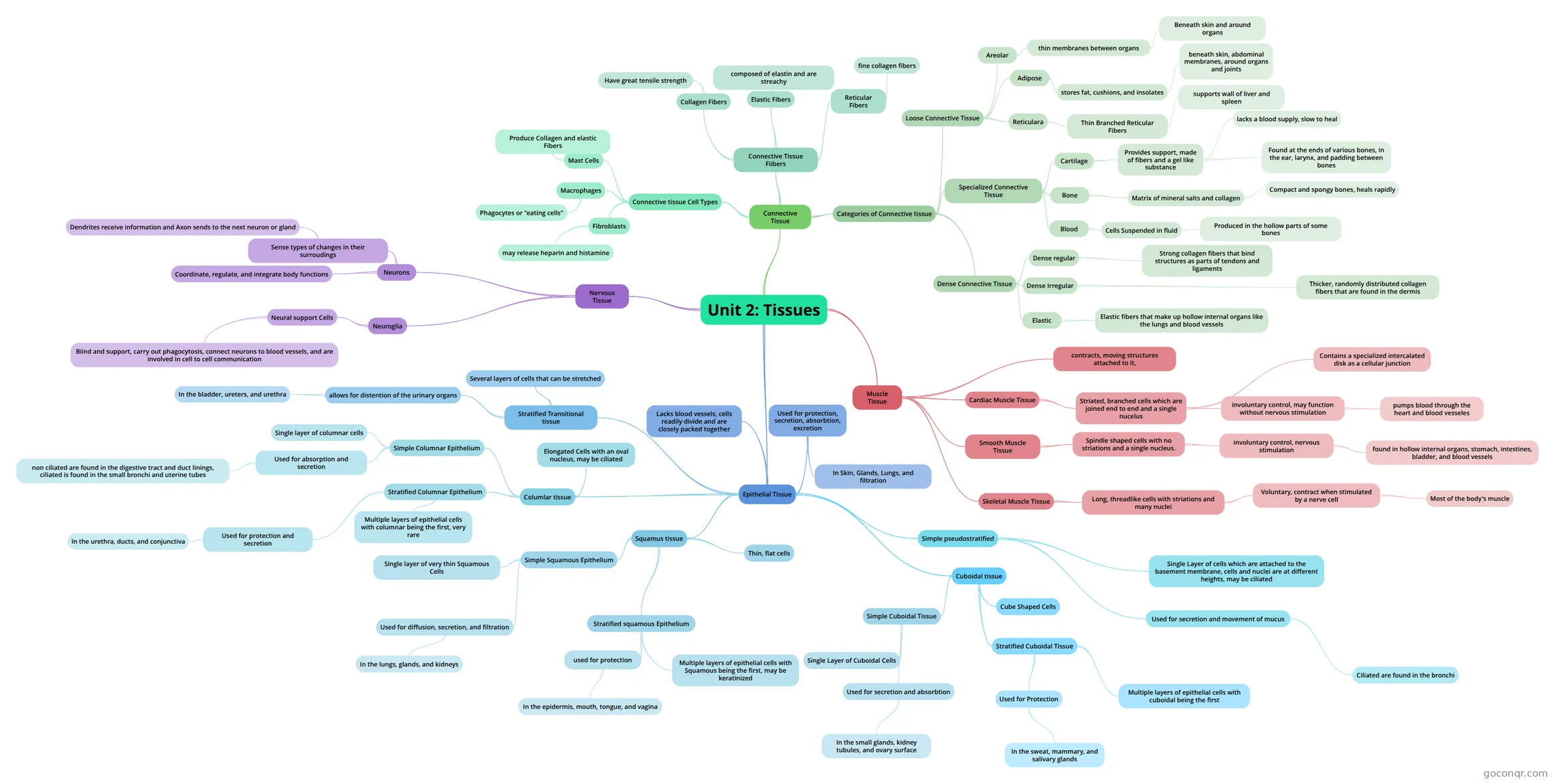
Mind map: Tissues
Conteúdo do mapa
Unit 2: Tissues
Epithelial Tissue
- Squamus tissue
- Thin, flat cells
- Simple Squamous Epithelium
- Single layer of very thin Squamous Cells
- Used for diffusion, secretion, and filtration
- In the lungs, glands, and kidneys
- Stratified squamous Epithelium
- Multiple layers of epithelial cells with Squamous being the first, may be keratinized
- used for protection
- In the epidermis, mouth, tongue, and vagina
- Cuboidal tissue
- Simple Cuboidal Tissue
- Single Layer of Cuboidal Cells
- Used for secretion and absorbtion
- In the small glands, kidney tubules, and ovary surface
- Stratified Cuboidal Tissue
- Multiple layers of epithelial cells with cuboidal being the first
- Used for Protection
- In the sweat, mammary, and salivary glands
- Cube Shaped Cells
- Simple Cuboidal Tissue
- Columlar tissue
- Stratified Columnar Epithelium
- Multiple layers of epithelial cells with columnar being the first, very rare
- Used for protection and secretion
- In the urethra, ducts, and conjunctiva
- Simple Columnar Epithelium
- Single layer of columnar cells
- Used for absorption and secretion
- non ciliated are found in the digestive tract and duct linings, ciliated is found in the small bronchi and uterine tubes
- Elongated Cells with an oval nucleus, may be ciliated
- Stratified Columnar Epithelium
- Simple pseudostratified
- Single Layer of cells which are attached to the basement membrane, cells and nuclei are at different heights, may be ciliated
- Used for secretion and movement of mucus
- Ciliated are found in the bronchi
- Stratified Transitional tissue
- Several layers of cells that can be stretched
- allows for distention of the urinary organs
- In the bladder, ureters, and urethra
- Used for protection, secretion, absorbtion, excretion
- In Skin, Glands, Lungs, and filtration
- Lacks blood vessels, cells readily divide and are closely packed together
- Squamus tissue
Muscle Tissue
- contracts, moving structures attached to it,
- Skeletal Muscle Tissue
- Long, threadlike cells with striations and many nuclei
- Voluntary, contract when stimulated by a nerve cell
- Most of the body's muscle
- Voluntary, contract when stimulated by a nerve cell
- Long, threadlike cells with striations and many nuclei
- Smooth Muscle Tissue
- Spindle shaped cells with no striations and a single nucleus.
- involuntary control, nervous stimulation
- found in hollow internal organs, stomach, intestines, bladder, and blood vessels
- involuntary control, nervous stimulation
- Spindle shaped cells with no striations and a single nucleus.
- Cardiac Muscle Tissue
- Striated, branched cells which are joined end to end and a single nucelus
- involuntary control, may function without nervous stimulation
- pumps blood through the heart and blood vesseles
- Contains a specialized intercalated disk as a cellular junction
- involuntary control, may function without nervous stimulation
- Striated, branched cells which are joined end to end and a single nucelus
Nervous Tissue
- Neurons
- Sense types of changes in their surroudings
- Dendrites receive information and Axon sends to the next neuron or gland
- Coordinate, regulate, and integrate body functions
- Sense types of changes in their surroudings
- Neuroglia
- Neural support Cells
- Biind and support, carry out phagocytosis, connect neurons to blood vessels, and are involved in cell to cell communication
- Neural support Cells
- Neurons
Connective Tissue
- Connective tissue Cell Types
- Mast Cells
- Produce Collagen and elastic Fibers
- Macrophages
- Phagocytes or "eating cells"
- Fibroblasts
- may release heparin and histamine
- Mast Cells
- Connective Tissue Fiibers
- Collagen Fibers
- Have great tensile strength
- Elastic FIbers
- composed of elastin and are streachy
- Reticular Fibers
- fine collagen fibers
- Collagen Fibers
- Categories of Connective tissue
- Loose Connective Tissue
- Areolar
- thin membranes between organs
- Beneath skin and around organs
- thin membranes between organs
- Adipose
- stores fat, cushions, and insolates
- beneath skin, abdominal membranes, around organs and joints
- stores fat, cushions, and insolates
- Reticulara
- Thin Branched Reticular Fibers
- supports wall of liver and spleen
- Thin Branched Reticular Fibers
- Areolar
- Dense Connective Tissue
- Dense regular
- Strong collagen fibers that bind structures as parts of tendons and ligaments
- Dense Irregular
- Thicker, randomly distributed collagen fibers that are found in the dermis
- Elastic
- Elastic fibers that make up hollow internal organs like the lungs and blood vessels
- Dense regular
- Specialized Connective Tissue
- Cartilage
- Provides support, made of fibers and a gel like substance
- lacks a blood supply, slow to heal
- Found at the ends of various bones, in the ear, larynx, and padding between bones
- Provides support, made of fibers and a gel like substance
- Bone
- Matrix of mineral salts and collagen
- Compact and spongy bones, heals rapidly
- Matrix of mineral salts and collagen
- Blood
- Cells Suspended in fluid
- Produced in the hollow parts of some bones
- Cells Suspended in fluid
- Cartilage
- Loose Connective Tissue
- Connective tissue Cell Types