
Mapa mental
Bone marrow failure syndromes
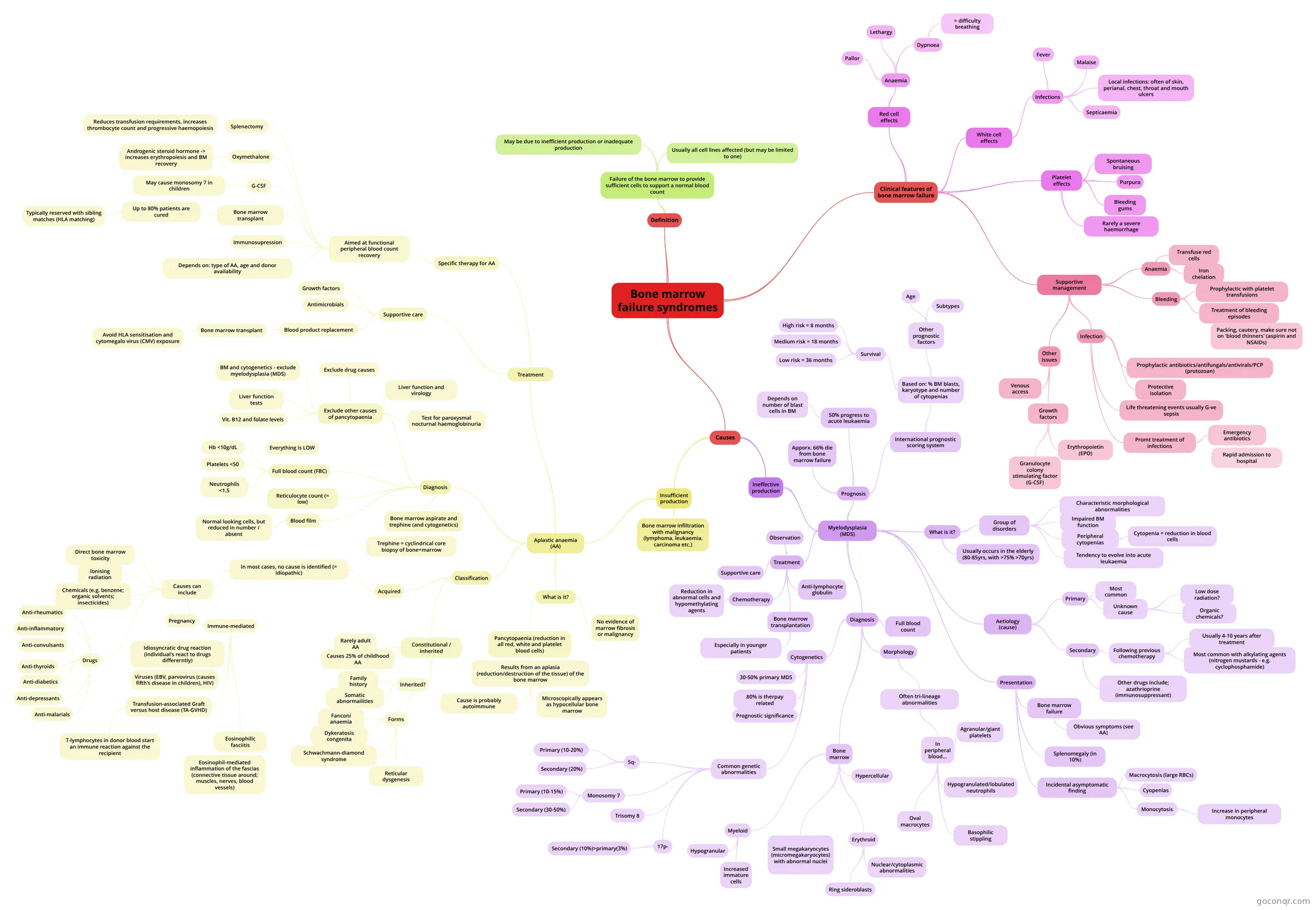
Mind map: bone marrow failure syndromes
Conteúdo do mapa
Bone marrow failure syndromes
Definition
- Failure of the bone marrow to provide sufficient cells to support a normal blood count
- May be due to inefficient production or inadequate production
- Usually all cell lines affected (but may be limited to one)
- Failure of the bone marrow to provide sufficient cells to support a normal blood count
Clinical features of bone marrow failure
- Red cell effects
- Anaemia
- Pallor
- Lethargy
- Dypnoea
- = difficulty breathing
- Anaemia
- White cell effects
- Infections
- Fever
- Malaise
- Local infections: often of skin, perianal, chest, throat and mouth ulcers
- Septicaemia
- Infections
- Platelet effects
- Spontaneous bruising
- Purpura
- Bleeding gums
- Rarely a severe haemorrhage
- Supportive management
- Anaemia
- Transfuse red cells
- Iron chelation
- Bleeding
- Prophylactic with platelet transfusions
- Treatment of bleeding episodes
- Packing, cautery, make sure not on 'blood thinners' (aspirin and NSAIDs)
- Infection
- Prophylactic antibiotics/antifungals/antivirals/PCP (protozoan)
- Protective isolation
- Life threatening events usually G-ve sepsis
- Promt treatment of infections
- Emergency antibiotics
- Rapid admission to hospital
- Emergency antibiotics
- Other issues
- Venous access
- Growth factors
- Granulocyte colony stimulating factor (G-CSF)
- Erythropoietin (EPO)
- Anaemia
- Red cell effects
Causes
- Ineffective production
- Myelodysplasia (MDS)
- What is it?
- Group of disorders
- Characteristic morphological abnormalities
- Impaired BM function
- Peripheral cytopenias
- Cytopenia = reduction in blood cells
- Tendency to evolve into acute leukaemia
- Usually occurs in the elderly (80-85yrs, with >75% >70yrs)
- Group of disorders
- Aetiology (cause)
- Primary
- Most common
- Unknown cause
- Low dose radiation?
- Organic chemicals?
- Secondary
- Following previous chemotherapy
- Usually 4-10 years after treatment
- Most common with alkylating agents (nitrogen mustards - e.g. cyclophosphamide)
- Other drugs include; azathrioprine (immunosuppressant)
- Following previous chemotherapy
- Primary
- Presentation
- Bone marrow failure
- Obvious symptoms (see AA)
- Splenomegaly (in 10%)
- Incidental asymptomatic finding
- Macrocytosis (large RBCs)
- Cyopenias
- Monocytosis
- Increase in peripheral monocytes
- Bone marrow failure
- Diagnosis
- Full blood count
- Morphology
- Often tri-lineage abnormalities
- In peripheral blood...
- Oval macrocytes
- Basophilic stippling
- Hypogranulated/lobulated neutrophils
- Agranular/giant platelets
- In peripheral blood...
- Often tri-lineage abnormalities
- Bone marrow
- Hypercellular
- Erythroid
- Nuclear/cytoplasmic abnormalities
- Ring sideroblasts
- Small megakaryocytes (micromegakaryocytes) with abnormal nuclei
- Myeloid
- Hypogranular
- Increased immature cells
- Cytogenetics
- 30-50% primary MDS
- 80% is therpay related
- Prognostic significance
- Common genetic abnormalities
- 5q-
- Primary (10-20%)
- Secondary (20%)
- Monosomy 7
- Primary (10-15%)
- Secondary (30-50%)
- Trisomy 8
- 17p-
- Secondary (10%)>primary(3%)
- 5q-
- Prognosis
- Apporx. 66% die from bone marrow failure
- 50% progress to acute leukaemia
- Depends on number of blast cells in BM
- International prognostic scoring system
- Based on: % BM blasts, karyotype and number of cytopenias
- Survival
- Low risk = 36 months
- Medium risk = 18 months
- High risk = 8 months
- Other prognostic factors
- Age
- Subtypes
- Survival
- Based on: % BM blasts, karyotype and number of cytopenias
- Treatment
- Observation
- Supportive care
- Chemotherapy
- Reduction in abnormal cells and hypomethylating agents
- Anti-lymphocyte globulin
- Bone marrow transplantation
- Especially in younger patients
- What is it?
- Myelodysplasia (MDS)
- Insufficient production
- Aplastic anaemia (AA)
- What is it?
- Pancytopaenia (reduction in all red, white and platelet blood cells)
- Results from an aplasia (reduction/destruction of the tissue) of the bone marrow
- Cause is probably autoimmune
- Microscopically appears as hypocellular bone marrow
- Results from an aplasia (reduction/destruction of the tissue) of the bone marrow
- No evidence of marrow fibrosis or malignancy
- Pancytopaenia (reduction in all red, white and platelet blood cells)
- Classification
- Constitutional / inherited
- Causes 25% of childhood AA
- Rarely adult AA
- Inherited?
- Family history
- Somatic abnormailities
- Forms
- Fanconi anaemia
- Dykeratosis congenita
- Schwachmann-diamond syndrome
- Reticular dysgenesis
- Acquired
- In most cases, no cause is identified (= idiopathic)
- Causes can include
- Direct bone marrow toxicity
- Ionising radiation
- Chemicals (e.g. benzene; organic solvents; insecticides)
- Drugs
- Anti-rheumatics
- Anti-inflammatory
- Anti-convulsants
- Anti-thyroids
- Anti-depressants
- Anti-diabetics
- Anti-malarials
- Immune-mediated
- Pregnancy
- Idiosyncratic drug reaction (individual's react to drugs differerntly)
- Viruses (EBV, parvovirus (causes fifth's disease in children), HIV)
- Transfusion-associated Graft versus host disease (TA-GVHD)
- T-lymphocytes in donor blood start an immune reaction against the recipient
- Eosinophilic fasciitis
- Eosinophil-mediated inflammation of the fascias (connective tissue around; muscles, nerves, blood vessels)
- Causes can include
- In most cases, no cause is identified (= idiopathic)
- Constitutional / inherited
- Diagnosis
- Full blood count (FBC)
- Hb <10g/dL
- Platelets <50
- Neutrophils <1.5
- Everything is LOW
- Reticulocyte count (= low)
- Blood film
- Normal looking cells, but reduced in number / absent
- Bone marrow aspirate and trephine (and cytogenetics)
- Trephine = cyclindrical core biopsy of bone+marrow
- Exclude other causes of pancytopaenia
- Vit. B12 and folate levels
- Liver function tests
- BM and cytogenetics - exclude myelodysplasia (MDS)
- Exclude drug causes
- Liver function and virology
- Test for paroxysmal nocturnal haemoglobinuria
- Full blood count (FBC)
- Treatment
- Supportive care
- Blood product replacement
- Bone marrow transplant
- Avoid HLA sensitisation and cytomegalo virus (CMV) exposure
- Bone marrow transplant
- Antimicrobials
- Growth factors
- Blood product replacement
- Specific therapy for AA
- Aimed at functional peripheral blood count recovery
- Depends on: type of AA, age and donor availability
- Immunosupression
- Bone marrow transplant
- Up to 80% patients are cured
- Typically reserved with sibling matches (HLA matching)
- Up to 80% patients are cured
- G-CSF
- May cause monosomy 7 in children
- Oxymethalone
- Androgenic steroid hormone -> increases erythropoiesis and BM recovery
- Splenectomy
- Reduces transfusion requirements, increases thrombocyte count and progressive haemopoiesis
- Aimed at functional peripheral blood count recovery
- Supportive care
- What is it?
- Bone marrow infiltration with malignancy (lymphoma, leukaemia, carcinoma etc.)
- Aplastic anaemia (AA)
- Ineffective production
Informações
- Descrição
- Blood Science Mapa Mental sobre Bone marrow failure syndromes, criado por maisie_oj em 01-05-2013.
- Criado por
- maisie_oj
- Visualizações
- 103
- Tags
- Avaliação