
Mapa mental
C3 Part 1 - The Periodic Table
Conteúdo do mapa
C3 Part 1 - The Periodic Table
PERIODIC TABLE
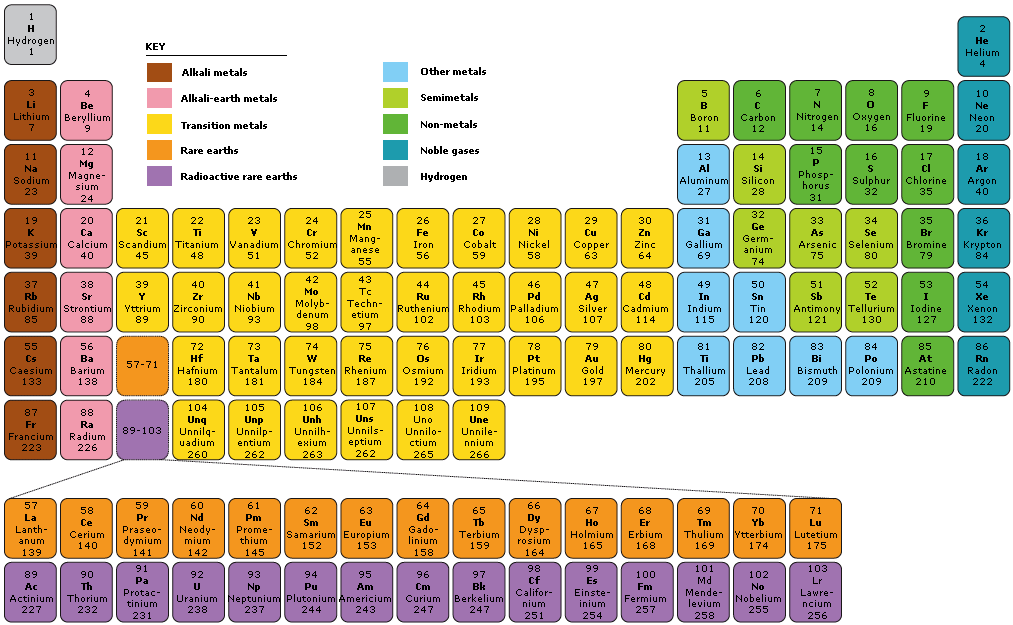
- The periodic table
- Atomic Number
- The number of protons in an atom of an element
- Elements arranged in order of increasing atomic number
- Atomic Number
- Alkali metals - 1
- The more easily the outer electron is lost, the more reactive the Group 1 element is
- As you go down Group 1, electronic shielding increases - this means the "pull" on the outer electron from the nucleus is reduced
- The outer electron is also further away from the positive nucleus as you go down the Group
- As you go down Group 1, electronic shielding increases - this means the "pull" on the outer electron from the nucleus is reduced
- Density
- Density (gcm-3) = Mass(g)/Volume(cm3)
- Lithium - 0.53gcm-3
- Sodium - 0.97gcm-3
- Potassium - 0.86gcm-3
- Rubidium - 1.53gcm-3
- Lithium, Sodium and Potassium will all float on water as their density is less than water (1gcm-3)
- Density (gcm-3) = Mass(g)/Volume(cm3)
- Low densities
- Soft
- Low melting and boiling point
- As you go down Group 1 metals, the melting and boiling point of the alkali metals decrease
- Melting point
- Lithium - 180
- Sodium - 97.8
- Potassium - 63.5
- Rubidium - 38.9
- Caesium - 28.7
- Francium - 27
- Boiling point
- Lithium - 1330
- Sodium - 890
- Potassium - 774
- Rubidium - 688
- Caesium - 690
- Francium - 680
- Melting point
- As you go down Group 1 metals, the melting and boiling point of the alkali metals decrease
- The more easily the outer electron is lost, the more reactive the Group 1 element is
- Alkali metals - 2
- Alkali metals reacting with air (oxygen)
- Sodium + Oxygen --> Sodium Oxide
- 4Na+ + O2- > 2Na2O
- Sodium + Oxygen --> Sodium Oxide
- Alkali metals reacting with halogens to form Alkali metal Halides
- Sodium + Chlorine --> Sodium Chloride
- 2Na + Cl2 --> 2NaCl
- Sodium + Chlorine --> Sodium Chloride
- Alkali Metals and water
- Sodium + Water --> Sodium Hydroxide + Hydrogen
- 2Na + 2H2O --> 2NaOH + H2
- Sodium + Water --> Sodium Hydroxide + Hydrogen
- Alkali metals reacting with air (oxygen)
- The Transition Elements
- Centre block of Periodic table
- High Densities, Hard, Strong
- Do not react vigorously with water
- Frequently used as catalysts
- The Halogens
- As you go up Group 7, the reactivity increases
- Diatomic molecules formed (F2/Cl2/Br2/I2)
- Weak intermolecular bonds between the diatomic molecules
- Low Melting point
- Low Boiling point
- As you go down Group 7 the melting and boiling point increase due to the intermolecular bonding between the molecules become stronger as you go down Group 7
- Iron + Chlorine --> Iron Chloride
- Colour
- Fluorine - Pale Yellow
- Chlorine - Pale Green
- Bromine - Orange/Brown
- Iodine - Purple Vapour
- Organising the Elements
- Antoine Lavaiser
- Book
- Lists 33 elements
- Classifying them into gases, metals, non-metals and earths
- Book
- Stanislac Connizzaro
- Worked out
- Atomic weights and listed them in a scientific paper
- Worked out
- John Newlands
- 'Law of Octaves'
- Listed 56 elements in order of increasing atomic weight
- Every eighth element had similar properties
- Listed 56 elements in order of increasing atomic weight
- 'Law of Octaves'
- Dmitri Mendeleev
- Published first periodic table
- Elements in order of atomic weights
- In groups of similar properties
- Predicted the elements that hadn't been discovered yet
- Published first periodic table
- Johann Dobreiner
- Announced findings
- Elements come in groups of three
- Middle weight was and average of the lighter and heavier elements
- Elements come in groups of three
- Announced findings
- Alexandre Chancourtois
- Discovered
- Elements with similar properties occur at regular intervals
- Discovered
- Lothar Meyer
- Graph
- Volume of atom against atomic weight
- Noticed a pattern and deduced a periodic table
- Volume of atom against atomic weight
- Graph
- Antoine Lavaiser
- The periodic table
Imagens e arquivos do mapa
Informações
- Descrição
- AQA Additional Science Course Chemistry Part 1 -The Periodic Table (COMPLETED)
- Criado por
- Kayleigh Peek
- Visualizações
- 110
- Tags
- Avaliação