
Mapa mental
Animal By-Products
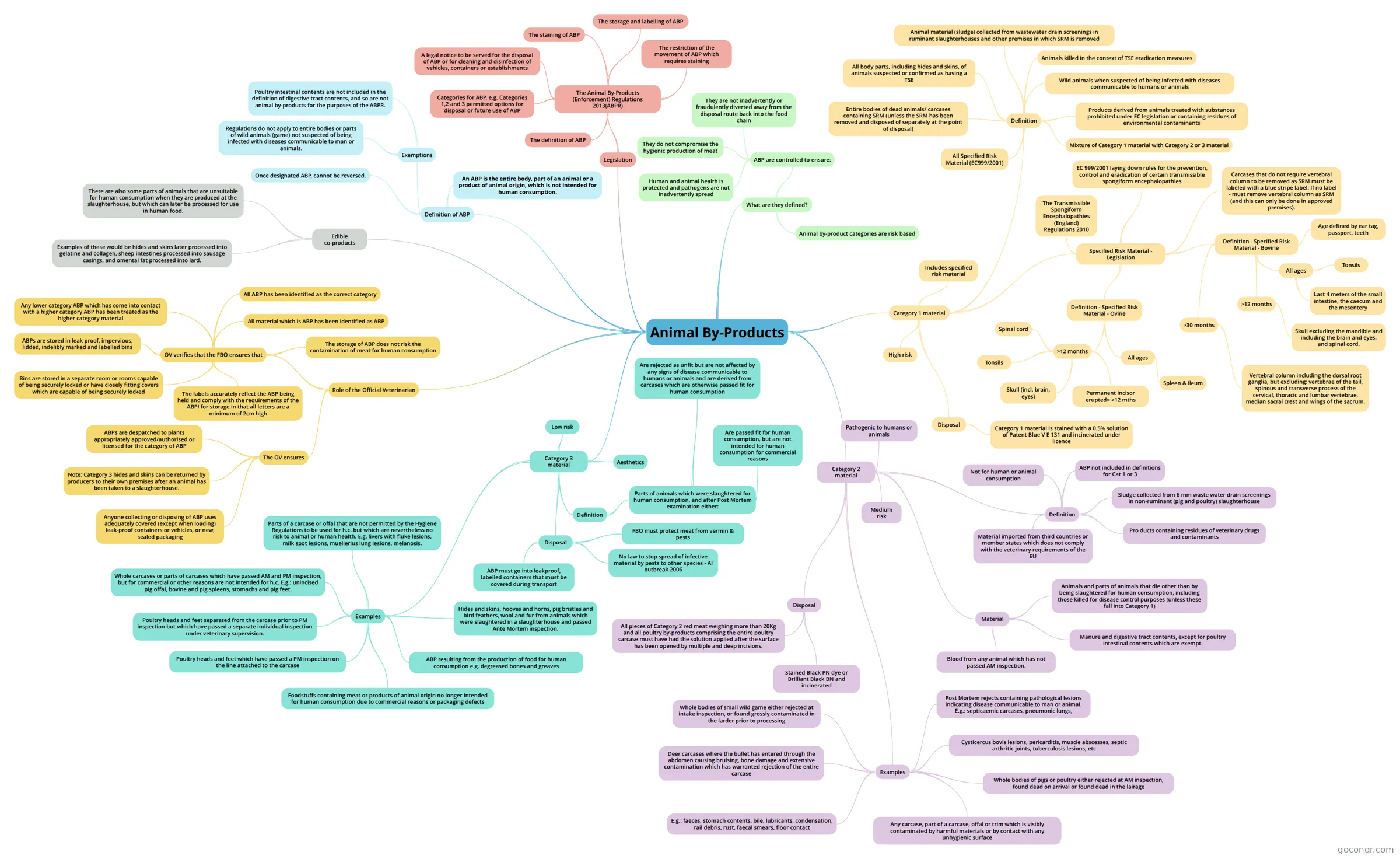
Mind map: Animal by-products
Conteúdo do mapa
Animal By-Products
Definition of ABP
- An ABP is the entire body, part of an animal or a product of animal origin, which is not intended for human consumption.
- Once designated ABP, cannot be reversed.
- Exemptions
- Regulations do not apply to entire bodies or parts of wild animals (game) not suspected of being infected with diseases communicable to man or animals.
- Poultry intestinal contents are not included in the definition of digestive tract contents, and so are not animal by-products for the purposes of the ABPR.
Legislation
- The Animal By-Products (Enforcement) Regulations 2013(ABPR)
- The definition of ABP
- Categories for ABP, e.g. Categories 1,2 and 3 permitted options for disposal or future use of ABP
- A legal notice to be served for the disposal of ABP or for cleaning and disinfection of vehicles, containers or establishments
- The staining of ABP
- The storage and labelling of ABP
- The restriction of the movement of ABP which requires staining
- The Animal By-Products (Enforcement) Regulations 2013(ABPR)
What are they defined?
- ABP are controlled to ensure:
- They do not compromise the hygienic production of meat
- They are not inadvertently or fraudulently diverted away from the disposal route back into the food chain
- Human and animal health is protected and pathogens are not inadvertently spread
- Animal by-product categories are risk based
- ABP are controlled to ensure:
Category 1 material
- Definition
- All Specified Risk Material (EC999/2001)
- Entire bodies of dead animals/ carcases containing SRM (unless the SRM has been removed and disposed of separately at the point of disposal)
- All body parts, including hides and skins, of animals suspected or confirmed as having a TSE
- Animal material (sludge) collected from wastewater drain screenings in ruminant slaughterhouses and other premises in which SRM is removed
- Animals killed in the context of TSE eradication measures
- Wild animals when suspected of being infected with diseases communicable to humans or animals
- Products derived from animals treated with substances prohibited under EC legislation or containing residues of environmental contaminants
- Mixture of Category 1 material with Category 2 or 3 material
- Specified Risk Material - Legislation
- EC 999/2001 laying down rules for the prevention, control and eradication of certain transmissible spongiform encephalopathies
- The Transmissible Spongiform Encephalopathies (England) Regulations 2010
- Definition - Specified Risk Material - Bovine
- All ages
- Tonsils
- Last 4 meters of the small intestine, the caecum and the mesentery
- >12 months
- Skull excluding the mandible and including the brain and eyes, and spinal cord.
- >30 months
- Vertebral column including the dorsal root ganglia, but excluding: vertebrae of the tail, spinous and transverse process of the cervical, thoracic and lumbar vertebrae, median sacral crest and wings of the sacrum.
- Age defined by ear tag, passport, teeth
- All ages
- Carcases that do not require vertebral column to be removed as SRM must be labeled with a blue stripe label. If no label - must remove vertebral column as SRM (and this can only be done in approved premises).
- Definition - Specified Risk Material - Ovine
- All ages
- Spleen & ileum
- >12 months
- Permanent incisor erupted= >12 mths
- Skull (incl. brain, eyes)
- Tonsils
- Spinal cord
- All ages
- Disposal
- Category 1 material is stained with a 0.5% solution of Patent Blue V E 131 and incinerated under licence
- High risk
- Includes specified risk material
- Definition
Category 2 material
- Definition
- Not for human or animal consumption
- ABP not included in definitions for Cat 1 or 3
- Sludge collected from 6 mm waste water drain screenings in non-ruminant (pig and poultry) slaughterhouse
- Pro ducts containing residues of veterinary drugs and contaminants
- Material imported from third countries or member states which does not comply with the veterinary requirements of the EU
- Material
- Animals and parts of animals that die other than by being slaughtered for human consumption, including those killed for disease control purposes (unless these fall into Category 1)
- Manure and digestive tract contents, except for poultry intestinal contents which are exempt.
- Blood from any animal which has not passed AM inspection.
- Disposal
- Stained Black PN dye or Brilliant Black BN and incinerated
- All pieces of Category 2 red meat weighing more than 20Kg and all poultry by-products comprising the entire poultry carcase must have had the solution applied after the surface has been opened by multiple and deep incisions.
- Medium risk
- Pathogenic to humans or animals
- Examples
- Post Mortem rejects containing pathological lesions indicating disease communicable to man or animal. E.g.: septicaemic carcases, pneumonic lungs,
- Cysticercus bovis lesions, pericarditis, muscle abscesses, septic arthritic joints, tuberculosis lesions, etc
- Whole bodies of pigs or poultry either rejected at AM inspection, found dead on arrival or found dead in the lairage
- Any carcase, part of a carcase, offal or trim which is visibly contaminated by harmful materials or by contact with any unhygienic surface
- E.g.: faeces, stomach contents, bile, lubricants, condensation, rail debris, rust, faecal smears, floor contact
- Deer carcases where the bullet has entered through the abdomen causing bruising, bone damage and extensive contamination which has warranted rejection of the entire carcase
- Whole bodies of small wild game either rejected at intake inspection, or found grossly contaminated in the larder prior to processing
- Definition
Category 3 material
- Definition
- Parts of animals which were slaughtered for human consumption, and after Post Mortem examination either:
- Are passed fit for human consumption, but are not intended for human consumption for commercial reasons
- Are rejected as unfit but are not affected by any signs of disease communicable to humans or animals and are derived from carcases which are otherwise passed fit for human consumption
- Parts of animals which were slaughtered for human consumption, and after Post Mortem examination either:
- Examples
- Hides and skins, hooves and horns, pig bristles and bird feathers, wool and fur from animals which were slaughtered in a slaughterhouse and passed Ante Mortem inspection.
- ABP resulting from the production of food for human consumption e.g. degreased bones and greaves
- Foodstuffs containing meat or products of animal origin no longer intended for human consumption due to commercial reasons or packaging defects
- Poultry heads and feet which have passed a PM inspection on the line attached to the carcase
- Poultry heads and feet separated from the carcase prior to PM inspection but which have passed a separate individual inspection under veterinary supervision.
- Whole carcases or parts of carcases which have passed AM and PM inspection, but for commercial or other reasons are not intended for h.c. E.g.: unincised pig offal, bovine and pig spleens, stomachs and pig feet.
- Parts of a carcase or offal that are not permitted by the Hygiene Regulations to be used for h.c. but which are nevertheless no risk to animal or human health. E.g. livers with fluke lesions, milk spot lesions, muellerius lung lesions, melanosis.
- Disposal
- ABP must go into leakproof, labelled containers that must be covered during transport
- FBO must protect meat from vermin & pests
- No law to stop spread of infective material by pests to other species - AI outbreak 2006
- Low risk
- Aesthetics
- Definition
Edible co-products
- There are also some parts of animals that are unsuitable for human consumption when they are produced at the slaughterhouse, but which can later be processed for use in human food.
- Examples of these would be hides and skins later processed into gelatine and collagen, sheep intestines processed into sausage casings, and omental fat processed into lard.
Role of the Official Veterinarian
- OV verifies that the FBO ensures that
- All material which is ABP has been identified as ABP
- All ABP has been identified as the correct category
- Any lower category ABP which has come into contact with a higher category ABP has been treated as the higher category material
- ABPs are stored in leak proof, impervious, lidded, indelibly marked and labelled bins
- Bins are stored in a separate room or rooms capable of being securely locked or have closely fitting covers which are capable of being securely locked
- The labels accurately reflect the ABP being held and comply with the requirements of the ABPI for storage in that all letters are a minimum of 2cm high
- The storage of ABP does not risk the contamination of meat for human consumption
- The OV ensures
- ABPs are despatched to plants appropriately approved/authorised or licensed for the category of ABP
- Note: Category 3 hides and skins can be returned by producers to their own premises after an animal has been taken to a slaughterhouse.
- Anyone collecting or disposing of ABP uses adequately covered (except when loading) leak-proof containers or vehicles, or new, sealed packaging
- OV verifies that the FBO ensures that
Informações
- Descrição
- BVSc3 AD2 (Public Health) Mapa Mental sobre Animal By-Products, criado por Jess Pope em 09-01-2017.
- Criado por
- Jess Pope
- Visualizações
- 1
- Avaliação
Mais sobre Meat Inspection and Food Safety