
Mapa mental
IB Economics SL: Microeconomics
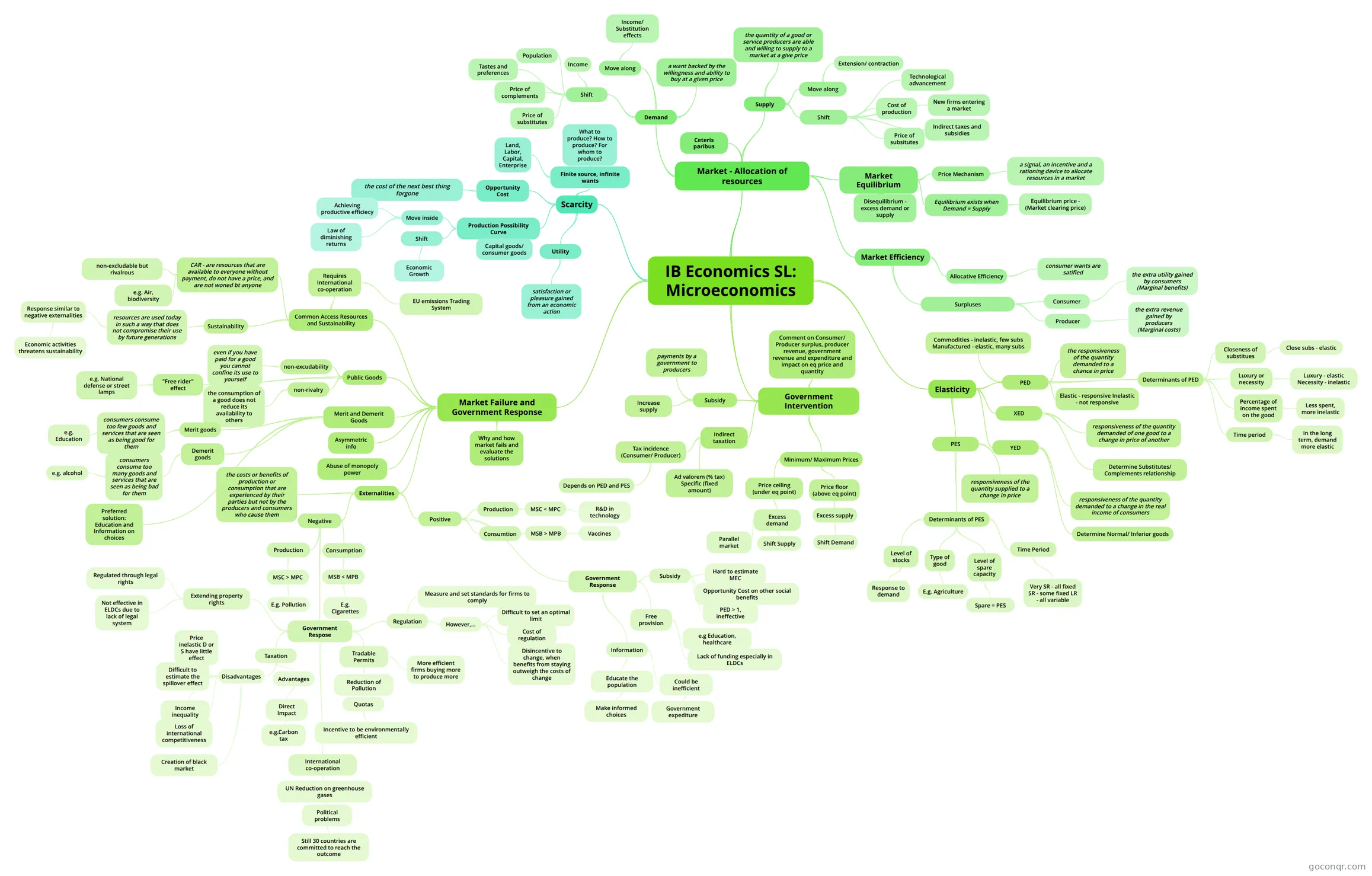
Mind map: IB Economics SL microeconomics
Conteúdo do mapa
IB Economics SL: Microeconomics
Scarcity
- Opportunity Cost
- the cost of the next best thing forgone
- Production Possibility Curve
- Capital goods/ consumer goods
- Move inside
- Law of diminishing returns
- Achieving productive efficiecy
- Shift
- Economic Growth
- Utility
- satisfaction or pleasure gained from an economic action
- Finite source, infinite wants
- What to produce? How to produce? For whom to produce?
- Land, Labor, Capital, Enterprise
- Opportunity Cost
Market - Allocation of resources
- Demand
- a want backed by the willingness and ability to buy at a given price
- Move along
- Income/ Substitution effects
- Shift
- Income
- Population
- Price of complements
- Price of substitutes
- Tastes and preferences
- Supply
- the quantity of a good or service producers are able and willing to supply to a market at a give price
- Move along
- Extension/ contraction
- Shift
- Cost of production
- New firms entering a market
- Indirect taxes and subsidies
- Price of subsitutes
- Technological advancement
- Ceteris paribus
- Market Equilibrium
- Equilibrium exists when Demand = Supply
- Equilibrium price - (Market clearing price)
- Disequilibrium - excess demand or supply
- Price Mechanism
- a signal, an incentive and a rationing device to allocate resources in a market
- Equilibrium exists when Demand = Supply
- Market Efficiency
- Surpluses
- Producer
- the extra revenue gained by producers (Marginal costs)
- Consumer
- the extra utility gained by consumers (Marginal benefits)
- Producer
- Allocative Efficiency
- consumer wants are satified
- Surpluses
- Demand
Elasticity
- PED
- the responsiveness of the quantity demanded to a chance in price
- Elastic - responsive Inelastic - not responsive
- Determinants of PED
- Closeness of substitues
- Close subs - elastic
- Luxury or necessity
- Luxury - elastic Necessity - inelastic
- Percentage of income spent on the good
- Less spent, more inelastic
- Time period
- In the long term, demand more elastic
- Closeness of substitues
- Commodities - inelastic, few subs Manufactured - elastic, many subs
- PES
- responsiveness of the quantity supplied to a change in price
- Determinants of PES
- Time Period
- Very SR - all fixed SR - some fixed LR - all variable
- Level of spare capacity
- Spare = PES
- Type of good
- E.g. Agriculture
- Level of stocks
- Response to demand
- Time Period
- XED
- responsiveness of the quantity demanded of one good to a change in price of another
- Determine Substitutes/ Complements relationship
- YED
- responsiveness of the quantity demanded to a change in the real income of consumers
- Determine Normal/ Inferior goods
- PED
Government Intervention
- Minimum/ Maximum Prices
- Price floor (above eq point)
- Excess supply
- Shift Demand
- Excess supply
- Price ceiling (under eq point)
- Excess demand
- Parallel market
- Shift Supply
- Excess demand
- Price floor (above eq point)
- Indirect taxation
- Tax incidence (Consumer/ Producer)
- Depends on PED and PES
- Ad valorem (% tax) Specific (fixed amount)
- Tax incidence (Consumer/ Producer)
- Subsidy
- payments by a government to producers
- Increase supply
- Comment on Consumer/ Producer surplus, producer revenue, government revenue and expenditure and impact on eq price and quantity
- Minimum/ Maximum Prices
Market Failure and Government Response
- Externalities
- Negative
- Production
- MSC > MPC
- E.g. Pollution
- MSC > MPC
- Consumption
- MSB < MPB
- E.g. Cigarettes
- MSB < MPB
- Government Respose
- Taxation
- Disadvantages
- Difficult to estimate the spillover effect
- Price inelastic D or S have little effect
- Income inequality
- Loss of international competitiveness
- Creation of black market
- Advantages
- Direct Impact
- e.g.Carbon tax
- Direct Impact
- Disadvantages
- Tradable Permits
- Reduction of Pollution
- Quotas
- Incentive to be environmentally efficient
- Quotas
- More efficient firms buying more to produce more
- Reduction of Pollution
- Regulation
- Measure and set standards for firms to comply
- However,...
- Difficult to set an optimal limit
- Cost of regulation
- Disincentive to change, when benefits from staying outweigh the costs of change
- Extending property rights
- Regulated through legal rights
- Not effective in ELDCs due to lack of legal system
- International co-operation
- UN Reduction on greenhouse gases
- Political problems
- Still 30 countries are committed to reach the outcome
- Political problems
- UN Reduction on greenhouse gases
- Taxation
- Production
- Positive
- Production
- MSC < MPC
- R&D in technology
- MSC < MPC
- Consumtion
- MSB > MPB
- Vaccines
- MSB > MPB
- Government Response
- Subsidy
- Hard to estimate MEC
- Opportunity Cost on other social benefits
- PED > 1, ineffective
- Free provision
- e.g Education, healthcare
- Lack of funding especially in ELDCs
- Information
- Educate the population
- Make informed choices
- Could be inefficient
- Government expediture
- Educate the population
- Subsidy
- Production
- the costs or benefits of production or consumption that are experienced by their parties but not by the producers and consumers who cause them
- Negative
- Merit and Demerit Goods
- Merit goods
- consumers consume too few goods and services that are seen as being good for them
- e.g. Education
- consumers consume too few goods and services that are seen as being good for them
- Demerit goods
- consumers consume too many goods and services that are seen as being bad for them
- e.g. alcohol
- consumers consume too many goods and services that are seen as being bad for them
- Preferred solution: Education and Information on choices
- Merit goods
- Common Access Resources and Sustainability
- CAR - are resources that are available to everyone without payment, do not have a price, and are not woned bt anyone
- e.g. Air, biodiversity
- non-excludable but rivalrous
- Sustainability
- resources are used today in such a way that does not compromise their use by future generations
- Response similar to negative externalities
- Economic activities threatens sustainability
- Response similar to negative externalities
- resources are used today in such a way that does not compromise their use by future generations
- Requires International co-operation
- EU emissions Trading System
- CAR - are resources that are available to everyone without payment, do not have a price, and are not woned bt anyone
- Public Goods
- non-excudability
- even if you have paid for a good you cannot confine its use to yourself
- non-rivalry
- the consumption of a good does not reduce its availability to others
- "Free rider" effect
- e.g. National defense or street lamps
- non-excudability
- Why and how market fails and evaluate the solutions
- Asymmetric info
- Abuse of monopoly power
- Externalities
Informações
- Descrição
- A mind map for key elements of Microeconomics for Paper 1 questions
- Criado por
- Han Zhang
- Visualizações
- 3.557
- Tags
- Avaliação