
Mapa mental
Transport in Plants
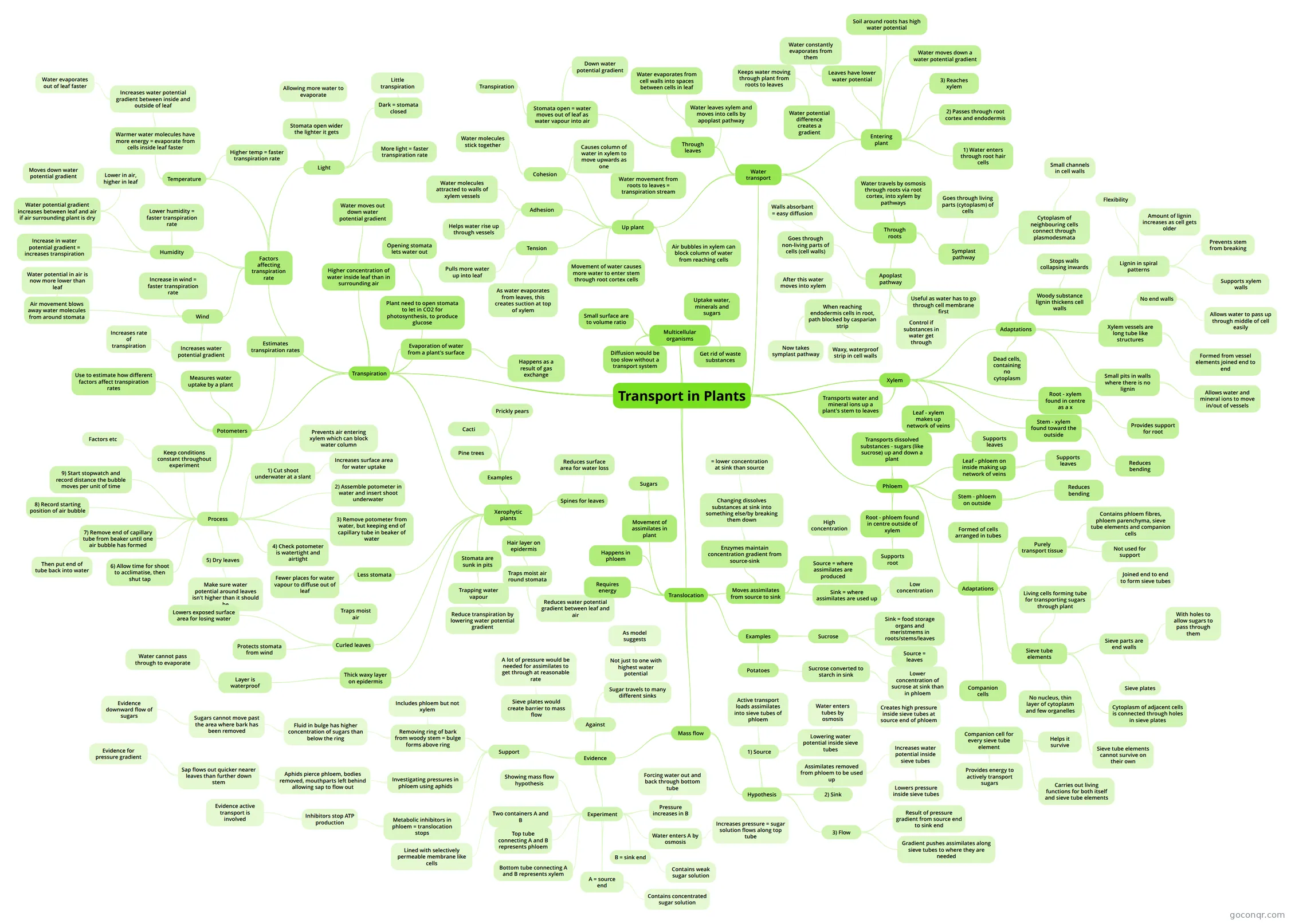
Mind map: Transport in plants
Conteúdo do mapa
Transport in Plants
Xylem
- Transports water and mineral ions up a plant's stem to leaves
- Root - xylem found in centre as a x
- Provides support for root
- Stem - xylem found toward the outside
- Reduces bending
- Leaf - xylem makes up network of veins
- Supports leaves
- Adaptations
- Xylem vessels are long tube like structures
- Formed from vessel elements joined end to end
- No end walls
- Allows water to pass up through middle of cell easily
- Dead cells, containing no cytoplasm
- Woody substance lignin thickens cell walls
- Stops walls collapsing inwards
- Lignin in spiral patterns
- Flexibility
- Prevents stem from breaking
- Amount of lignin increases as cell gets older
- Supports xylem walls
- Small pits in walls where there is no lignin
- Allows water and mineral ions to move in/out of vessels
- Xylem vessels are long tube like structures
Phloem
- Transports dissolved substances - sugars (like sucrose) up and down a plant
- Root - phloem found in centre outside of xylem
- Supports root
- Stem - phloem on outside
- Reduces bending
- Leaf - phloem on inside making up network of veins
- Supports leaves
- Adaptations
- Formed of cells arranged in tubes
- Purely transport tissue
- Contains phloem fibres, phloem parenchyma, sieve tube elements and companion cells
- Not used for support
- Sieve tube elements
- Living cells forming tube for transporting sugars through plant
- Joined end to end to form sieve tubes
- Sieve parts are end walls
- With holes to allow sugars to pass through them
- Sieve plates
- No nucleus, thin layer of cytoplasm and few organelles
- Sieve tube elements cannot survive on their own
- Cytoplasm of adjacent cells is connected through holes in sieve plates
- Living cells forming tube for transporting sugars through plant
- Companion cells
- Companion cell for every sieve tube element
- Helps it survive
- Carries out living functions for both itself and sieve tube elements
- Provides energy to actively transport sugars
- Companion cell for every sieve tube element
Multicellular organisms
- Small surface are to volume ratio
- Uptake water, minerals and sugars
- Get rid of waste substances
- Diffusion would be too slow without a transport system
Water transport
- Entering plant
- 1) Water enters through root hair cells
- 2) Passes through root cortex and endodermis
- 3) Reaches xylem
- Water moves down a water potential gradient
- Soil around roots has high water potential
- Leaves have lower water potential
- Water constantly evaporates from them
- Water potential difference creates a gradient
- Keeps water moving through plant from roots to leaves
- Through roots
- Water travels by osmosis through roots via root cortex, into xylem by pathways
- Symplast pathway
- Goes through living parts (cytoplasm) of cells
- Cytoplasm of neighbouring cells connect through plasmodesmata
- Small channels in cell walls
- Apoplast pathway
- Goes through non-living parts of cells (cell walls)
- Walls absorbant = easy diffusion
- When reaching endodermis cells in root, path blocked by casparian strip
- Waxy, waterproof strip in cell walls
- Now takes symplast pathway
- After this water moves into xylem
- Useful as water has to go through cell membrane first
- Control if substances in water get through
- Goes through non-living parts of cells (cell walls)
- Through leaves
- Water leaves xylem and moves into cells by apoplast pathway
- Water evaporates from cell walls into spaces between cells in leaf
- Stomata open = water moves out of leaf as water vapour into air
- Down water potential gradient
- Transpiration
- Up plant
- Water movement from roots to leaves = transpiration stream
- Cohesion
- Water molecules stick together
- Causes column of water in xylem to move upwards as one
- Tension
- As water evaporates from leaves, this creates suction at top of xylem
- Pulls more water up into leaf
- Movement of water causes more water to enter stem through root cortex cells
- Adhesion
- Water molecules attracted to walls of xylem vessels
- Helps water rise up through vessels
- Air bubbles in xylem can block column of water from reaching cells
- Entering plant
Transpiration
- Evaporation of water from a plant's surface
- Happens as a result of gas exchange
- Plant need to open stomata to let in CO2 for photosynthesis, to produce glucose
- Opening stomata lets water out
- Higher concentration of water inside leaf than in surrounding air
- Water moves out down water potential gradient
- Factors affecting transpiration rate
- Light
- More light = faster transpiration rate
- Stomata open wider the lighter it gets
- Allowing more water to evaporate
- Dark = stomata closed
- Little transpiration
- Temperature
- Higher temp = faster transpiration rate
- Warmer water molecules have more energy = evaporate from cells inside leaf faster
- Increases water potential gradient between inside and outside of leaf
- Water evaporates out of leaf faster
- Increases water potential gradient between inside and outside of leaf
- Humidity
- Lower humidity = faster transpiration rate
- Water potential gradient increases between leaf and air if air surrounding plant is dry
- Lower in air, higher in leaf
- Moves down water potential gradient
- Increase in water potential gradient = increases transpiration
- Wind
- Increase in wind = faster transpiration rate
- Air movement blows away water molecules from around stomata
- Water potential in air is now more lower than leaf
- Increases water potential gradient
- Increases rate of transpiration
- Light
- Potometers
- Estimates transpiration rates
- Measures water uptake by a plant
- Use to estimate how different factors affect transpiration rates
- Process
- 1) Cut shoot underwater at a slant
- Prevents air entering xylem which can block water column
- Increases surface area for water uptake
- 2) Assemble potometer in water and insert shoot underwater
- 3) Remove potometer from water, but keeping end of capillary tube in beaker of water
- 4) Check potometer is watertight and airtight
- 5) Dry leaves
- Make sure water potential around leaves isn't higher than it should be
- 6) Allow time for shoot to acclimatise, then shut tap
- 7) Remove end of capillary tube from beaker until one air bubble has formed
- Then put end of tube back into water
- 8) Record starting position of air bubble
- 9) Start stopwatch and record distance the bubble moves per unit of time
- Keep conditions constant throughout experiment
- Factors etc
- 1) Cut shoot underwater at a slant
- Xerophytic plants
- Examples
- Cacti
- Pine trees
- Prickly pears
- Stomata are sunk in pits
- Trapping water vapour
- Reduce transpiration by lowering water potential gradient
- Trapping water vapour
- Hair layer on epidermis
- Traps moist air round stomata
- Reduces water potential gradient between leaf and air
- Traps moist air round stomata
- Curled leaves
- Traps moist air
- Lowers exposed surface area for losing water
- Protects stomata from wind
- Less stomata
- Fewer places for water vapour to diffuse out of leaf
- Thick waxy layer on epidermis
- Layer is waterproof
- Water cannot pass through to evaporate
- Layer is waterproof
- Spines for leaves
- Reduces surface area for water loss
- Examples
- Evaporation of water from a plant's surface
Translocation
- Movement of assimilates in plant
- Sugars
- Requires energy
- Happens in phloem
- Moves assimilates from source to sink
- Source = where assimilates are produced
- High concentration
- Sink = where assimilates are used up
- Low concentration
- Enzymes maintain concentration gradient from source-sink
- Changing dissolves substances at sink into something else/by breaking them down
- = lower concentration at sink than source
- Changing dissolves substances at sink into something else/by breaking them down
- Source = where assimilates are produced
- Examples
- Sucrose
- Source = leaves
- Sink = food storage organs and meristmems in roots/stems/leaves
- Potatoes
- Sucrose converted to starch in sink
- Lower concentration of sucrose at sink than in phloem
- Sucrose converted to starch in sink
- Sucrose
- Mass flow
- Hypothesis
- 1) Source
- Active transport loads assimilates into sieve tubes of phloem
- Lowering water potential inside sieve tubes
- Water enters tubes by osmosis
- Creates high pressure inside sieve tubes at source end of phloem
- Water enters tubes by osmosis
- 2) Sink
- Assimilates removed from phloem to be used up
- Increases water potential inside sieve tubes
- Lowers pressure inside sieve tubes
- Increases water potential inside sieve tubes
- Assimilates removed from phloem to be used up
- 3) Flow
- Result of pressure gradient from source end to sink end
- Gradient pushes assimilates along sieve tubes to where they are needed
- 1) Source
- Evidence
- Support
- Removing ring of bark from woody stem = bulge forms above ring
- Includes phloem but not xylem
- Fluid in bulge has higher concentration of sugars than below the ring
- Sugars cannot move past the area where bark has been removed
- Evidence downward flow of sugars
- Sugars cannot move past the area where bark has been removed
- Investigating pressures in phloem using aphids
- Aphids pierce phloem, bodies removed, mouthparts left behind allowing sap to flow out
- Sap flows out quicker nearer leaves than further down stem
- Evidence for pressure gradient
- Sap flows out quicker nearer leaves than further down stem
- Aphids pierce phloem, bodies removed, mouthparts left behind allowing sap to flow out
- Metabolic inhibitors in phloem = translocation stops
- Inhibitors stop ATP production
- Evidence active transport is involved
- Inhibitors stop ATP production
- Removing ring of bark from woody stem = bulge forms above ring
- Against
- Sugar travels to many different sinks
- Not just to one with highest water potential
- As model suggests
- Not just to one with highest water potential
- Sieve plates would create barrier to mass flow
- A lot of pressure would be needed for assimilates to get through at reasonable rate
- Sugar travels to many different sinks
- Experiment
- Showing mass flow hypothesis
- Two containers A and B
- Lined with selectively permeable membrane like cells
- Top tube connecting A and B represents phloem
- Bottom tube connecting A and B represents xylem
- A = source end
- Contains concentrated sugar solution
- B = sink end
- Contains weak sugar solution
- Water enters A by osmosis
- Increases pressure = sugar solution flows along top tube
- Pressure increases in B
- Forcing water out and back through bottom tube
- Support
- Hypothesis
- Movement of assimilates in plant
Informações
- Descrição
- A-Levels Biology f211 Mapa Mental sobre Transport in Plants, criado por Gemma Bradford em 12-05-2013.
- Criado por
- Gemma Bradford
- Visualizações
- 266
- Tags
- Avaliação