
Mapa mental
Development Gap: EQ1
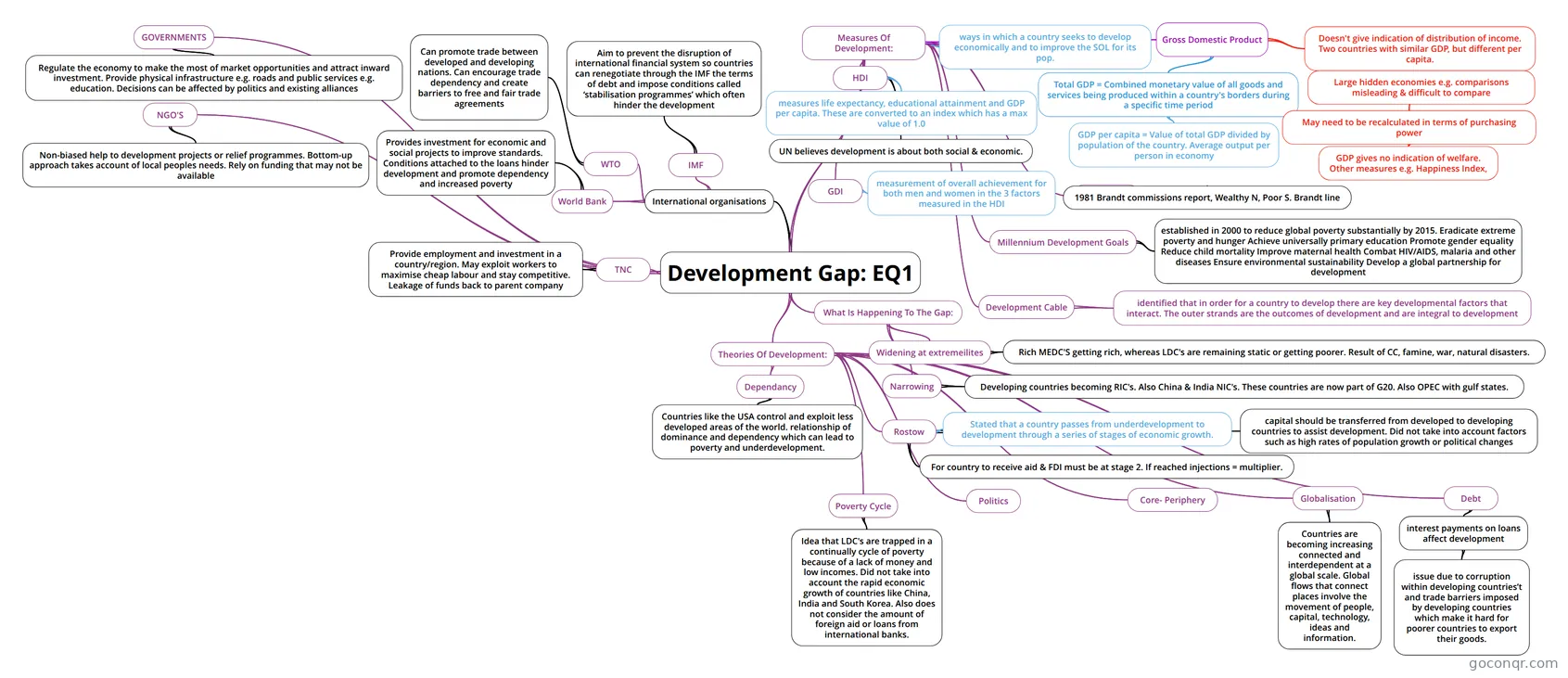
Mind map: Development Gap
Conteúdo do mapa
Development Gap: EQ1
Measures Of Development:
- Gross Domestic Product
- Total GDP = Combined monetary value of all goods and services being produced within a country's borders during a specific time period
- GDP per capita = Value of total GDP divided by population of the country. Average output per person in economy
- Doesn't give indication of distribution of income. Two countries with similar GDP, but different per capita.
- May need to be recalculated in terms of purchasing power
- GDP gives no indication of welfare. Other measures e.g. Happiness Index,
- Large hidden economies e.g. comparisons misleading & difficult to compare
- May need to be recalculated in terms of purchasing power
- Total GDP = Combined monetary value of all goods and services being produced within a country's borders during a specific time period
- ways in which a country seeks to develop economically and to improve the SOL for its pop.
- HDI
- measures life expectancy, educational attainment and GDP per capita. These are converted to an index which has a max value of 1.0
- UN believes development is about both social & economic.
- GDI
- measurement of overall achievement for both men and women in the 3 factors measured in the HDI
- N VS S Divide
- 1981 Brandt commissions report, Wealthy N, Poor S. Brandt line
- Millennium Development Goals
- established in 2000 to reduce global poverty substantially by 2015. Eradicate extreme poverty and hunger Achieve universally primary education Promote gender equality Reduce child mortality Improve maternal health Combat HIV/AIDS, malaria and other diseases Ensure environmental sustainability Develop a global partnership for development
- Development Cable
- identified that in order for a country to develop there are key developmental factors that interact. The outer strands are the outcomes of development and are integral to development
- Gross Domestic Product
What Is Happening To The Gap:
- Widening at extremeilites
- Rich MEDC'S getting rich, whereas LDC's are remaining static or getting poorer. Result of CC, famine, war, natural disasters.
- Narrowing
- Developing countries becoming RIC's. Also China & India NIC's. These countries are now part of G20. Also OPEC with gulf states.
- Widening at extremeilites
Theories Of Development:
- Rostow
- Stated that a country passes from underdevelopment to development through a series of stages of economic growth.
- capital should be transferred from developed to developing countries to assist development. Did not take into account factors such as high rates of population growth or political changes
- For country to receive aid & FDI must be at stage 2. If reached injections = multiplier.
- Dependancy
- Countries like the USA control and exploit less developed areas of the world. relationship of dominance and dependency which can lead to poverty and underdevelopment.
- Poverty Cycle
- Idea that LDC's are trapped in a continually cycle of poverty because of a lack of money and low incomes. Did not take into account the rapid economic growth of countries like China, India and South Korea. Also does not consider the amount of foreign aid or loans from international banks.
- Politics
- Core- Periphery
- Globalisation
- Countries are becoming increasing connected and interdependent at a global scale. Global flows that connect places involve the movement of people, capital, technology, ideas and information.
- Debt
- interest payments on loans affect development
- issue due to corruption within developing countries’t and trade barriers imposed by developing countries which make it hard for poorer countries to export their goods.
- interest payments on loans affect development
- Rostow
International organisations
- IMF
- Aim to prevent the disruption of international financial system so countries can renegotiate through the IMF the terms of debt and impose conditions called ‘stabilisation programmes’ which often hinder the development
- WTO
- Can promote trade between developed and developing nations. Can encourage trade dependency and create barriers to free and fair trade agreements
- World Bank
- Provides investment for economic and social projects to improve standards. Conditions attached to the loans hinder development and promote dependency and increased poverty
- IMF
TNC
- Provide employment and investment in a country/region. May exploit workers to maximise cheap labour and stay competitive. Leakage of funds back to parent company
GOVERNMENTS
- Regulate the economy to make the most of market opportunities and attract inward investment. Provide physical infrastructure e.g. roads and public services e.g. education. Decisions can be affected by politics and existing alliances
NGO'S
- Non-biased help to development projects or relief programmes. Bottom-up approach takes account of local peoples needs. Rely on funding that may not be available
Informações
- Descrição
- A - Level Geography (6GEO3) Mapa Mental sobre Development Gap: EQ1, criado por Fayzan Khan em 17-04-2017.
- Criado por
- Fayzan Khan
- Visualizações
- 0
- Histórico
-
- Criado por Fayzan Khan · 16 mar 2017
- Copiado por Fayzan Khan · 17 abr 2017
- Avaliação