
Mapa mental
Liberal Democracy
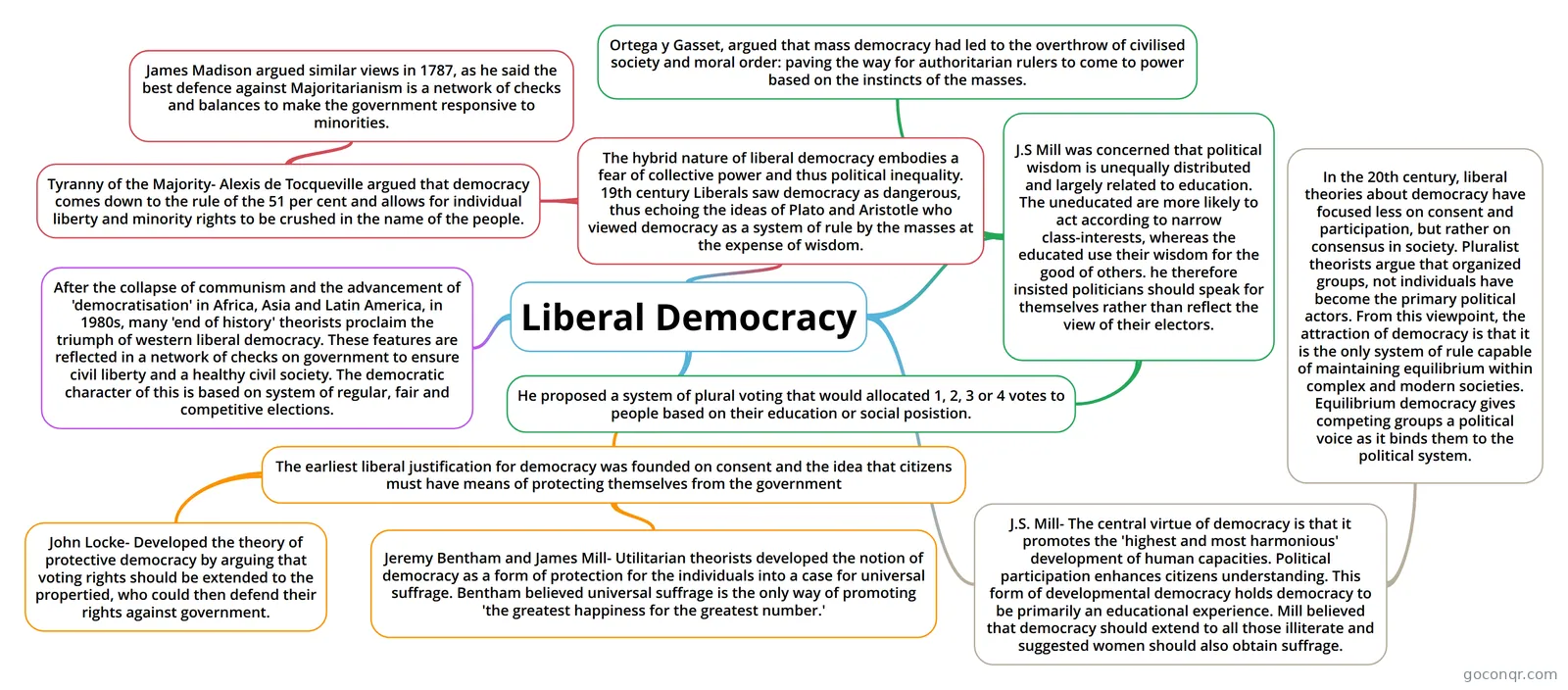
Mind map: Liberal democracy
Conteúdo do mapa
Liberal Democracy
After the collapse of communism and the advancement of 'democratisation' in Africa, Asia and Latin America, in 1980s, many 'end of history' theorists proclaim the triumph of western liberal democracy. These features are reflected in a network of checks on government to ensure civil liberty and a healthy civil society. The democratic character of this is based on system of regular, fair and competitive elections.
The hybrid nature of liberal democracy embodies a fear of collective power and thus political inequality. 19th century Liberals saw democracy as dangerous, thus echoing the ideas of Plato and Aristotle who viewed democracy as a system of rule by the masses at the expense of wisdom.
- Tyranny of the Majority- Alexis de Tocqueville argued that democracy comes down to the rule of the 51 per cent and allows for individual liberty and minority rights to be crushed in the name of the people.
- James Madison argued similar views in 1787, as he said the best defence against Majoritarianism is a network of checks and balances to make the government responsive to minorities.
- Tyranny of the Majority- Alexis de Tocqueville argued that democracy comes down to the rule of the 51 per cent and allows for individual liberty and minority rights to be crushed in the name of the people.
J.S Mill was concerned that political wisdom is unequally distributed and largely related to education. The uneducated are more likely to act according to narrow class-interests, whereas the educated use their wisdom for the good of others. he therefore insisted politicians should speak for themselves rather than reflect the view of their electors.
- Ortega y Gasset, argued that mass democracy had led to the overthrow of civilised society and moral order: paving the way for authoritarian rulers to come to power based on the instincts of the masses.
- He proposed a system of plural voting that would allocated 1, 2, 3 or 4 votes to people based on their education or social posistion.
The earliest liberal justification for democracy was founded on consent and the idea that citizens must have means of protecting themselves from the government
- John Locke- Developed the theory of protective democracy by arguing that voting rights should be extended to the propertied, who could then defend their rights against government.
- Jeremy Bentham and James Mill- Utilitarian theorists developed the notion of democracy as a form of protection for the individuals into a case for universal suffrage. Bentham believed universal suffrage is the only way of promoting 'the greatest happiness for the greatest number.'
J.S. Mill- The central virtue of democracy is that it promotes the 'highest and most harmonious' development of human capacities. Political participation enhances citizens understanding. This form of developmental democracy holds democracy to be primarily an educational experience. Mill believed that democracy should extend to all those illiterate and suggested women should also obtain suffrage.
- In the 20th century, liberal theories about democracy have focused less on consent and participation, but rather on consensus in society. Pluralist theorists argue that organized groups, not individuals have become the primary political actors. From this viewpoint, the attraction of democracy is that it is the only system of rule capable of maintaining equilibrium within complex and modern societies. Equilibrium democracy gives competing groups a political voice as it binds them to the political system.
Informações
- Descrição
- AS - Level POLITICS (Liberalism) Mapa Mental sobre Liberal Democracy, criado por Jake Clarke em 09-05-2017.
- Criado por
- Jake Clarke
- Visualizações
- 1
- Avaliação