
Mapa mental
theory and methods
Conteúdo do mapa
theory and methods
functionalism
- emile durkheim
- he developed the organic analogy- he imagined society as similar to a living being that adapts to its envrand coionment mprised of parts each helping the being to exist
- each organ preforms a vital function to keep us alive- in the case of society each insitiution preforms a function to maintain it
- the method of functioal analysis- invovles expaning why insitutions exist in terms of the function they preform or society.
- Durkhiem was also well known for advocating positivist resreach methods, based on looking for correlations in statistical data. in particular, he carried out a pioneering study of suicide rates in different European countries.
- he developed the organic analogy- he imagined society as similar to a living being that adapts to its envrand coionment mprised of parts each helping the being to exist
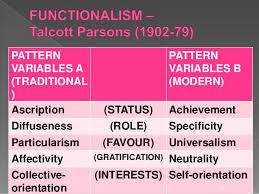
- Talcott parsons
- parsons suggests there are four basic needs (functional prerequisites) that all socities have to satisfy:
- adaptation (economic function): every society has to provide an adequate standard of life for survival.
- goal attainment (political function): socities must develop ways of making decisions
- intergration (social harmony): each institution in society develops in response to particular functions
- latency (individual beliefs and values): how individuals cope in society- patttern maintainence and tension management
- value consensus- the whole soical system is underpinned by a general agreement on values about what is good and desirable, or bad and undesirable
- social evolution and diffrentiation
- parsons believes that as societies change they can retain a degree of balance in order to continue functioning effectively. if one part of the social structure changes the other parts adapt to fit round it
- as they develop or evolve modern societies generally become more effective and effcient at raising living standards and meeting the needs of their members. this involves a change in cultural values or what parsons calls 'pattern variables'
- structural differentiation- as well as cultures changing as societies evolve, parsons also sees them as becoming more structurally complex. industrial societies develop new and more efficient specialist institutions.
- parsons suggests there are four basic needs (functional prerequisites) that all socities have to satisfy:
- evaluation
- robert merton (1957)
- parsons assumed institutions were functional for all parts of society. however merton argues it can be both functional and dysfunctional for a society- e.g. religion
- parsons failed to realise the distinction between manifest functions and latent consequences of these functions and that latent ones arent always desirable ones
- merton says that any analysis of society is much more complex than parson simple model implies
- sharrock et al (2003)
- functionalism over emphasies the level of agreement or consensus in society. people have different values and attitudes within the same society
- the positivist approach supported by durkheim and its application the the study of sucicide have both been criticised
- organic analogy- organisms are biological entities that have a natural form and life cycle. society is a concept consisting of the activities of possibly millions of people. theres no natural form or cycle
- functionalists have problems explaining social change. if institutions exist t fulfil socal needs, then once these needs are fulfilled there is no reason to change them
- functionalists claim to explain why insitiutions exist but in fact only explains some effects of insitiutions. just because it is needed doesnt explain why it developed in the first place
- robert merton (1957)
- emile durkheim
marxism
- marxism derives from the 19th century writings of karl marx who sought to create a scientific explanation of socities
- hie claimed that the economic system of any society largely determined its social structure. the owners of the economic structure are able to control society and construct values and social relationships that reflect the owners interests. other groups, being less powerful., generally accept these values and social relationships even though these are not in their interests
- marx suggested that history can be divided into 5 epochs: primitive communism, ancient societies, feudalism, capitalism and communism
- in each of the 5 epochs there is a particular mode of production . a mode of production is a complete economic and social system based on a different way of organising the production of goods. in the first epoch its based around hunting and gathering because there is no surplus to accumulate and no social classes. in the other 4 society and production are based around the exploitation of one class by another.
- classes develop because some poeople are able to gain ownership and control over the means of production while classes that dont are forced to work for them since they dont have the means to create wealth themselves
- the ruling class owns the means of production. this ruling class then constructs a whole set of social relationships that benefit them and allow them to exploit all others who do not share in the ownership of the means of production
- marx believed that contemporary society has reached the stage of capitalism. within capitalism there is the ruling class; bourgeoisie and the working class: proletariat
- the bourgeoisie promote a set of distorted beleifs that support their interests by helping to maintain their wealth and power- this is referred to as an 'ideology'. it suppors the view that the enormous inequalities in capitalist socities are fair and reasonable
- the majority of the population acxcept the inequalities of this system because of the way they dominate institutions such as religion and education, justify the prevailling economic and social situation- marx called this the false conciousness. they do not realise that their interests as a class lie in changing society rather than allowing continued ruling class dominance
- marx argues that capitalism will enter periods of crisis which will get worse. some members of the W/C will begin to relaise that they are being exploited and believe that it is necessary to overthrow capitalism to end their own exploitation- they will develop class conciousness. they see through the distorted ideology of the ruling class. this will lead to social change and will usher in the final epoch of communism
- evaluation
- the description of capitalism and its inveitable move towards a crisis has simply not occured. capitalism has grown stronger and spread across the world. in most parts communist systems have been replaced by capitalism or adopted its characteristics
- capitalism changed significantly since marx's death, with the introduction of a wide range of health, pension, housing and welfare benefits, all of which were missing from marx's analysis
- marx paid little attention to other significant social divisions including those between men and women, ethnic differences, age differences and so on
- marxism derives from the 19th century writings of karl marx who sought to create a scientific explanation of socities
social action and interpretivist theories
- social action theory suggests the best way to understand society is to begin from the 'bottom'- analysing the way people interact with each other. they do not set out to construct a structual theory such as marxism, but are much more content to set out the rules of social interaction.
- these approaches explore the day to day routine actions that most poeple preform. these theories are based upon a social constructionist approach. this type of approach argues that through language, communication and interaction humans produce meanings which form the basis of their understanding of the social world.
- humans do not experience the world directly in an objective way, but rather they actively create meanings and they then see the world in terms of those meanings.
- aspects of the world which are really just socially constructed meanings are nevertheless seen as real, objective and, in some cases natural. e.g. gender differnces are not seen as the product of the meanings attached to being female and male , but as coming from natural, biological and unchanging differences between the sexes.
- symbolic interactionism
- develops from George Mead (1863-1931) and then Herbert Blumer (1900-1987)
- SI sees people actively working at relationships and creating and responding to symbols and ideas. it is this dynamic that forms the basis of interactionists' studies
- the theory of SI has 4 core ideas:
- the symbol- the world consists of millions of objects and people. we group things together into categories which we then classify. each group gets a name (symbol) e.g. trees. the symbols may evoke feelings in us. symbols have meanings for us and suggest a possible response or course of actions
- the self- in order to respond to symbols they have to know who they are within this world of symbols and meaning. this involves us being able to see ourselves through the eyes of others. labelling theorists developed this idea into the self-fulfilling prophecy.
- game-playing and role-taking: blumer suggests that we develop the notion of the self in childhood and game-playing. these games allow us to learn various social roles and also learn how these interact with the roles of others. role-taking is important as we imagine ourselves as the other person and try to understand the behaviour we witness from their point of view. this helps us understand actions and how to respond
- the interaction- the point at which the symbol and self come together with others in an interaction. we must take the viewpoint of others when we set out on any course of action. only when we have an idea about what others are thinking is it possible to interact. it involves reading the meaning of a situation from the viewpoint of others and responding in terms of how we see our own personality.
- goffman and the dramaturgical approach
- goffman (1968) was influenced by SI in his studies of peoples interaction.
- his work explores how people perceive themselves and then set out to present an image of themselves to others. he suggests that people work out strategies in dealing with others and are constantly altering and manipulating these strategies.
- the basis of his ideas is that social interaction can best be understood as a form of loosely scripted play, in which people (actors) interpret their roles
- all identities and behaviours are dependent upon the audience to whom one preforms
- we seek to control others impressions of ourselves- impression management. it is both a conscious and unconscious process in which people attempt to influence the perceptions of others.
- front state actions- those that are visible to the audience and a re part of the performance. back stage actions only occur when the audience is not around
feminism
- first wave: suffrage movement- obtaining votes for women aged 30 in 1918 and 21 (same as men) in 1928
- second wave: womens liberation movement in 1960s- radical approaches aimed at a complete transformation of relationship between men and women. this began influencing sociology
- third wave: 1990s- new generation argued women were still unequal in many ways even in western societies
- basic characteristics:
- type of conflict theory that sees a conflict of interest between males and females as the most important type
- most/all existing and historical societies are patriarchal or male dominated
- try to explain inequalities and differences between men & women and suggest what should be done about them
- sex and gender
- critical of the view that gender differences and inequalities are simply a product of biological differences between men & women
- sex; biological differences between men and women
- gender: beliefs about what it means to be masculine or feminine
- critique of sociology: abbott, walicace & tyler (2005
- many feminists believe sociology is malestream
- most research is about men and generalised to women.
- issues that concern women have been neglected
- women have been presented in sexist ways in research
- radical feminism
- associated with the second wave
- believe women are explored by & subservient to men
- patriarchy is the most important organising principle in society. its pervasive in all aspects of social life so is difficult to challenge/change
- all the apparent improvements in the position of women are relatively superficial and fundamental inequalities remain unchanged
- patriarchy is a universal feature of society that can only be challenged with a restructuring
- firestone (1970)
- women are at an biological disadvantage because they undergo pregnancy and birth which makes them weak and vulnerable
- tied down by breastfeeding
- hindered by menstruation
- millet (1970)
- biology plays some part
- ideological factors important for shaping women views of society
- educational & economic inequalities hold women back
- sociological factors relating to women roles in society are also important
- marxist
- the capitalist system is the main source of women oppression
- womens lack of wealth and income are the underlying factors stopping them having as much power as men
- economically disadvantaged as do more unpaid labour and be less successful in paid employment
- delphy & leonard (1992)- exploitation of labour in the family is important. do all domestic labour (unpaid) & help husband with their career
- ansley (1972) women absorb frustration men experience sue to exploitation and alienation at work- 'TAKERS OF SHIT'
- benston (1972) women are used as a reserved army of labour
- liberal
- seeks reforms rather than revolutions
- 2nd wave
- piecemeal improvements in position of women in society will ultimately lead to equality
- friedan- socialisation into gender roles and dominant cultural ideas about masculinity & femininity all contribute to subordination of women.
- adressed by challenging sex discrimination
- cultural factors are important in creating inequality between men & women
- black
- other types of feminism are ethnocentric
- feminists have tended to adopt 'victim ideology' with regards to black women, portraying them ad helpless victims of racism & sexism
- white feminists cannot claim to speak for the experience of all women and black women can provide a unique & essential contribution
- bell hooks (1981) argues the legacy of slavery has given women a unique insight to the nature of oppression
- mirza (1997) argues that a distinctive black feminism is essential in order to challenge idea that they are passive victims of racism, patriarchy, class inequality by representing how they've overcome all of these.
neo-marxism
- antonio gramsci
- he placed less emphasis on economics and the social structure and more on the choices or agency members of different classes. to gramsci ideology alongside economics was crucially important
- he argued that conventional marxism underestimated both the room for manoeuvre possessed by the state in capitalism and the ability of the proletariat to resist ruling class power
- the state could not simply impose its will as it wished on the W/C. it had to win consent from them to cement its dominance and maintain control. it could retain political and ideological dominance if it made some concessions to the W/C through things like welfare benefits.
- this was important because the W/C were never completely taken in by the ideology. institutions such as the media could food the W/C to some extent into accepting capitalism but day-today exploitation led the W/C to be critical of capitalism too.
- this lead to the W/C developing dual consciousness in which they were partly influenced by the ideology but they were aso aware of the injustice suffered. they were never completly taken in by the claims that capitalism was fair and that it worked well for everyone.
- this was important because the W/C were never completely taken in by the ideology. institutions such as the media could food the W/C to some extent into accepting capitalism but day-today exploitation led the W/C to be critical of capitalism too.
- althusser and the concept of reltive autonomy
- he argued that marx has overemphasised how much the economic system drove society. althusser suggested that capitalist society was made up of 3 interlocking elements:
- the economic system- producing all material goods
- the political system- organising soicety
- the ideological system- providing all ideas and beliefs
- according to althusser the economic system has ultimate control, but the political and ideological have significant degrees of independence or autonomy. politics and culture change in response to many different forces not just economic ones- he called this reltive autonomy
- althusser claims that the state was composed of two elements:
- the repressive state apparatuses- organisations such as the police and the army
- ideological state apparatuses- the more subtle organisations including education, media and religous institutions
- both sets of apparatus ultimately work for the benefit of capitalism, but there is a huge variation in the way they preform this task, with some contradictions between them
- he argued that marx has overemphasised how much the economic system drove society. althusser suggested that capitalist society was made up of 3 interlocking elements:
- the frankfurt school
- associated with the works of Marcuse, Adorno and Horkheimer who orginate form frankfurt university. they accuse marx for being economic determinist. they argue that peoples ideas and motivations are far more important than Marx ever acknowledged. despite Althussers idea of relative autonomy he is too concerned with the social structure and had little concerns on individuals ability to choose their own course of action- their 'agency'
- they developed a critique of structural Marxism in 3 main areas:
- instrumental reason; adorno- marx failed to explore peoples motivations for accepting capitalism. he suggests that is was wrong for marx to dismiss it as 'false conciousness'. people work hard to have a career and earn money but why this is their aim isnt explored. thinking therefore capitalism is rational in terms of achieving goals but the actual reason for those goals may not be rational
- mass culture: marcuse- hr argued that marx had ignored the importance of the media. he suggested the media play a key part in helping to control the population by teaching people to accept their lot and to concentrate on trivial entertainment
- the oppression of personality- marx neglected the fact individuals personalities and desires are controlled and directed to the benefit of capitalism. before capitalism there was no concept of 'work ethics'- people did the work then stopped.capitalism needed people who accepted going to work for the majority of their lives with little leisure time
- antonio gramsci
Imagens e arquivos do mapa
Informações
- Descrição
- Mapa Mental sobre theory and methods, criado por kiera wood em 11-05-2017.
- Criado por
- kiera wood
- Visualizações
- 3
- Avaliação