
Mapa mental
Science MYP 3
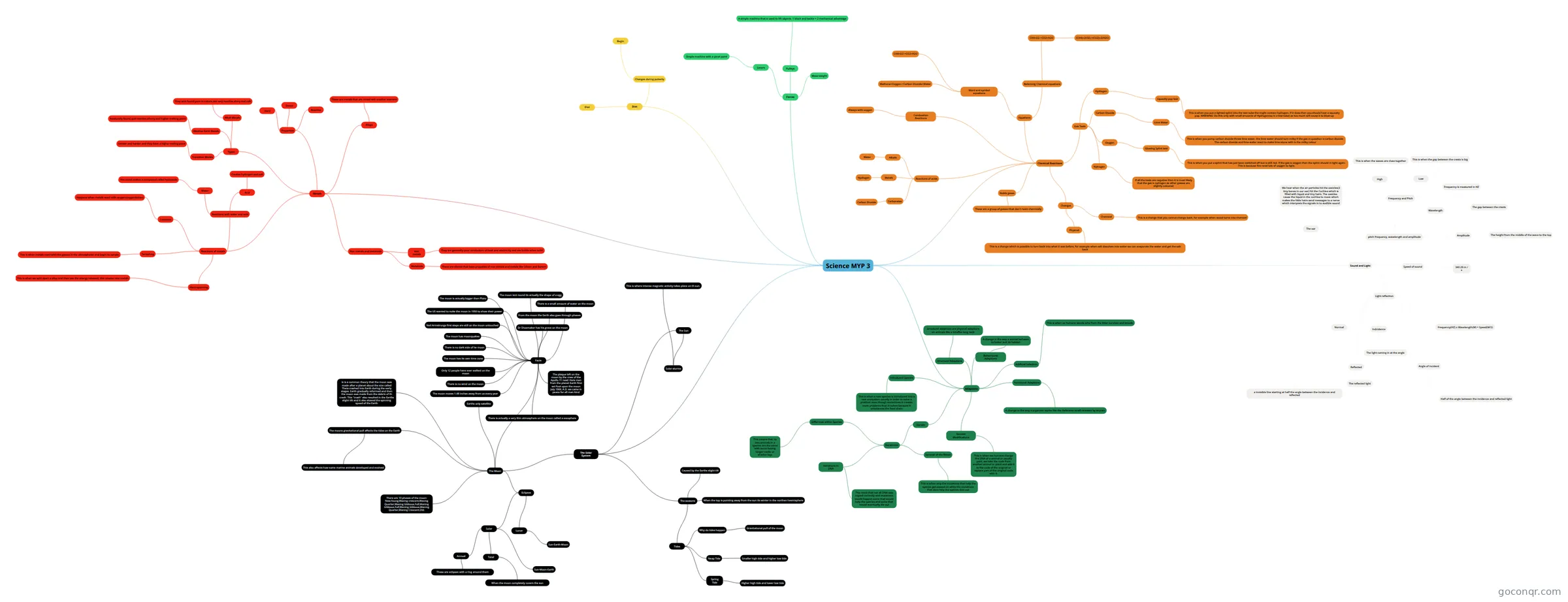
Mind map: Science MYP 3
Conteúdo do mapa
Science MYP 3
Adaptions
- Structural Adaptions
- Structural adaptions are physical adaptions on animals like a Giraffes long neck
- Behavioural Adaptions
- A change in the way a animal behaves to better suit its habitat
- Functional Adaptions
- A change in the way a organism works like the defensive smell released by skunks
- Introduced Species
- This is when a new species is introduced into a new ecosystem usually in order to solve a problem even though sometimes it creates more problems than it solves because it unbalances the food chain
- Darwin
- Darwinism
- Survival of the fittest
- This is when only the mutations that help the species get passed on while the mutations that dont help the species dies out
- Variations in DNA
- This ment that not all DNA was copied correctly and mutations would happen some that would help the species and some that would eventually die out
- Differnces within Species
- This means that no two animals in a species are the same with some having longer necks or shorter legs
- Survival of the fittest
- Darwinism
- Artificial Selection
- This is when us humans decide who from the litter survives and breeds
- Genetic Modifications
- This is when we humans change the DNA of a animal or usually pant, we take the code from another animal or plant and add it to the code of the original or replace part of the original code with it.
- Structural Adaptions
Diet
- Changes during puberty
- Begin
- Diet
- Changes during puberty
Metals
- Properties
- Hard
- Dense
- Reactive
- Types
- Alkali Metals
- They arnt found pure in nature,are very reactive,shiny and soft
- Alkaline Earth Metals
- Nauturally found,quit reactive,silvery and higher melting piont
- Transition Metals
- Denser and harder and they have a higher meling point
- Alkali Metals
- Alloys
- These are metals that are mixed wth another element
- Non metals and metaloids
- Non metals
- They are generally poor conductors of heat and electricity and are brittle when solid
- Metaloids
- These are elemts that have propeties of non metals and metals like Silicon and Bororn
- Non metals
- Reactions of metals
- Corotions
- Happens when metals react with oxygen(oxygentazion)
- Tarnishing
- This is when metals react with the gasses in the atmospherer and begin to corode
- Reactions with water and acid
- Water
- The metal makes a compound called hydroxide
- Acid
- Creates hydrogen and salt
- Water
- Electroplanting
- This is when we split apart a alloy and then use the energy released, this creates new metals
- Corotions
- Properties
Chemical Reactions
- Gas Tests
- Hydrogen
- Squeaky pop test
- This is when you put a lighted splint into the test tube the might contain hydrogen, if it does then you should hear a squeaky pop. WARNING: Do this only with small amounts of Hydrogen(so in a test tube) as too much will cause it to blow up
- Squeaky pop test
- Carbon Dioxide
- Lime Water
- This is when you pump carbon dioxide threw lime water, the lime water should turn milky if the gas in question is carbon dioxide. The carbon dioxide and lime water react to make lime stone with is the milky colour
- Lime Water
- Oxygen
- Glowing Splint test
- This is when you put a splint that has just been switched off but is still red. If the gas is oxygen then the splint should in light again. This is because fire need lots of oxygen to light.
- Glowing Splint test
- Nytrogen
- If all the tests are negative then it is most likely that the gas is nytrogen as other gasses are slightly coloured
- Hydrogen
- Changes
- Physical
- This is a change which is possible to turn back into what it was before, for example when salt dissolves into water we can evaporate the water and get the salt back
- Chemical
- This is a change that you cannot change back, for example when wood turns into charcoel
- Physical
- Equations
- Word and symbol equations
- CH4+O2->CO2+H2O
- Methane+Oxygen->Carbon Dioxide+Water
- Balancing Chemical equations
- CH4+O2->CO2+H2O
- (CH4)+2(O2)->(CO2)+2(H2O)
- CH4+O2->CO2+H2O
- Word and symbol equations
- Combustion Reactions
- Always with oxygen
- Reactions of acids
- Alkalis
- Water
- Metals
- Hydrogen
- Carbonates
- Carbon Dioxide
- Alkalis
- Noble gases
- These are a group of gasses that don't react chemically
- Gas Tests
Sound and Light
- The ear
- We hear when the air particles hit the ossicles(3 tiny bones in our ear) hit the Cochlea which is filled with liquid and tiny hairs. The ossicles cause the liquid in the cochlea to move which makes the little hairs send messages to a nerve which interprets the signals in to audible sound
- pitch frequency, wavelength and amplitude
- Frequency and Pitch
- High
- This is when the waves are close together
- Low
- This is when the gap between the crests is big
- Frequency is measured in HZ
- High
- Wavelength
- The gap between the crests
- Amplitude
- The height from the middle of the wave to the top
- Frequency and Pitch
- Speed of sound
- 340.29 m / s
- Light reflection
- Frequency(HZ) x Wavelength(M) = Speed(M/S)
- Indcidence
- The light coming in at the angle
- Normal
- a invisible line starting at half the angle between the incidence and reflected
- Reflected
- The reflected light
- Angle of incident
- Half of the angle between the incidence and reflected light
- The ear
The Solar System
- The Sun
- Solar storms
- This is where intense magnetic activity takes place on th sun.
- Solar storms
- The seasons
- Tides
- Neap Tide
- Smaller high tide and higher low tide
- Spring Tide
- Higher high tide and lower low tide
- Why do tides happen
- Gravitational pull of the moon
- Neap Tide
- Caused by the Earths slight tilt
- When the top is pointing away from the sun its winter in the northen hesmisphere
- Tides
- The Moon
- Earths only satellite
- Is is a common theory that the moon was made after a planet about the size called Theia crashed into Earth during the early stages. Earth gradually reformed and then the moon was made from the debris of th crash. This "crash" also resulted in the Earths slight tilt and it also slowed the spinning speed of the Earth
- The moons gravitational pull affects the tides on the Earth
- This also affects how some marine animals developed and evolved
- Facts
- There is no dark side of he moon
- The moon has its own time zone
- Only 12 people have ever walked on the moon
- The moon has moonquakes
- Neil Armstrongs first steps are still on the moon untouched
- There is no wind on the moon
- The moon moves 1.48 inches away from us every year
- The US wanted to nuke the moon in 1950 to show their power
- The moon is actually bigger than Pluto
- The moon isnt round its actually the shape of a egg
- There is a small amount of water on the moon
- From the moon the Earth also goes through phases
- Dr Shoemaker has his grave on the moon
- There is actually a very thin atmosphere on the moon called a exsophere
- The plaque left on the moon by the crew of the Apollo 11 read: Here men from the planet Earth first set foot upon the moon July 1969, A.D. we came in peace for all man kind
- There are 10 phases of the moon: New,Young,Waxing crescent,Waxing Quarter,Waxing Gibbous,Full,Waning Gibbous,Full,Waning Gibbous,Waning Quarter,Waning Crescent,Old.
- Eclipses
- Lunar
- Sun-Earth-Moon
- Solar
- Total
- When the moon completely covers the sun
- Annual
- These are eclipses with a ring around them
- Sun-Moon-Earth
- Total
- Lunar
- The Sun
Forces
- Levers
- Simple machine with a pivot point
- Pulleys
- A simple machine that is used to lift objects. 1 block and tackle = 2 mechanical advantage
- Mass/weight
- Levers
Informações
- Descrição
- Science Mapa Mental sobre Science MYP 3, criado por Maurer Noè em 16-05-2017.
- Criado por
- Maurer Noè
- Visualizações
- 2
- Avaliação