
Mapa mental
Class and Criminal Law
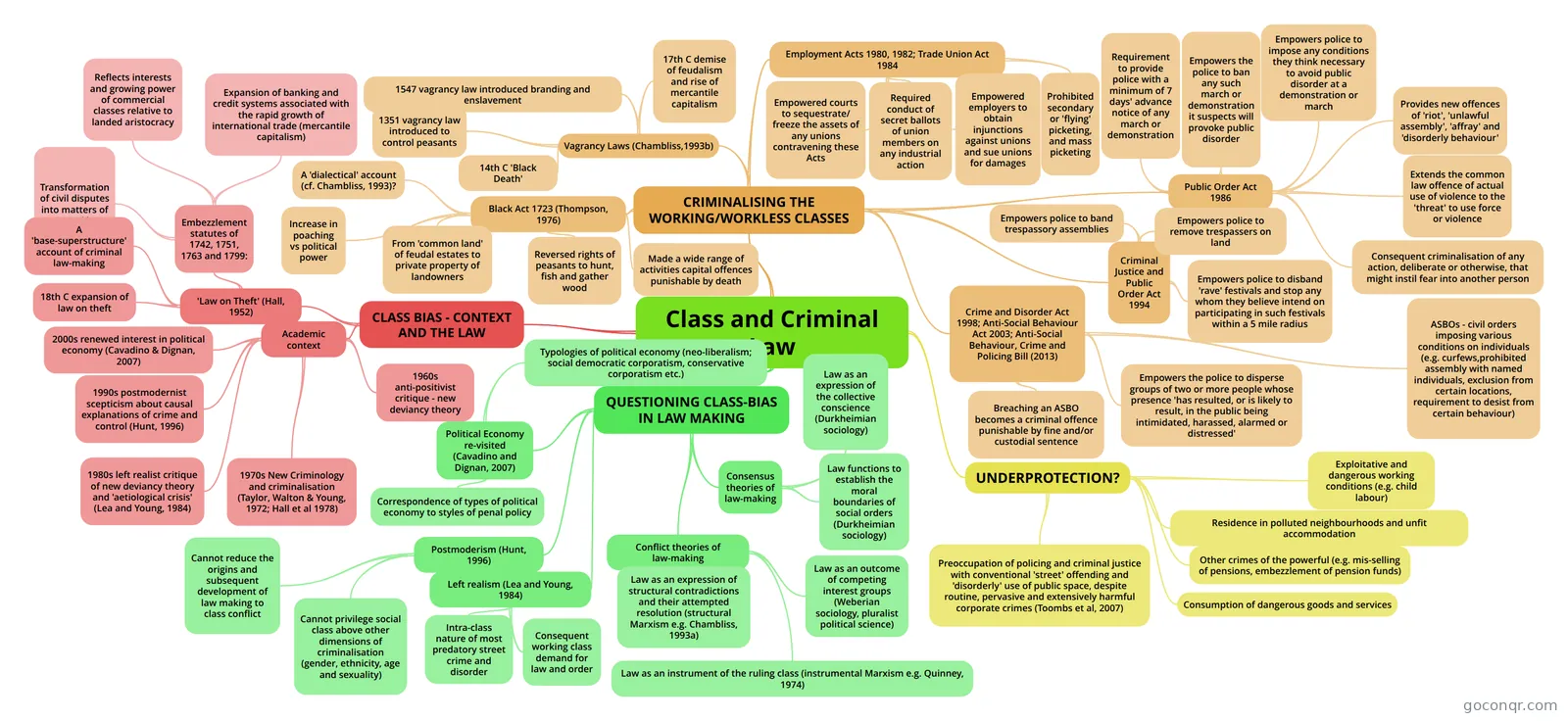
Mind map: Class and criminal law
Conteúdo do mapa
Class and Criminal Law
CLASS BIAS - CONTEXT AND THE LAW
- Academic context
- 1960s anti-positivist critique - new deviancy theory
- 1970s New Criminology and criminalisation (Taylor, Walton & Young, 1972; Hall et al 1978)
- 1980s left realist critique of new deviancy theory and 'aetiological crisis' (Lea and Young, 1984)
- 1990s postmodernist scepticism about causal explanations of crime and control (Hunt, 1996)
- 2000s renewed interest in political economy (Cavadino & Dignan, 2007)
- 'Law on Theft' (Hall, 1952)
- 18th C expansion of law on theft
- Embezzlement statutes of 1742, 1751, 1763 and 1799:
- Expansion of banking and credit systems associated with the rapid growth of international trade (mercantile capitalism)
- Reflects interests and growing power of commercial classes relative to landed aristocracy
- Transformation of civil disputes into matters of criminal law
- A 'base-superstructure' account of criminal law-making
- Academic context
CRIMINALISING THE WORKING/WORKLESS CLASSES
- Black Act 1723 (Thompson, 1976)
- Made a wide range of activities capital offences punishable by death
- Reversed rights of peasants to hunt, fish and gather wood
- From 'common land' of feudal estates to private property of landowners
- Increase in poaching vs political power
- A 'dialectical' account (cf. Chambliss, 1993)?
- Vagrancy Laws (Chambliss,1993b)
- 14th C 'Black Death'
- 1351 vagrancy law introduced to control peasants
- 1547 vagrancy law introduced branding and enslavement
- 17th C demise of feudalism and rise of mercantile capitalism
- Employment Acts 1980, 1982; Trade Union Act 1984
- Prohibited secondary or 'flying' picketing, and mass picketing
- Empowered employers to obtain injunctions against unions and sue unions for damages
- Required conduct of secret ballots of union members on any industrial action
- Empowered courts to sequestrate/ freeze the assets of any unions contravening these Acts
- Public Order Act 1986
- Requirement to provide police with a minimum of 7 days' advance notice of any march or demonstration
- Empowers the police to ban any such march or demonstration it suspects will provoke public disorder
- Empowers police to impose any conditions they think necessary to avoid public disorder at a demonstration or march
- Provides new offences of 'riot', 'unlawful assembly', 'affray' and 'disorderly behaviour'
- Extends the common law offence of actual use of violence to the 'threat' to use force or violence
- Consequent criminalisation of any action, deliberate or otherwise, that might instil fear into another person
- Criminal Justice and Public Order Act 1994
- Empowers police to remove trespassers on land
- Empowers police to disband 'rave' festivals and stop any whom they believe intend on participating in such festivals within a 5 mile radius
- Empowers police to band trespassory assemblies
- Crime and Disorder Act 1998; Anti-Social Behaviour Act 2003; Anti-Social Behaviour, Crime and Policing Bill (2013)
- ASBOs - civil orders imposing various conditions on individuals (e.g. curfews,prohibited assembly with named individuals, exclusion from certain locations, requirement to desist from certain behaviour)
- Breaching an ASBO becomes a criminal offence punishable by fine and/or custodial sentence
- Empowers the police to disperse groups of two or more people whose presence 'has resulted, or is likely to result, in the public being intimidated, harassed, alarmed or distressed'
- Black Act 1723 (Thompson, 1976)
UNDERPROTECTION?
- Exploitative and dangerous working conditions (e.g. child labour)
- Residence in polluted neighbourhoods and unfit accommodation
- Consumption of dangerous goods and services
- Other crimes of the powerful (e.g. mis-selling of pensions, embezzlement of pension funds)
- Preoccupation of policing and criminal justice with conventional 'street' offending and 'disorderly' use of public space, despite routine, pervasive and extensively harmful corporate crimes (Toombs et al, 2007)
QUESTIONING CLASS-BIAS IN LAW MAKING
- Consensus theories of law-making
- Law as an expression of the collective conscience (Durkheimian sociology)
- Law functions to establish the moral boundaries of social orders (Durkheimian sociology)
- Conflict theories of law-making
- Law as an outcome of competing interest groups (Weberian sociology, pluralist political science)
- Law as an instrument of the ruling class (instrumental Marxism e.g. Quinney, 1974)
- Law as an expression of structural contradictions and their attempted resolution (structural Marxism e.g. Chambliss, 1993a)
- Left realism (Lea and Young, 1984)
- Intra-class nature of most predatory street crime and disorder
- Consequent working class demand for law and order
- Postmoderism (Hunt, 1996)
- Cannot privilege social class above other dimensions of criminalisation (gender, ethnicity, age and sexuality)
- Cannot reduce the origins and subsequent development of law making to class conflict
- Political Economy re-visited (Cavadino and Dignan, 2007)
- Typologies of political economy (neo-liberalism; social democratic corporatism, conservative corporatism etc.)
- Correspondence of types of political economy to styles of penal policy
- Consensus theories of law-making
Informações
- Descrição
- Undergraduate Diversity, Crime and Criminal Justice (Class) Mapa Mental sobre Class and Criminal Law, criado por Laura Phillips em 21-05-2014.
- Criado por
- Laura Phillips
- Visualizações
- 45
- Avaliação
Mais sobre Marxist theories of crime