
Notas
OCR GCSE Chemistry C1a-h
Conteúdo das notas (8)
Página 1
C1a - Making Crude Oil Useful
Hydrocarbon = contains hydrogen and carbon atoms only (Key word examiners look for)
3 types of fossil fuels:
Crude Oil
Coal
Natural Gas
3 problems associated with the finite nature of crude oil:
All readily extractable resources used up
Finding replacements
Conflict between making petrochemicals and fuels
Hydrocarbon with:
1 Carbon = Methane (MY)
2 Carbons = Ethane (ELEPHANT)
3 Carbons = Propane (POOS) IN LPG
4 Carbons = Butane (BRICKS) IN LPG
5 Carbons = Pentane (PLEASE)
6 Carbons = Hexane (HELP)
Fractions in crude oil (from top of column to bottom):
LPG (LITTLE)
Petrol (PURPLE)
Paraffin (PUFFINS)
Diesel (DANCE)
Heating Oil (HOME)
Lubricating Oil (LEAVING)
Fuel Oil (FOOTPRINTS)
Bitumen (BEHIND)
Non-renewable = resource is being used up faster than it can be formed (e.g. crude oil)
Finite = Resource is no longer being made or is being made extremely slowly
Smaller Fractions:
Smaller molecules have weaker intermolecular forces
Require less energy to break
Lower boiling points
Larger Fractions:
Larger Molecules have stronger intermolecular forces
Require more energy to break
Higher boiling points
During boiling the intermolecular forces between molecules break, but the covalent bonds do not.
Political problems associated with the exploitation of Crude Oil:
UK dependent on Oil from politically unstable countries
Future supply issues
Environmental problems involved in the transportation of Crude Oil:
Detergents used to clean up Oil Slicks can cause damage to wildlife
Damage to bird's feathers causing death
Alkene = carbon-carbon double bond (un-saturated) (Test for an alkene = bromine water will decolourise) CnH2n
Alkane = no carbon-carbon double bond (saturated) Cn H2n+2
Cracking:
Helps to make more Petrol
Conditions required are a high temperature and a catalyst
Converts large alkane molecules into smaller alkane and alkene molecules
Makes useful alkene molecules that can be used to make polymers
Long un-useful hydrocarbons (in high supply yet low demand) are broken down into smaller hydrocarbons (in low supply yet high demand)
e.g. Bitumen to Petrol
Página 2
C1b - Using Carbon Fuels
Combustion = When fuels react with oxygen in the air and release useful heat energy
Incomplete combustion = When fuels burn without enough oxygen and some heat energy is released, but not as much as complete combustion
Complete Combustion of Methane: Bold = subscript
Methane (CH4) + Oxygen (2O2) →Carbon Dioxide (CO2) + Water (H2O)
Incomplete Combustion of Methane:
Methane (2CH4) + Oxygen (3O2) →Carbon monoxide (2CO) + Water (H2O)
7 Factors of fuels in order to choose the best for a particular purpose: (TEACUPS / ACEPETS)
Energy Value
Availability
Ease of storage
Cost
Toxicity
Pollution
Ease of Use
The blue Bunsen flame releases more energy than the yellow flame.
Increasing amount of fossil fuels being burnt because of:
Increasing world population
Increased use in developing countries, such as China
Página 3
C1c - Clean Air
How does _____ effect the level of carbon dioxide in the air?
Combustion? Increases
Respiration? Increases
Deforestation? Increases
Photosynthesis? Decreases
Increasing population? Increases
The 4 components of air:
Oxygen (21%)
Nitrogen (78%)
Water Vapour (0.035%)
Carbon Dioxide
These levels are approximately constant.
Balanced symbol equation for how a catalytic converter removes carbon monoxide from exhaust fumes:
2CO + 2NO →N2 + 2CO2
Possible theory for how the present day atmosphere evolved over millions of years:
Degassing of early volcanoes producing an atmosphere rich in water and carbon dioxide
Condensing of water vapour to form oceans
Dissolving of carbon dioxide in ocean waters
Relative increase of nitrogen due to its lack of reactivity
Development of photosynthetic organisms
Increase in oxygen levels due to photosynthesis
Página 4
C1d - Making Polymers
Covalent bond = a shared pair of electrons
Double Covalent bond = 2 shared pairs of electrons
The addition polymerisation process:
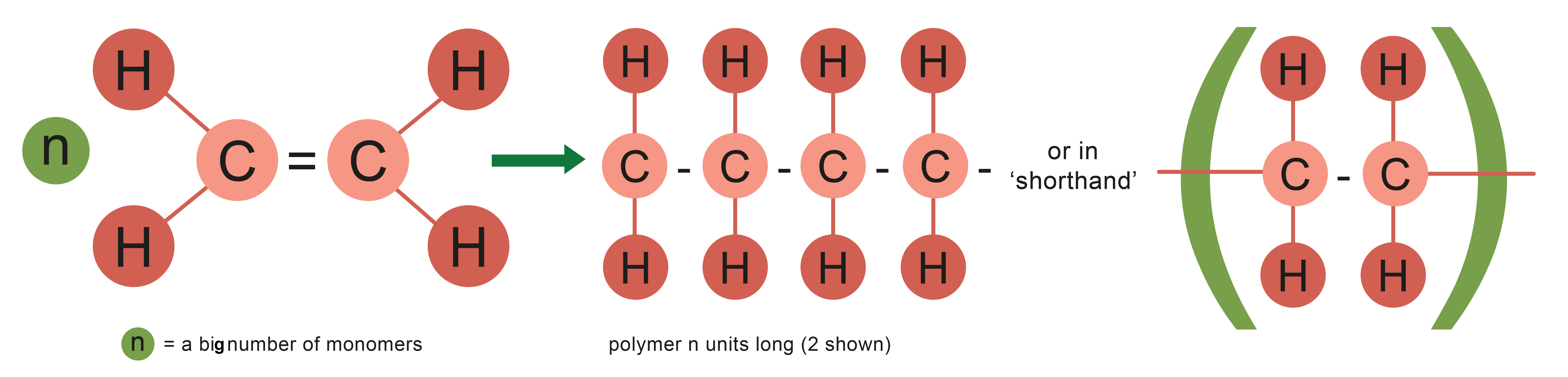
Many alkene monomer molecules react together to give a polymer which requires high pressure and a catalyst
Why does bromine water decolourise in the presence of an alkene?
An addition reaction occurs that forms a colourless dibromo compound
Why is Methane/Ethane/Propane/Butane/Pentane/Hexane an alkane?
It only contains single covalent bonds between carbon atoms
Unsaturated = a compound which contains at least one double covalent bond between carbon atoms
Saturated = a compound which contains only single covalent bonds between carbon atoms
Formation of a polymer:
Many small molecules (monomers) join together in a polymerisation reaction
Página 5
C1e - Designer Polymers
Environmental and economic issues related to the use and disposal of polymers:
Uses up valuable land in landfill
Can ham/kill wildlife
Burning release toxic gases
Burning is a waste of resources
What properties of polyethene allows it to be used for plastic bags?
Light
Flexible
Easily Moulded
Can be easily printed on
What properties of polyester allows it to be used for waterproof jackets?
Lightweight
Waterproof
Tough
Can be coloured
Blocks UV light
What properties of polystyrene allows it to be used to hold hot liquids?
Light
Poor conductor of heat
What properties of nylon allows it to be used for tents?
Lightweight
Waterproof
Tough
Blocks UV light
Plastics that have weak intermolecular forces have what properties?
Low melting points
Can be stretched easily as the polymer molecules can slide over one another
Plastics that have covalent bonds or cross-linking bridges have what properties?
High melting points
Cannot be stretched and are rigid
Main properties of nylon:
Tough
Lightweight
Keeps water and UV light out, but does not let water vapour through it which means that sweat condenses
Main properties of Gore-Tex:
Same as nylon + is breathable
Membrane = PTFE, not used on its own because its too fragile
Holes in membrane are too small for water to pass through but are big enough for water vapour to pass through
Methods of disposing polymers:
Use of land-fill sites
Burning
Recycling
Why are chemists developing...
polymers that bio-degrade? so that they can degrade faster in landfill
polymers that dissolve? so that they can increase their range of uses (e.g. dishwasher tablets)
Non-biodegradable = Will not decay or decompose by bacterial action
Página 6
C1f - Cooking and food additives
Emulsifiers = prevent oil and water from separating (e.g. In mayonnaise)
Hydrophilic head (binds to water molecules) and Hydrophobic tail (binds to oil molecules)
Food is a chemical change because:
A new substance is formed
The process cannot be reversed
An energy change takes place
Why is a potato easier to digest if cooked?
Cell walls rupture resulting in loss of rigid structure
Starch grains swell up and spread out
Why does the texture of an egg change when cooked?
Protein molecules permanently change shape and denature
Function of Antioxidants = stops food reacting with oxygen and gives it a longer life
Food colouring, Flavour enhancers, Antioxidants and Emulsifiers are all examples of food additives
Sodium Hydrogencarbonate is heated = Thermal decomposition, results in sodium carbonate, carbon dioxide and water
(Sodium Hydrogencarbonate → Sodium Carbonate + Carbon dioxide + water / 2NaHCO3 → Na2CO3 + CO2 + H2O)
How does baking soda help cakes to rise?
Sodium hydrogencarbonate thermally decomposes, which produces carbon dioxide, which helps cake to rise
Chemicals in food affected by cooking:
Proteins
Carbohydrates
Página 7
C1g - Smells
Soluble substance = Dissolves in a liquid (e.g. nail varnish is will dissolve in ethyl ethanoate)
Insoluble substance = Doesn't dissolve in a liquid (e.g. nail varnish does not dissolve in water)
Volatile = Evaporates easily
Solvent = The liquid in which a substance is dissolved (e.g. ethyl ethanoate)
Solute = The substance that gets dissolved
Solution = Result of mixing a solvent and a solute
Why does nail varnish not dissolve in water?
The attraction between water molecules and the attraction between nail varnish molecules is stronger than the attraction between water molecules and nail varnish molecules
How to make an ester:
(A family of compounds often used as perfumes and in solvents)
React an alcohol with an organic acid
Another name for manufactured perfumes = Synthetic perfumes
Main necessary properties of perfumes:
Smell Nice
Evaporate easily
Not be Toxic
Non-irritant
Insoluble
Not reactive with water
Why are perfumes volatile?
The molecules of perfume are held by weak forces of attraction, the molecules with lots of energy can easily overcome these weak forces and escape
Disadvantages of animal testing:
Cruel to animals
Different body chemistry so test results may be invalid
Advantages of animal testing:
Prevent harming humans
Test if medicines are safe
New drugs have to be tested to make sure they are safe:
The drugs are tested using computer models and human cells grown in the laboratory.
Drugs that pass the first stage are tested on animals. A typical test involves giving a known amount of the substance to the animals, then monitoring them carefully for any side-effects.
Drugs that have passed animal tests are used in clinical trials. They are tested on healthy volunteers to check they are safe. The substances are then tested on people with the illness that the drugs are designed to treat to ensure that they are safe and work properly.
Perfumes from natural sources:
Lavender
Musk
Rose
Página 8
C1h - Paints and Pigments
Paint = a colloid, the particles of pigment are mixed and dispersed with particles of a liquid but are not dissolved, they do not separate out because they are too small
Oil based paint = Pigments are dissolved in an oil, which may be dissolved in a solvents.
Oil Paints dry in 2 steps:
The solvent evaporates
The oil is oxidised by atmospheric oxygen
Emulsion Paints dry in 2 steps:
Paints are apllied as thin layer
The solvent (water) evaporates
A thermochromic paint changes colour when heated or cooled, acrylic paint can be added to thermochromic pigments to give thermochromic paints more colour changes
Uses for thermochromic pigments:
Babies bath toys
Kettle
Thermometers
A phosphorescent pigment can glow in the dark, phosphorescent pigments are used rather than radioactive alternatives because they are much safer
A phosphorescent pigment glows in the dark because they absorb and store energy and then release it as light over a period of time
3 components of paint:
Binder = Sticks pigment in paint to surface
Solvent = Thins the paint and makes it easier to spread
Pigment = Gives the substance its colour