
Notas
Introduction and Ionic Bonding
Conteúdo das notas (1)
Página 1
Introduction:
bonding = electrostatic attraction between two oppositely charged species
3 types of bonding: ionic, covalent, metallic
Difference between atoms and ions:
- atoms are uncharged
- number of protons in an atom is the same as the number of electrons
- if an atom gains or loses an electron, it will become electrically charged
Metal atoms and hydrogen atoms form positive ions
- sodium atom loses one electron to form a positively charged sodium ion
Non-metallic elements form negative ions
- do this by gaining electrons
- chlorine atom gains one electron to become a chloride ion, Cl-
Negative ions: anions
Positive ions: cations
Polyatomic ions:
- hydroxide ion OH-
- nitrate ion NO3-
- sulphate ion SO42-
Any atom becomes an ion if it loses or gains electrons
ion is a charged particle
- it is charged because it contains an unequal number of protons and electrons
Reaction between two atoms (sodium and chlorine)
sodium atom can lose one electron
chlorine atom can gain one
TO OBTAIN FULL OUTER SHELLS
when a sodium atom and a chlorine atom react together:
- the sodium atoms loses one electrons
- the chlorine atom gains one electron (the one sodium lost)
Metals (left-hand side of the periodic table) have only a few electrons in their outer shell = easier for them to form ions by losing electrons
Non-metal atoms have almost full outer shells = easiest for them to form ions by gaining electrons
Ions formed by metals will have a positive charfe because there are less electrons than protons present in the ion
Ions formed by non-metals will have a negative charge bacause there are more electrons than protons
A
According to the valencies of the different atoms, the number of ions in a reaction will change
Sodium Chloride
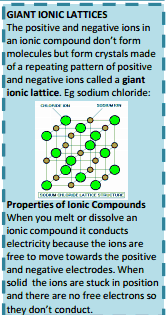
when sodium reacts with chlorine, billions of sodium and chloride ions form = attracted to each other
Ions do not stay in pairs --> cluster together
held together by strong ionic bonds
each ions forms six bonds
equal numbers of each atom
lattice structure
regular arrangement of alternating positive and negative ions
Ionic compounds are always solids at room temperatures
- high melting and boiling points
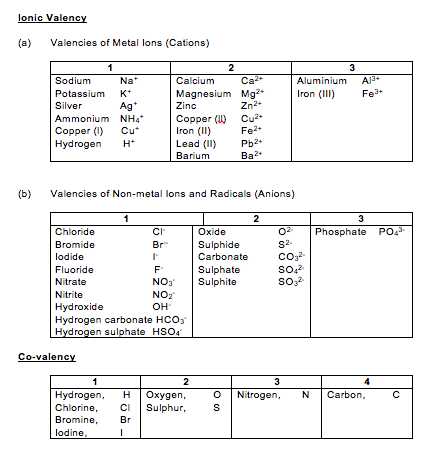
Empirical formula: ratio of number of atoms in each compound in a reaction
Introduction to Ions
Ionic Bonding
Crystals
Valencies and Formulas
Informações
- Descrição
- IGCSE Chemistry (C2 Bonding) Notas sobre Introduction and Ionic Bonding, criado por ShreyaDas em 30-03-2014.
- Criado por
- ShreyaDas
- Visualizações
- 991
- Tags
- Avaliação