
Notas
Chemistry

Conteúdo das notas (1)
Página 1
Basics
atom - basic unit of matter
element - made up of atoms of all the same type
key biologically relevant elements (more than 95% of the mass of a cell):
hydrogen
carbon
nitrogen
oxygen
phosphorous
sulfur
atoms composed of protons (+), neutrons (neutral), and electrons (-)
valence electrons - the electrons in the outermost orbit (the only ones involved in chemical bonding)
atomic mass = # protons + # neutrons (the number in the top right corner for an element on the periodic table)
molecular mass = sum of atomic mass of all atoms in a molecule
amu = atomic mass units
electronegativity - degree to which an atom will attract electrons in a chemical bond (the closer an atom is to filling up it's valence shell, the more electronegative it is)
Chemical Bonds
Chemical bonds result when atoms of the same element or different elements combine into relatively strong, commonly neutral, structures
2 major types:
ionic bond
ion - an atom with a gain or loss in valence electrons
anion - negatively charged ion (commonly form from atoms with higher electronegativities)
cation - positively charged ion (commonly form from atoms with lower electronegativities)
electrostatic attraction between an anion and a cation creates an ionic bond
covalent bond - a bond in which electrons are shared between two atoms
polar covalent - form between atoms with different electronegativies; the electrons are not shared equally (the more electronegative atom has a stronger pull on the electron). This results in part of the molecule having a slightly positive charge and part of the molecule having a slightly negative charge
nonpolar covalent - form between atoms with the same or similar electronegativities
molecule - group of at least 2 atoms in a specific arrangement held together by covalent bonds
Water & Hydrogen Bonding
hydrogen bonding - occurs between partially negatively charged atoms with high electronegativity--oxygen, nitrogen, or fluorine--and partially positively charged hydrogen atoms that are bonded to oxygen, nitrogen, or fluorine atoms;
In the case of water, the partial positive end of one water molecule will be attracted to the partial negative end of a neighboring water molecule
Water + Ions
Due to the polarity of water, many ionic compounds (like NaCl) will dissociate into ions in water. Water molecules surround the ions to form polar interactions. The ions become encapsulated by water spheres (spheres of hydration).
spheres of hydration -maintain the separation of the many ions of the cell from each other
Hydrophilic Interactions
polar molecules are hydrophilic (water-loving) because they are capable of hydrogen bonding
Hydrophobic Interactions
nonpolar molecules are hydrophobic (water-fearing) because they do not interact with water
hydrophobic molecules are driven together in water (e.g., oil and water)
amphipathic molecules - have a distinct nonpolar region and a distict polar region; nonpolar parts are forced together, leaving the polar part of the molecule to interact with water
Bond Energy
breaking a bond requires energy
in metabolism, bonds are broken to "release" energy, which the cell utilizes to drive other energy-consuming reactions
covalent bonds contain the most energy (100 kcal/mol); ionic, hydrogen, hydrophobic interactions, and van der Waals force (network of hydrogen bonds) contain less energy (5 kcal/mol)
Electrolytes & pH
electrolyte - fluid that contains free ions
pH - the hydrogen ion concentration (H+) of a solution
acid - proton donor (contains higher concentration of hydrogen ions)
base - proton acceptor (contains lower concentration of hydrogen ions)
strong acid- dissociates completely in solution and donates all of its protons
weak acid - exists in an equilibrium between starting molecule and dissociated parts (weak acid exists in equilibrium with a proton (H+) and corresponding conjugate base (A-)
Macromolecules
macromolecule - typically comprised of at least 1,000 atoms with repeated structures of smaller components
polymerization - links together the smaller components (monomers)
polymer - single molecule composed of smaller units joined by covalent bonds using a common set of chemical reactions
macromolecules are not intrinsically stable, are not created in the absence of life, and cannot persist for long outside living systems
4 major macromolecules:
nucleic acids - made of nucleotide subunits linked through phosphate backbone
proteins - made of amino acid subunits linked between carbon and nitrogen
lipids - typically large molecules comprised of nonpolar bonds, making them hydrophobic; some contain covalently attached polar groups (which serve as attachment points for multiple hydrophobic lipid molecules)
carbohydrates (saccharides) - have covalently linked sugar groups
Carbohydrates
carbohydrates are known as energy storage molecules
composed of hydrated carbon molecules: (C(H2O))n -- n = number of carbons
monosaccharides - most basic units of carbohydrates; simple sugars like glucose and fructose; contain between 3-7 carbon atoms
backbone of DNA - one monosaccharide in each nucleotide
polysaccharides - long polymers of monosaccharide sugars covalently bonded together; often used to store energy of monosaccharides
starch and cellulose (plants); humans can't digest cellulose into monosaccharides
glycogen (humans/animals)
complex carbohydrates - include polysaccharides but also saccharides conjugated with other macromolecules
glycoproteins - carbohydrates + proteins
glycolipids - carbohydrates + lipids
functions of carbohydrates:
energy source - easily broken down (digested) into usable energy by cells
structure - e.g., cellulose is a linear polymer made of glucose that interacts with other cellulose polymers to form fibers that make up the cell wall of plants
cell recognition and signaling - typically occur with glycoproteins and glycolipids; glycosylations (carbohydrate modifications) allow for a large number of different structures to be formed, which can be used for identification as a "signature" of the cell; important for immune response and cell-to-cell communication
Proteins
proteins are the most complex macromolecules; linear molecule comprised of amino acids (there are 20 different amino acids)
sequence of a protein's amino acids is determined by the sequence of bases in the DNA coding for the synthesis of that protein (a single protein molecule may be comprised of hundreds of amino acids)
size, shape, and reactive properties are determined by the number, type, and sequence of amino acids
4 structural levels:
primary structure - the linear sequence of the protein's amino acids
secondary structure - proteins often fold to form a shape as a result of localized interactions (hydrogen bonding) of amino acid side chains (alpha helix and beta sheet structures)
tertiary structure - twists and kinks in the secondary structure that form a 3D protein
quaternary structure - when several proteins combine to form a protein complex
functions:
enzymes - control the rate of chemical reactions (responsiveness of cell to external stimuli)
important in DNA replication, transcription, and repair
digestive processes are facilitated by enzymes, which break down molecules to make them more absorbable
play a role in muscle contractions
cell signaling and cell recognition
receptor proteins recognize substances as foreign and initiate immune response
through cell signaling, proteins mediate cell growth and differentiation during development
mechanical support for the cell; scaffolding that helps the cell maintain its shape
comprise much of the body's connective tissue and structures such as hair and nails
protein production requires amino acids (which we ingest, often in the form of other proteins)
body breaks down proteins into amino acids, distributes them, and then builds up new proteins
cells can synthesize some amino acids from similar ones, but essential amino acids must be obtained from the diet (cannot be synthesized)
proteins are metabolized into ammonia and urea and excreted by the kidneys
proteins are meant to be transient (produced, complete their function, and then recycled)
proteins denature easily with extremes of heat or pH (e.g., change in meat and eggs when cooked)
Amino Acids
amino acids - building blocks of proteins
physical and chemical properties of the 20 different amino acids dictate the shape of the protein and its interactions with the environment
certain sequences of amino acids also determine where the protein resides in the cell
all amino acids have the same backbone structure:
an amino group (alpha-amino group), a carboxyl group, an alpha-hydrogen, and a variety of functional groups (R) all attached to the alpha-carbon
R group (side chain) is where all the variation comes from. All amino acids have the same main-chain atoms, but differ in the side chains (R group).
R group is composed of functional groups
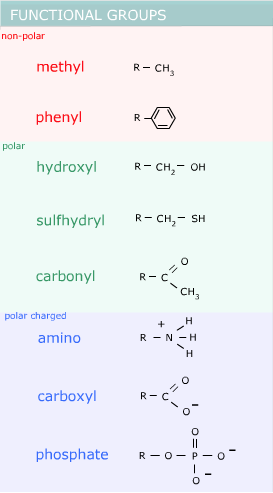
Functional groups:
methyl
phenyl
hydroxyl
sulfhydryl
carbonyl
amino
carboxyl
phosphate
amino acids are joined together by a condensation reaction which is also a dehydration reaction (attachment of the nitrogen of an amino group of one amino acid to the carbonyl carbon (C=O) of the carboxyl group of another amino acid, creating a covalent peptide bond and a molecule of water)
there will always be one free amino group on one end of the polymer (the N-terminus) and a free carboxyl group on the other end (the C-terminus); N-terminus is listed on the left and C-terminus is listed on the right
each amino acid in the polymer is referred to as a residue
primary sequence - amino acid sequence of a protein
peptides - short polymers (less than 50 residues)
polypeptides - longer polymers (more than 50 residues)
several polypeptides can form large proteins
Nucleic Acids
nucleic acids - replicating macromolecules (most importantly RNA and DNA), located primarily in the cell nucleus
code that stores the cell's instructions that govern function, processes, and structure
code is a sequence of 4 bases (adenine, cytosine, guanine, and thymine--and uracil in RNA) arranged in sets of 3 called triplets
each triplet corresponds with an amino acid, which is in turn a component of a protein macromolecule
nucleic acids instruct cells on how to differentiate into various organs
nucleic acids are organized into higher-level structures (chromosomes)
nucleotide = fundamental unit of DNA
nucleotide has 3 components:
phosphate group
furanose sugar group
nitrogenous base (adenine, cytosine, guanine, thymine, and uracil) - determines type of nucleotide formed
nucleotides linked by bridging a phosphate molecule between two hydroxyl (OH) groups, one on each furanose ring, with phosphodiester bonds
structural characteristics of DNA/RNA:
phosphate-ribose/deoxyribose-phosephate-ribose/deoxyribose sequence
linked by phosphodiester covalent bonds
3' position linked to 5' position of adjacent ribose/deoxyribose through phosphodiester bridge
chain has a 3' end and a 5' end
DNA double helix held in place with hydrogen bonding of purines (adenosine or guanosine) to pyrimidines (cytidine, thymidine, or uridine)
A binds with T and G binds with C
DNA replication - DNA is duplicated during cell division so daughter cell has same DNA as mother cell
DNA transcription - DNA is transcribed into RNA and RNA is shuttled away from the DNA to the region of protein synthesis
RNA translation - RNA is translated from nucleic acid code into the amino acid sequence of a protein
Lipids
lipids - fats and waxes
roles:
form membranes of cells and organelles, which enables isolation and control of chemical processes
energy storage - long-term energy storage in adipose (fat) cells; excess carbs converted into lipids for storage
cell signaling
lipid molecules in cell membranes have a hydrophilic "head" and hydrophobic "tail"
phospholipid bilayer- formed when two layers of phospholipid molecules organize with the hydrophobic tails meeting in the middle
proteins with hydrophobic regions float within the lipid bilayer; these molecules govern transport of charged or lipophobic molecules in and out of the cell (e.g., energy molecules and waste products)
some lipids also have attached carbohydrate molecules jutting out of the membrane for cell recognition/signaling
Informações
- Descrição
- TEAS A&P (Levels of Organization) Notas sobre Chemistry, criado por Arielle Solcher em 30-01-2019.
- Criado por
- Arielle Solcher
- Visualizações
- 0
- Avaliação