
Notas
Machine learning paper explained
Conteúdo das notas (3)
Página 1
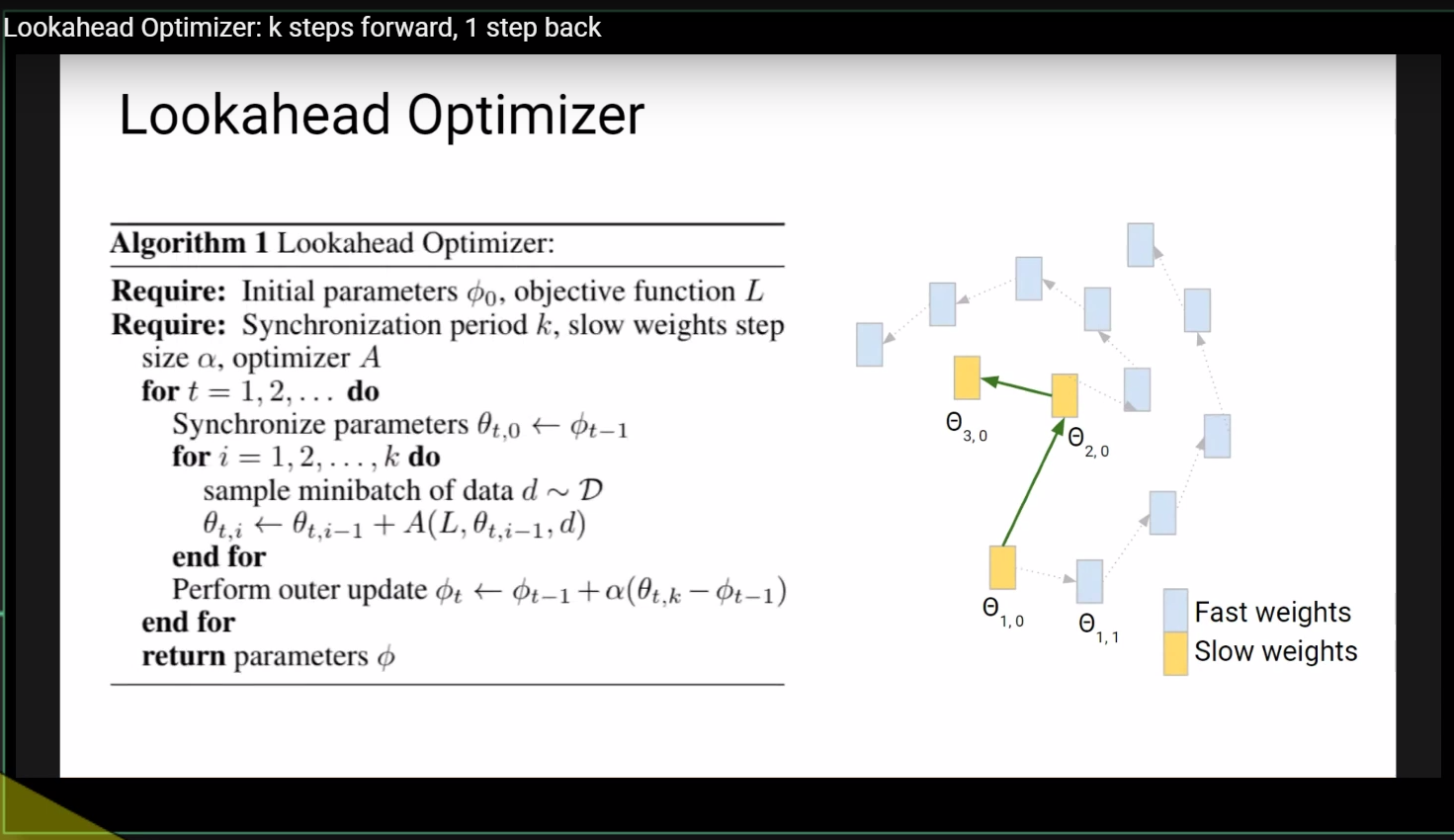
LOOK AHEAD OPTIMIZER : K STEPS FORWARD 1 STEP BACKWARD
https://www.youtube.com/watch?v=ypqf7UUird4
Stochastic weight optimizing : taking weight average when in weight space
Regularized non linear acceleration(RNA)
tries to find lace where gradient is zero
solve linear system of eqn based on last k iterates
O(K^2d+K^3) : K times more memory and compute. K no of iterate
Noisy Quadratic analysis :
loss is taken as quadratic version of the parameter.
step is then equal to actual gradient + some noise ci ~N(0,var)
variance of lookahead is lower than the stochastic gradient descent. in noisy quadratic model
They introduced two new parameter, how many steps you want to look ahead(K) and then step you want to take based on that(alpha).
Página 2
EigenDamage : Structured pruning in kronecker - factored eigenbase
(https://www.youtube.com/watch?v=OymzTQYvY_I&t=2s)
Pruning of the network
Help in generalization like dropout
biological and practical perspective
way of doing the pruning in the network
structure pruning: irregular sparsity in the network.
weight pruning: introduce sparsity of the weight matrix.
Hessian based pruning network :
It requires you to mention the pruning ratio and it automatically identify best network structure.
we do an approximation of the function around optimal theta and remove those weights which will lead to least increase in overall training error.
There are two type of hessian based approximation algorithms.
Optimal brain damage
it uses a diagonal approximation of hessian to compute the importance of each weight.
It does an inaccurate approximation of the correlation matrix.
It ignores the corrrelation between features.
Optimal brain surgeon
It uses full hessian for the calculation of the importance of weights.
But it's challenging to calculate a full hessian for any neural network.
It is guaranteed to be better than OBD, if weight is pruned one by one (i.e. Hessian is calculated in multiple iterations)
But we want to prune multiple weights at a time.
If we Prune multiple Weights at a time will OBS is better than OBD ?? -- NO
both OBS and OBD faces there own issues,
Soln :
Pruning in a new coordinate system (i.e. new basis ) in which each weights are closer to independence.
Hessian is hard to calculate.
Idea :
KFAC approximation => approximation fisher information matrix => in turn approximate Hessian
KFAC approximation:
FIM of a matrix is decomposed as Kronecker product of two smaller matrices under independence assumption.
generally it is kronecker product of gradient before and after activation
We do en decomposition of the approximated FIM and do the pruning in the new eigen space.
Taylor approximation is only valid for the optimal v*, so we have to prune it and then fine tune.
Página 3
Neural Turing Machine
(https://www.youtube.com/watch?v=XwqWTX1pW4s)
IT's a simple model of a computer
Memory tape
Read and write heads
Neural turing machine has a memory and uses a differentiable network structure as a controller
XOR and other gates based function are not differentiable . It uses some sort of approximated smooth function for such gates.
Can learn general tasks.
Copy, repeat, recognize simple formal language.
Generalize
Do well at language model
DO well at Babi
Can be used to recognize balanced paranthesis problem.
Problems :
Architecture dependent
Large number of parameters
Doesn't benefit much from GPU acceleration : harder to parallelize each input is dependent on previous generated result.
Numerically unstable : making mistake in algorithm is very risky
Using memory is hard : learn not to accidentally forget
Needs smart optimization.
Gradient clipping
limit training speed of parameter
Helpful in learning long range dependencies
Use curriculum learning
Dynamic Neural computers
o index shift based addressing
Can allocate and de-lallocate memory
Can be used in inference tasks
Informações
- Descrição
- Computer Science (Machine Learning paper explained) Notas sobre Machine learning paper explained, criado por Kumar Shubham em 26-09-2019.
- Criado por
- Kumar Shubham
- Visualizações
- 0
- Avaliação