
Notas
EEB 2244: Behavioral Ecology
Conteúdo das notas (5)
Página 1
Behavioral Ecology
Should be able to:
-Discuss the cost and benefits of a group-living
-Categorize the different types of social interactions
-Describe why eusociality and why it exists
Página 2
Benefits
Groups: purposeful joining of individuals
-increases the chances of surviving, feeding, or finding a mate
-increased rate of resource depletion
-optimal grouping behavior balances these factors
Benefit: Protection
Shared Vigilance:
- More eyes--> each individual must spend less time watching and can spend more time feeding.
Shared Defense:
-group attacks on potential predator
- coordinated distraction and evasion
Numerical dilution effect:
-reduced probability of predation for an individual during a successful attack on a group. (school of fish)
Confusion effect:
-difficult for predators to focus on one out of many moving prey. (zebras)
Benefits: Mating
- Large groups attract the attention of females
-Lek: place animals aggregate, display and attract the opposite sex. (the more males, the possible females)
Página 3
Costs
What is one potential cost to group behavior:
- Increased detectability to predators of the group
Cost: predation, disease, resource sharing--
-Large groups attract predator attention
-Alarm-calling attracts attention
-Increased spread of parasites and pathogens
-Individuals may need to share food, mates, etc
Costs: resource sharing and energy for social behavior--
Territory and Dominance Hierarchies
- organize resource access
-dominant individual get more
Interactions Require Energy:
- both aggressive and non-aggressive (friendly)
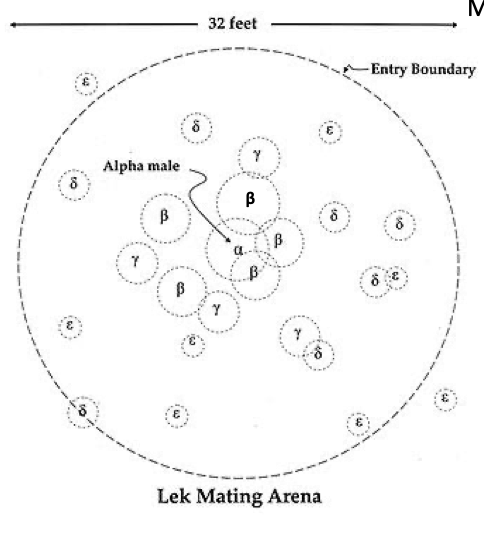
Closer to the center the more dominant (picture below)
Página 4
Types of Social Interactions
Should be able to:
-Categorize the different types of social interactions
Social Behavior:
Social behavior: within species, intra- species interaction
Genetic basis= heritable
4 main types
NOT JUST ANIMALS
Social behaviors seen in plants. (ex: bacteria)
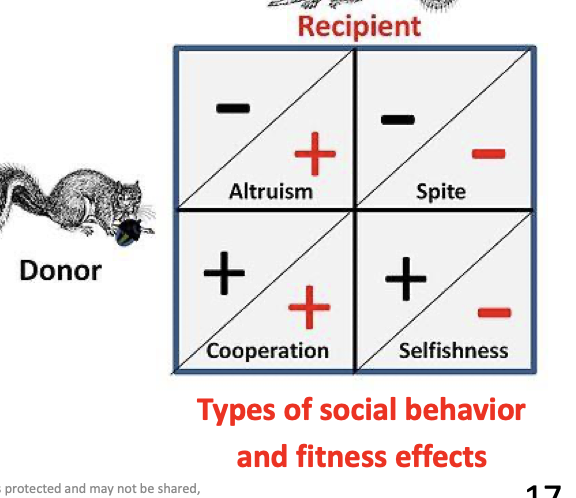
Spitefulness (-,-)
Reduces the fitness of both donor and recipient--->maladaptive
Not observed in nature populations
Selfishness (+,-)
Donor experiences increased fitness, recipient experiences decreased fitness
Most behaviors
Examples
intra-specific competition for food, space
avoidance of a predator by pushing to the center of a group
(Lions and infanticide)
Cooperation (+,+)
Donor and the recipient both experience increased fitness
Cooperation is common
- hunting, feeding by two parents, protection, heat conservation
-Cheating in a cooperative group is prevented by short and long term reduced individual fitness
Altruism (-,+)
Cost to donor, benefit to recipient ("selfless behavior")
Does not lead to direct fitness (the fitness an individual gains by passing genes to its offspring)
Altruism is really "apparent altruism"
-the idea that altruistic acts may actually be cooperative
-the donor may eventually benefit
-two main mechanisms proposed
Reciprocal "Altruism": expectation that the other organism will act in a similar manner at a later time.
Kin Selection: Altruistic behavior increases the fitness a relative and in so indirectly increases the fitness of the altruist
Family Matters
Indirect fitness: the fitness an individual gains through the reproduction of their relatives which passes on copies of their genes (can be increased by helping. behaviors)
Inclusive fitness: the mathematical sum of direct and indirect fitness
Depends on three things:
cost to donor= C
Benefit to recipient= B
Relatedness=. r
r for full siblings= 1/2= 0.5
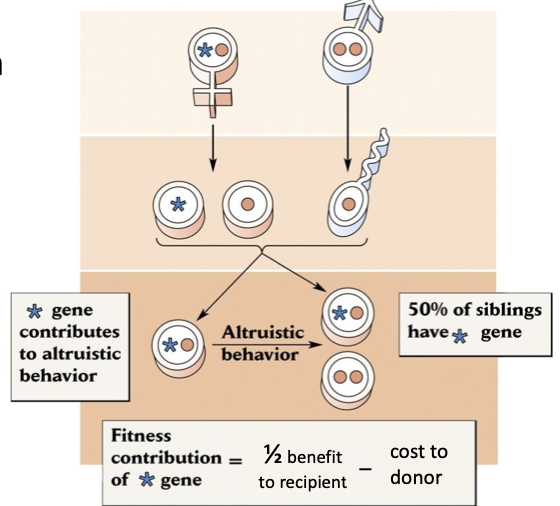
Coefficient of relatedness, r
relatives have a specific probabilities of sharing copies of the same genes (due to. recent ancestry)
When Should Altruism be Favored?
Hamilton's rule: benefit to the genes of donor must be greater than the cost
Recipient benefit x relatedness > donor cost
B x r > C or C/B< r
for altruism to evolve, the cost:benefit ration must be less than r
Altruism and Extended Families
Altruistic behavior occurs in proportion to degree of relatedness
Página 5
Eusociality
Should be able to:
Describe eusociality and why it exists
Eusociality
Highest grade of sociality
Most offspring help parents rear siblings rather than reproduce themselves
Some organisms have no direct fitness, only indirect (thus inclusive) fitness
Characterized by
Several adults living together in groups
Overlapping generations
Cooperation (not altruism)
Reproductive dominance and sterile castes
Found only in termites, bees, ants, wasps, and two species of mole rat
Eusocial Hymenopteran Societies
Many (not all) bees, wasps and ants are eusocial
One or a few egg-laying female queens
Non-reproductive female workers gather food and care for younger siblings
Male offspring (drones) and new queens sexually mature and leave the nest.
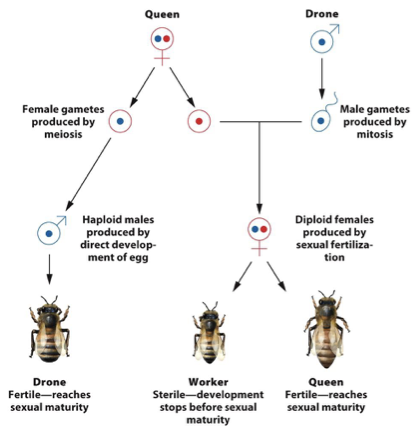
Haplodiploidy in Hymenoptera
Daughter: egg is fertilized by drone --> diploid
Drones: from unfertilized egg--> haploid -->. drones must give same DNA to all daughters
mother-daughter r=0.5
sister-sister r=0.75
MORE BENEFICIAL TO RAISE SISTERS THAN DAUGHTERS
Evolutionary origins of Eusociality
haplodiploid favors eusociality, but is NOT required
Diploid eusocial species: termites, mole rats
Eusociality also favored when cost of staying with a colony is low (high cost of leaving due to mortality)