
Notas
Notes: Atoms, Elements, Compounds and Mixtures
Conteúdo das notas (3)
Página 1
Atoms, Elements and Compounds
Every substance is composed of atoms.
The smallest part of an element that can exist is an atom.
Only one type of atom is contained in an element.
Approximately 100 different elements exist.
The periodic table displays the elements.
Each element's atoms are represented by a different chemical symbol, eg. Ne is neon, Ar is argon, C is carbon, etc.
Most substances are compounds.
Compounds contain two or more different elements which are chemically combined at fixed proportions.
A combination of numbers and symbols called a chemical formula represent compounds.
Chemical formulae are used to indicate the different elements in a compound and the number of each element that exist in one molecule of the compound.
The only ways in which compounds can be separated into their elements are through chemical reactions and electrolysis (chemical decomposition produced by causing an electric current to pass through a liquid or solution containing ions).
Equations
The events that occur in a chemical reaction can be summarised through a word equation or a balanced symbol equation.
On the left hand side of the equation are the reactants, on the right are the products.
The total mass of the products of the equation is the same as that of the reactants as no atoms can be lost or gained.
The products of a chemical reaction are always made from the exact same atoms as the reactants.
Página 2
Separating Mixtures
Mixtures are made of two more different elements or compounds which are not chemically combined.
The properties of the components of the mixture are conserved.
Physical processes can separate mixtures and because they involve no chemical reactions, no new substances are created.
Filtration can be used in order to separate insoluble solids from soluble solids.
In order to obtain a soluble solid from a solution, crystallisation can be used. An example of how this is used is to separate the salt crystals from salty water:
1- The mixture is warmed gently
2- The water evaporates leaving pure salt crystals behind.
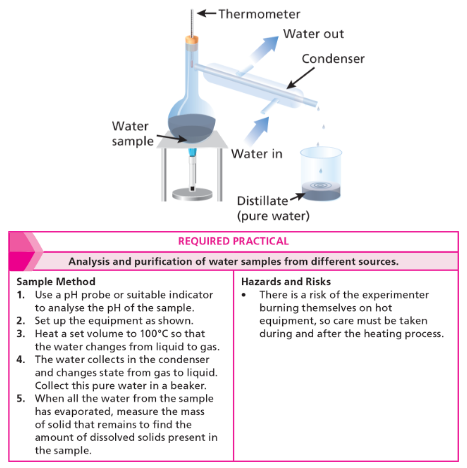
To obtain a solvent from a solution, simple distillation can be used.
In order to separate mixtures with components of different boiling points, fractional distillation can be used. This is done by carefully monitoring the temperature of the mixture until the lower boiling point of the substances has been reached. Fractional distillation can be used to separate oxygen and nitrogen from liquid air due to the different boiling points.
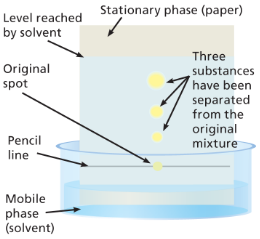
Chromatography is used to separate the differently coloured soluble components of a mixture.
Página 3
Key point
Elements are only made of one type of atom. They are displayed in the periodic table and represented by symbols consisting of one or two letters.
Key words
Atom
Element
Compound
Equation
Reactants
Products
Mixture
Filtration
Crystallisation
Simple distillation
Fractional distillation
Chromatography
Informações
- Descrição
- GCSE Chemistry (Atomic structure and the periodic table) Notas sobre Notes: Atoms, Elements, Compounds and Mixtures, criado por Hannah Berry em 04-02-2017.
- Criado por
- Hannah Berry
- Visualizações
- 47
- Avaliação